
Syllabus: GS II & V– Indian Constitution, Sixth Schedule, Tribal Administration
Why in the News?
The Constitution (125th Amendment) Bill, 2019, which seeks to strengthen governance under the Sixth Schedule of the Constitution, has regained attention amid discussions on implementing the Bodo Peace Accord (2020) and improving democratic and financial autonomy for tribal institutions in Northeast India.
Background
India’s Northeast is home to diverse tribal communities with distinct cultures, customary laws, languages and traditional institutions. Recognising these unique characteristics, the framers of the Constitution incorporated the Sixth Schedule to provide Autonomous District Councils (ADCs) with legislative, administrative and judicial powers.
However, despite constitutional protection, many councils continue to face financial constraints, weak institutional capacity and limited democratic representation. The 125th Constitutional Amendment Bill aims to address these shortcomings by making Sixth Schedule institutions more representative, accountable and financially stronger.
What is the Sixth Schedule?
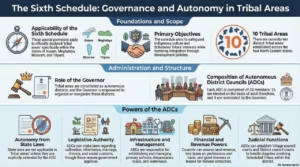
The Sixth Schedule of the Constitution provides autonomous self-governance to certain tribal areas of Assam, Meghalaya, Tripura and Mizoram.
It seeks to:
- Protect tribal identity, customs, traditions and land rights.
- Empower Autonomous District Councils to govern local affairs.
- Balance tribal autonomy with India’s federal structure.
At present, there are 10 Autonomous District Councils functioning under the Sixth Schedule.
What is the Constitution (125th Amendment) Bill, 2019?
The Bill was introduced in the Rajya Sabha on 6 February 2019 and later examined by the Department-related Parliamentary Standing Committee on Home Affairs, which submitted its report in March 2020.
Its primary objective is to modernise and strengthen local self-governance in Sixth Schedule areas by improving democratic representation, financial autonomy and institutional accountability.
Major Features of the Bill
Strengthening Autonomous District Councils
- The Bill proposes to strengthen the powers and functioning of Autonomous District and Regional Councils.
- It seeks broader representation by increasing the number of elected members wherever necessary.
Village and Municipal Councils
- It proposes the establishment of Village Councils in rural areas and Municipal Councils in urban areas within Sixth Schedule regions.
- These institutions will improve grassroots participation in governance and development planning.
Women’s Representation
- The Bill provides reservation for women in District Councils, promoting inclusive governance.
State Election Commission
- Elections to District, Regional, Village and Municipal Councils will be conducted under the supervision of the State Election Commission, ensuring free and fair elections.
Anti-Defection Provisions
- Governors will be empowered to frame rules regarding disqualification of members on grounds of defection, improving political stability.
Greater Financial Autonomy
- The Bill seeks to strengthen financial independence of Sixth Schedule institutions through constitutional mechanisms.
Important Constitutional Provisions
Article 280
- The Bill proposes amending Article 280 to empower the Finance Commission to recommend measures for augmenting the financial resources of District, Village and Municipal Councils.
- This will ensure more predictable and formula-based financial support.
Article 275(1)
- Article 275 provides grants-in-aid from the Consolidated Fund of India for the welfare of Scheduled Tribes and administration of tribal areas.
- It remains an important source of targeted developmental assistance for Sixth Schedule regions.
Together, Articles 275 and 280 can provide a stronger and more sustainable fiscal framework for tribal self-governance.
Why is the Amendment Important?
It strengthens democratic decentralisation
- Greater participation by tribal communities improves local governance.
- Village-level institutions become more responsive to people’s needs.
It promotes inclusive representation
- Women, smaller tribes and remote communities receive better political representation.
It improves financial sustainability
- Autonomous Councils receive greater financial certainty for developmental activities.
It strengthens peace-building
- Effective local governance reduces grievances and builds trust between communities and the State.
- It complements the implementation of the Bodo Peace Accord, 2020.
It supports India’s Act East Policy
- A peaceful and well-governed Northeast is essential for connectivity, trade and regional cooperation with Southeast Asia.
Challenges
- Many Autonomous District Councils continue to depend heavily on State governments for finances.
- Administrative capacity remains weak in several councils.
- Coordination between State governments and Autonomous Councils often requires improvement.
- Implementation of constitutional reforms has remained slow.
Way Forward
- The 125th Constitutional Amendment should be enacted after addressing legitimate concerns of all stakeholders.
- Financial devolution under Articles 275 and 280 should be strengthened.
- Capacity building programmes should improve administrative efficiency of Autonomous Councils.
- Women, youth and smaller tribal communities should receive meaningful representation in governance.
- Implementation of peace accords should be linked with stronger constitutional institutions to ensure lasting peace.
Important Terms Explained
Sixth Schedule
A constitutional provision providing autonomous governance to tribal areas of Assam, Meghalaya, Tripura and Mizoram.
Autonomous District Council (ADC)
A constitutionally established local governing body with legislative, executive and judicial powers over specified subjects in tribal areas.
Article 275
Provides grants-in-aid from the Consolidated Fund of India for the welfare of Scheduled Tribes and administration of tribal areas.
Article 280
Establishes the Finance Commission, which recommends the distribution of financial resources between the Union and States. The Bill proposes extending this role to Sixth Schedule local bodies.
Bodo Peace Accord (2020)
A peace agreement between the Government of India, Government of Assam and Bodo groups aimed at ensuring peace, development and greater autonomy in the Bodoland region.
Act East Policy
India’s strategic policy to strengthen economic, cultural and strategic relations with Southeast Asian countries, with Northeast India serving as the gateway.
Exam Hook – Key Takeaway
The 125th Constitutional Amendment Bill seeks to strengthen tribal self-governance by improving democratic representation, financial autonomy and institutional accountability under the Sixth Schedule.
UPSC/APSC Mains Question
“The Sixth Schedule is a unique constitutional mechanism balancing tribal autonomy with national integration. Examine how the Constitution (125th Amendment) Bill, 2019 seeks to strengthen this framework.” (250 words)
One-Line Wrap
By strengthening Sixth Schedule institutions through greater autonomy, financial empowerment and inclusive governance, the 125th Constitutional Amendment can deepen democracy, promote lasting peace and accelerate sustainable development across Northeast India.



Start Yours at Ajmal IAS – with Mentorship StrategyDisciplineClarityResults that Drives Success
Your dream deserves this moment — begin it here.