
WhatsApp Channel Join Now
Telegram Group Join Now
| Relevance: GS Paper III — Infrastructure & Internal Security · GS Paper I — Geography | Source: Current Affairs, June 2026 |
Zojila Tunnel Breakthrough: India’s All-Weather Lifeline to Ladakh
1 · What happened
| On June 9, 2026, India’s strategic Zojila Tunnel reached its final breakthrough. A “breakthrough” means the two ends of the digging finally met and the tunnel now runs through from one side to the other — so the digging (excavation) work is fully complete. This is a big achievement. The tunnel has been built in one of the world’s most difficult and dangerous places — the high Greater Himalayas — where heavy snow, landslides, falling stones, and freezing cold make construction extremely hard. |
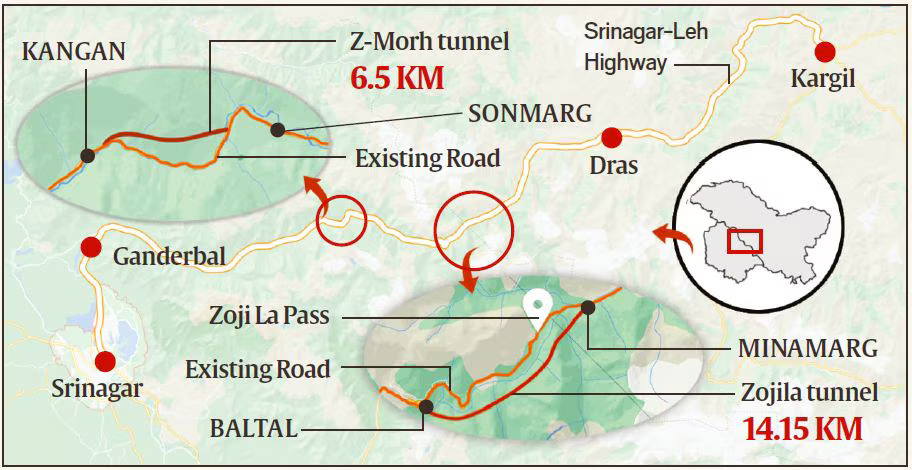
Image : The Zojila and the Z- Morh tunnel on the the Srinagar – Kargil Highway
2 · What the tunnel is and why it matters
| The Zojila Tunnel is a 13.14-km-long road tunnel built right under the dangerous Zojila Pass (the tunnel takes its name from this pass) on the National Highway -1.
It connects the Ganderbal district in the Kashmir valley with the Drass area of Ladakh’s Kargil district, and will be the world’s longest single-tube, two-way road tunnel built above 11,500 feet. |
|
The Project
A Himalayan Giant
13.14 km long, 7.57 m high, horseshoe-shaped, single-tube (one main passage), two-lane tunnel at 11,578 feet. Cost: over ₹6,800 crore. Work began in 2020.
|
The Problem
The Deadly Pass
The Zojila Pass shuts fully in winter under heavy snow, and faces landslides and falling stones. The land also lies in unstable Seismic Zone IV — a high earthquake-risk area.
|
|
The Method
NATM Technology
Engineers used the New Austrian Tunnelling Method — dig a small part, then support it at once with sprayed concrete and rock bolts, so the rock itself helps carry the weight.
|
The Gain
3 Hours to 20 Minutes
Travel between Ganderbal and Kargil drops from 3 hours to just 20 minutes — giving Ladakh safe, all-weather road access for the very first time.
|
- Strategic value for the Army: Thr armed forces can move troops, heavy machines, fuel, and supplies to high-altitude Ladakh bases even in peak winter, when roads earlier stayed shut for months. This keeps soldiers on the Line of Actual Control (LAC) — India’s border with China — fully supplied all year round.
- Breaking Ladakh’s isolation: For ordinary people, the tunnel ends Ladakh’s long winter cut-off from the rest of the country.
- Boosting tourism: It will help local trade and jobs, allow students and patients to travel safely, and bring the region into the national mainstream.
- Who built it: The work was carried out by Megha Engineering and Infrastructures Ltd. (MEIL). The nodal (lead) government agency is the NHIDCL, set up specially for border and difficult mountain projects.
- A “Smart Tunnel”: It runs on an Integrated Tunnel Control System (ITCS) — non-stop CCTV cameras, emergency lay-bys (safe stopping spaces), a ventilation system to clear vehicle smoke, and fire-fighting cabinets — so travel stays safe even in sub-zero cold.
- The twin-tunnel team: The Zojila Tunnel works hand in hand with the nearby 6.5-km Z-Morh Tunnel. Together they make the NH-1 (Srinagar–Leh Highway) avalanche-free and open in every season.
| UPSC Value Box | ||||||||||||||
|
| MCQ Practice Question |
Q. With reference to the Zojila Tunnel, consider the following statements:
Which of the statements given above is/are correct? |
Answer: (c) 1 and 3 only
|



Start Yours at Ajmal IAS – with Mentorship StrategyDisciplineClarityResults that Drives Success
Your dream deserves this moment — begin it here.