
Syllabus: GS: III & V: Agriculture & Industry
Why in the News?
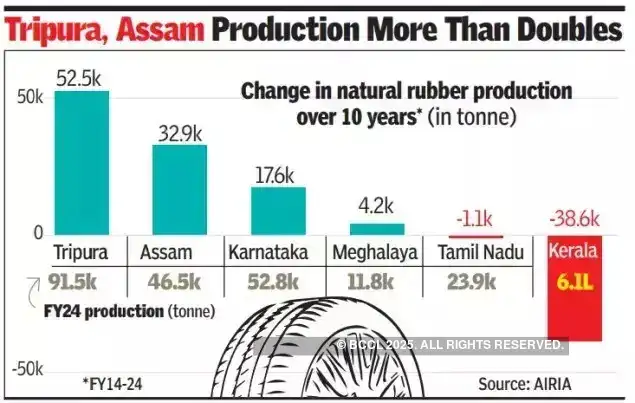
Tripura, India’s second-largest natural rubber-producing state, is facing logistic and infrastructural challenges that continue to prevent the establishment of major rubber-based industries such as tyre manufacturing units, despite large-scale rubber cultivation and government-backed expansion plans.
Tripura’s Rubber Potential
- Produces over 1.16 lakh metric tonnes of natural rubber annually.
- Over 46,000 rubber-based products exist globally, from tyres to medical equipment.
- Rubber cultivation has transformed rural livelihoods, with advance payments and assured market access for growers.
Under the Chief Minister’s Rubber Mission (2021–2026), the plantation target of 30,000 hectares, already exceeded with 47,746 hectares planted.
Key Logistic Challenges Limiting Industrial Growth
- Lack of essential non-rubber raw materials
- Tyre units require 70% non-rubber components (chemicals, steel wires, carbon black, etc.)
- These are not available locally; transporting from other states raises production cost.
- Tyre units require 70% non-rubber components (chemicals, steel wires, carbon black, etc.)
- Small production scale for large industries
- Current rubber output may be consumed in 1–2 months by a full-scale tyre factory.
- Low raw material volume discourages large investors.
- Current rubber output may be consumed in 1–2 months by a full-scale tyre factory.
- Weak industrial ecosystem
- Only one rubber-based factory (rubber thread unit at Bodhjungnagar) is currently operational.
- No value-addition clusters → most rubber sold as sheets instead of finished goods.
- Only one rubber-based factory (rubber thread unit at Bodhjungnagar) is currently operational.
- Transportation bottlenecks
- Landlocked state; dependency on long-distance road transport via Assam–Siliguri corridor raises cost.
- Rail and port connectivity (Agartala–Chittagong link) still evolving.
- Landlocked state; dependency on long-distance road transport via Assam–Siliguri corridor raises cost.
- Inadequate processing infrastructure
- Small growers lack common facilities like smoke houses and sheet rollers → affects quality.
- Private processing leads to uneven quality, harming export prospects.
- Small growers lack common facilities like smoke houses and sheet rollers → affects quality.
Government and Institutional Efforts
- Rubber Board & ATMA Initiative → new planting over 30,000 hectares (2021–26).
- State policies offer subsidies for rubber-based industries, but uptake remains low.
- Tripura Industrial Investment Promotion Policy aims at logistics support, export linkages.
- Proposal for Common Facility Centres (CFCs) for sheet processing, yet to scale up.
About Natural Rubber (Hevea brasiliensis)
Global & Indian Production Snapshot
|

Key Terms Explained
|
Term |
Meaning |
| Natural Rubber | Latex-based plant product used in tyres, footwear, medical devices, etc. |
| Rubber Producers’ Societies (RPS) | Cooperative clusters of rubber growers supported by Rubber Board. |
| Smoke House Facility | A chamber used to dry and preserve rubber sheets to improve durability and grade. |
| Value Addition | Converting raw material to processed or industrial product for higher returns. |
| Logistic Constraints | Transport, supply chain, raw material sourcing and cost-related bottlenecks. |
| Chief Minister’s Rubber Mission | Tripura’s large-scale plantation programme to boost rubber economy. |
Way Forward
- Develop cluster-based industrial parks with raw material storage, transport links, and common processing units.
- Integrate with Bangladesh’s Chittagong Port to reduce transport cost and expand export markets.
- Attract small and medium units first (e.g., chappal, gloves, rubber toys) instead of only tyre plants.
- Support growers with quality-enhancing infrastructure (smoke houses, rolling machines).
- Build supply-chain agreements between Rubber Board, MSMEs, tyre companies.
Exam Hook – UPSC/APSC Mains Question
“Despite being the second-largest natural rubber producer in India, Tripura has failed to convert its rubber economy into an industry-driven growth model. Analyse the structural and logistic constraints and suggest a viable industrial strategy.”
One-line wrap:
Tripura grows rubber in abundance—but without logistics, value addition, and industrial planning, the State continues to export raw rubber instead of exporting finished wealth.



Start Yours at Ajmal IAS – with Mentorship StrategyDisciplineClarityResults that Drives Success
Your dream deserves this moment — begin it here.