
Syllabus: GS-II & V: India and its Neighbourhood
Why in the News?
The newly elected government in West Bengal has initiated the process of handing over land to the Border Security Force for the construction of border fencing along strategic stretches of the India–Bangladesh border, particularly near the Chicken Neck Corridor (Siliguri Corridor). The move is expected to strengthen border security and enhance the protection of Northeast India.
Why is the Issue Important?
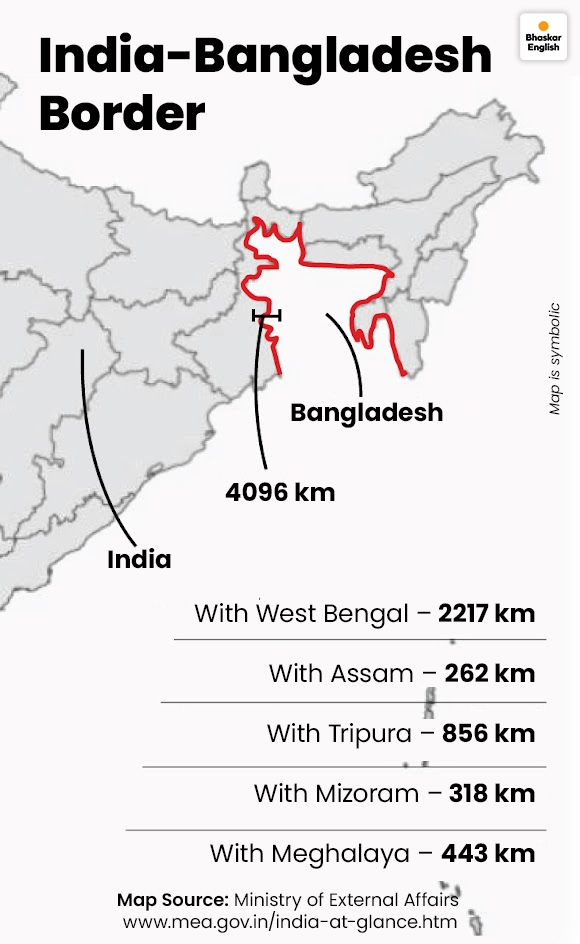
The India–Bangladesh border is one of the longest international borders in the world, extending about 4,096 kilometres across five Indian states.
Current Status of Border Fencing
- Around 3,232 kilometres of the border has already been fenced.
- Approximately 175 kilometres, mostly riverine stretches, cannot be fenced.
- Nearly 689 kilometres of feasible border remain unfenced.
What is the Chicken Neck Corridor?
The Chicken Neck Corridor, also known as the Siliguri Corridor, is a narrow strip of land in northern West Bengal.
Key Facts
- Situated near Siliguri city in northern West Bengal. It connects the Northeastern States with the rest of India.
- It is bordered by Nepal (west), Bangladesh (south), Bhutan (north), and close to the Chumbi Valley (China–Bhutan–India tri-junction).
- Narrowest width: 20–22 km, making it one of the world’s most sensitive strategic bottlenecks.
Any security challenge in this corridor can directly impact connectivity and national security in the Northeast.

Possible Threat to India Northeast India
The current crisis in Bangladesh might have the following impact on India especially the Northeast India:
- Influx of Refugees: It could lead to an influx of refugees into Northeast India as seen during the 1971 crises. This could strain local resources and disrupt social harmony in the region.
- Cross-Border Security Concerns: It might lead to increased cross-border infiltration by militants or illegal activities such as smuggling of arms, drugs, and human trafficking, posing a threat to the security and stability of Northeast India.
-
-
- ULFA and several other insurgent organizations operating in the northeast were allowed to set up bases in Bangladesh.
-
- Economic Disruption: It could disrupt cross-border trade, adversely affecting the economy of the Northeast region and impact the ongoing infrastructural project between the two countries.
-
-
- India had a $9.2 billion trade surplus with Bangladesh in FY24.
- India’s proposal to connect matarbari port to NE India will be affected .
-
- Strain on Bilateral Relations: It will strain India-Bangladesh relations, potentially impacting counterterrorism projects and security cooperation that are vital for maintaining peace and development in Northeast India.
-
- Connectivity Issues: It could restrict India’s access to northeast, which is connected to mainland India through ‘Chicken’s Neck’ and jeopardize existing bus routes and agreements for Chittagong and Mongla ports.
- Ethnic and Communal Tensions: The influx of refugees could heighten ethnic and communal tensions in NE States particularly Assam and alter their demographic patterns like in Tripura.
- Unstable Neighborhood: With Sri Lanka facing an economic crisis, Afghanistan under Taliban rule, and the Maldives growing closer to China, Bangladesh’s stability was crucial for India.
- Geopolitical Balance: With its close ties to both India and China, Bangladesh serves as a key geopolitical force in the region.
Government Measures to Strengthen Border Security
Border Security Force
- It is India’s primary border-guarding force along the India–Bangladesh border.
- It operates under the Ministry of Home Affairs.
Comprehensive Integrated Border Management System
- Uses smart fencing, sensors, surveillance cameras and command centres.
- Improves monitoring in difficult terrain.
Riverine Surveillance
- Deployment of floating Border Outposts and high-speed patrol boats.
- Increased use of drones and night-vision equipment.
Integrated Check Posts
- Facilitate legal trade and movement while strengthening security checks.
About Bangladesh
|
Way Forward
- Border fencing must be completed in all feasible areas.
- Special surveillance mechanisms are needed in riverine stretches.
- Technology-driven border management should be expanded.
- India and Bangladesh should continue cooperative border management.
- Development of border communities should accompany security measures.
A balanced approach combining security, development and diplomacy will provide long-term stability to the region.
Exam Hook: Key Takeaways
- India–Bangladesh border length: About 4,096 km.
- Border Security Force guards the India–Bangladesh border.
- Chicken Neck Corridor (Siliguri Corridor) is India’s strategic gateway to the Northeast.
- Around 689 km of feasible border fencing remains incomplete.
- Riverine stretches require technological surveillance rather than physical fencing.
Mains Question
Discuss the strategic significance of the Siliguri Corridor and evaluate the role of border management in ensuring security and stability in Northeast India.
One-Line Wrap
Securing the India–Bangladesh border, particularly around the Siliguri Corridor, is essential for strengthening national security, managing cross-border challenges and ensuring the long-term stability and development of Northeast India.



Start Yours at Ajmal IAS – with Mentorship StrategyDisciplineClarityResults that Drives Success
Your dream deserves this moment — begin it here.