
Why in the news?
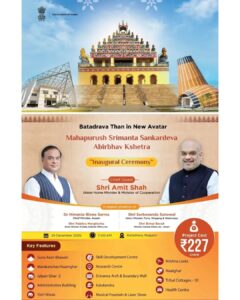
On December 29, 2025, the Union Home Minister inaugurated the Batadrava Cultural Project (also known as Srimanta Sankardeva Abirbhav Kshetra) in Nagaon, Assam. This ₹227-crore project marks the completion of a massive effort to restore the birthplace of the 15th-century saint-reformer Srimanta Sankardeva, which had faced years of neglect and encroachment.
Spiritual and Historical Anchor: Batadrava Than
- Birthplace of a Legend: Batadrava (Bordowa) is the birthplace of Mahapurush Srimanta Sankardeva, the 15th-century polymath who founded the Neo-Vaishnavite movement in Assam.
- First Satra: In 1468, Sankardeva established the first Than (later called Satra) here. It served as the laboratory where he developed Sattriya dance, Borgeets (devotional songs), and Ankia Naats (one-act plays).
- Cultural Identity: For the Assamese people, Batadrava is the “anchor of civilization.” It represents a “New Humane Social Order” that broke caste hierarchies and promoted equality through the Eka Saran Nama Dharma.
Architecture Inspired by Tradition
The redeveloped complex is a visual tribute to Assamese heritage:
- The Tree Concept: The entire complex is designed in the form of a tree. At its center is the Guru Asana (representing the roots), with all other buildings extending like branches.
- Musical Architecture: Buildings are shaped like traditional instruments like the Khol (drum) and Taal (cymbals).
- Key Features:
- Guru Asana: A 25-metre high structure inspired by the Sapta Baikuntha (Seven Heavens).
- Art & Research Centres: Dedicated spaces for documenting Sankardeva’s literature and the performing arts.
- Manikanchan Griha: A specialized gallery introduced to tourists to showcase the “Namghar culture.”
Governance and Cultural Policy: The “Assam Darshan” Scheme
The restoration is part of a broader governance philosophy aimed at protecting Jati, Mati, and Bheti (Identity, Land, and Roots).
- The Assam Darshan Scheme: A flagship initiative under which focused support is provided to over 915 religious institutions (Temples, Satras, Namghars, Mosques, and Churches) for infrastructure and connectivity.
- Protection of Land: The government has amended land laws to safeguard the sacred landscapes of Batadrava, Barpeta, and Majuli.
- Financial Empowerment: For the first time, grants totaling over ₹433.67 crore have been extended to more than 22,900 religious sites across the state to preserve their original architecture.
Impact on Social Life and Economy
- Social Reform: By restoring the Satras, the state is reviving Sankardeva’s vision of a society without rigid hierarchies.
- Cultural Tourism: The upgrade has transformed Batadrava into a world-class tourism destination, creating jobs for the local youth and boosting the regional economy.
- Peace and Continuity: The project’s completion symbolizes a “lasting atmosphere of peace” and a synergy between heritage preservation and modern development.
Years of neglect and emerging concerns
- Over time, Batadrava Than faced: Weak conservation, infrastructure decay and pressure on satra land
- Such neglect threatened not only physical structures but also cultural continuity and collective memory.
- The challenge was not renovation alone, but restoring purpose, dignity, and relevance.
Important Terms to Know
- Satra: Unique institutional centers associated with the Neo-Vaishnavite tradition of Assam that serve as centers for religious, social, and cultural activities.
- Namghar: Literally “Prayer House”; it is the central assembly hall of a village or Satra where people gather for prayers, discussions, and local justice.
- Eka Saran Nama Dharma: The religion of “shelter in one God (Vishnu/Krishna)” propagated by Sankardeva, emphasizing pure devotion over complex rituals.
- Chihna Yatra: Considered the first play in Assamese literature, staged by Sankardeva at Batadrava, laying the foundation for modern Assamese theater.
- Guru Asana: A sacred seven-tiered throne in a Namghar that holds the holy book (Bhagavat or Gunamala), representing the presence of the spiritual guide.
Exam Hook: Key Takeaways
- Prelims Fact: Srimanta Sankardeva established the first Than at Batadrava in 1468.
Mains Practice Question:
“Srimanta Sankardeva was not just a religious preacher but a social architect who shaped the moral imagination of Assam.” Discuss this statement in the light of the recent redevelopment of Batadrava Than.
One line wrap: The Batadrava Cultural Project is more than a renovation; it is a “cultural resurrection” that cements Assam’s roots in the broader civilizational landscape of India.



Start Yours at Ajmal IAS – with Mentorship StrategyDisciplineClarityResults that Drives Success
Your dream deserves this moment — begin it here.