
WhatsApp Channel Join Now
Telegram Group Join Now
| Relevance: GS-III (Economy: Infrastructure, Railways, Logistics) | Source: Economy & Infrastructure Updates, September 2026 |
1 · News and Context
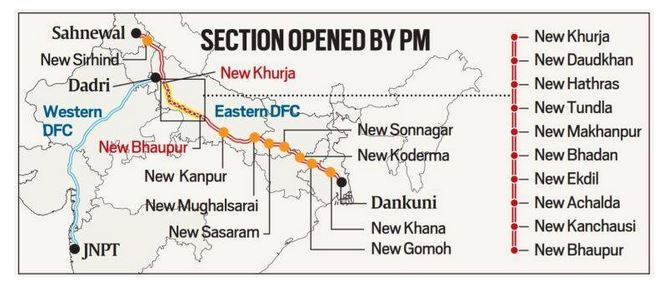
| For decades, India’s slow goods trains had to share the same railway tracks as fast passenger trains. This caused massive traffic jams, making it incredibly slow and expensive to transport factory goods across the country. To fix this, India built the Dedicated Freight Corridors (DFCs)—special railway highways strictly reserved for cargo trains. Recently, the Prime Minister inaugurated the final sections of the Western Corridor. With both the Eastern and Western corridors now fully operational, Indian freight trains can run twice as fast. This is a game-changer: it lowers the cost of goods, boosts our manufacturing sector, and makes Indian products globally competitive. |
2 · How the Freight Network Works
|
Step 1: The Track Separation
By moving cargo to these exclusive new tracks, regular passenger trains no longer get delayed by slow, heavy goods trains. |
| ▼ |
|
Step 2: Double Speed & Capacity
Without passenger traffic, these massive cargo trains can now average over 50 kmph, easily carrying double-stacked shipping containers. |
| ▼ |
|
Step 3: Rapid Transit to Ports
Factory goods from North India now reach major seaports in Gujarat and Maharashtra hours faster, saving fuel and time. |
| ▼ |
|
Step 4: Lowering Logistics Costs
This efficiency is expected to bring India’s total logistics costs down to around 7%, making everything cheaper to produce and buy. |
3 · Key Infrastructure Terms & Concepts
|
Western DFC (WDFC)
The Export Route
Connects Dadri (UP) to JNPT (Mumbai). It is specially designed to carry double-stacked containers quickly to major western seaports.
|
Eastern DFC (EDFC)
The Power Route
Connects Sahnewal in Punjab to Dankuni in West Bengal. Instead of containers, this route focuses heavily on transporting coal and minerals to keep India’s power plants running.
|
|
DFCCIL
The Builders
The Dedicated Freight Corridor Corporation of India Limited. A special government company set up in 2006 solely to build and manage these massive tracks.
|
Global Funding
International Loans
These giant projects required immense money, heavily financed by loans from the World Bank and Japan’s aid agency (JICA).
|
| Prelims Quick Facts: Economy & Railways | ||||||||
|
| MCQ Practice Question |
Q. With reference to the Dedicated Freight Corridors (DFCs) in India, consider the following statements:
Which of the statements given above is/are correct? |
Answer: (b) 2 and 3 only
|



Start Yours at Ajmal IAS – with Mentorship StrategyDisciplineClarityResults that Drives Success
Your dream deserves this moment — begin it here.