
Syllabus: G-II & V: India and its neighbor
Why in the News?
India and China are witnessing a gradual normalisation of bilateral relations through the restoration of border patrolling arrangements, high-level diplomatic engagements, easing of visa and travel restrictions, and renewed economic cooperation after the 2020 border tensions.
India and China are two of the world’s oldest civilizations and largest economies. Together, they account for over one-third of the global population and play a crucial role in shaping the economic and geopolitical future of Asia. However, the relationship has remained a mix of cooperation, competition and strategic mistrust, influenced by an unresolved boundary dispute, growing economic interdependence and changing global geopolitics.
Recent diplomatic engagement indicates a cautious attempt by both countries to stabilise relations without compromising their core national interests.
Evolution of India–China Relations
- India was among the first countries to recognise the People’s Republic of China in 1950.
- The Panchsheel Agreement (1954) introduced the Five Principles of Peaceful Coexistence, laying the foundation for bilateral cooperation.
- Relations deteriorated after the Tibetan Uprising (1959) and the India–China War of 1962.
- In recent years, tensions increased due to the Doklam Standoff (2017) and the Galwan Valley clash (2020), leading to military deployments and suspension of several bilateral engagements.
- Since 2024, both countries have resumed diplomatic dialogue through meetings on the sidelines of BRICS, the Shanghai Cooperation Organisation, and other multilateral platforms.
Recent Developments
Restoration of Border Patrolling
India and China have agreed to restore patrolling arrangements in the Depsang Plains and Demchok along the Line of Actual Control (LAC).
- The agreement seeks to restore patrolling and grazing rights that existed before May 2020.
- It is expected to facilitate disengagement, de-escalation and reduce the possibility of future military confrontations.
Resumption of Diplomatic Engagement
- High-level political meetings have resumed.
- Direct flights and visa services have gradually restarted.
- The Kailash Mansarovar Yatra has also resumed after several years.
Improved Economic Cooperation
- China has eased export restrictions on rare earth magnets, fertilisers, and tunnel-boring machines.
- India has relaxed selected investment restrictions and reopened limited engagement with certain Chinese digital platforms.
- Both countries have revived dialogue mechanisms to address bilateral issues.
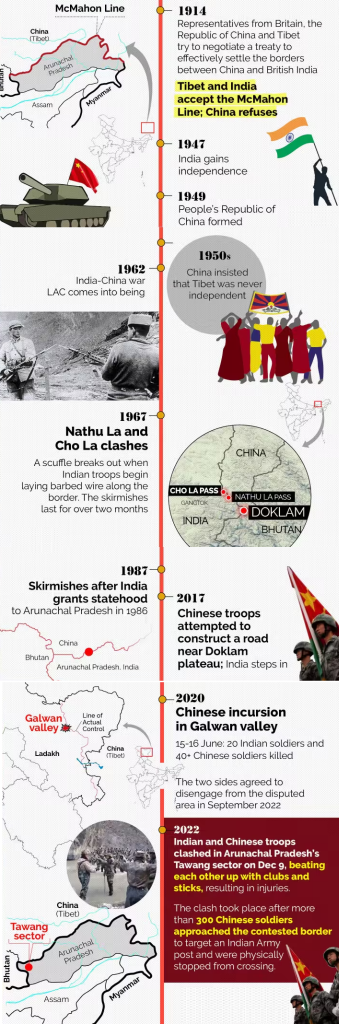
Understanding the Border Dispute
What is the Line of Actual Control (LAC)?
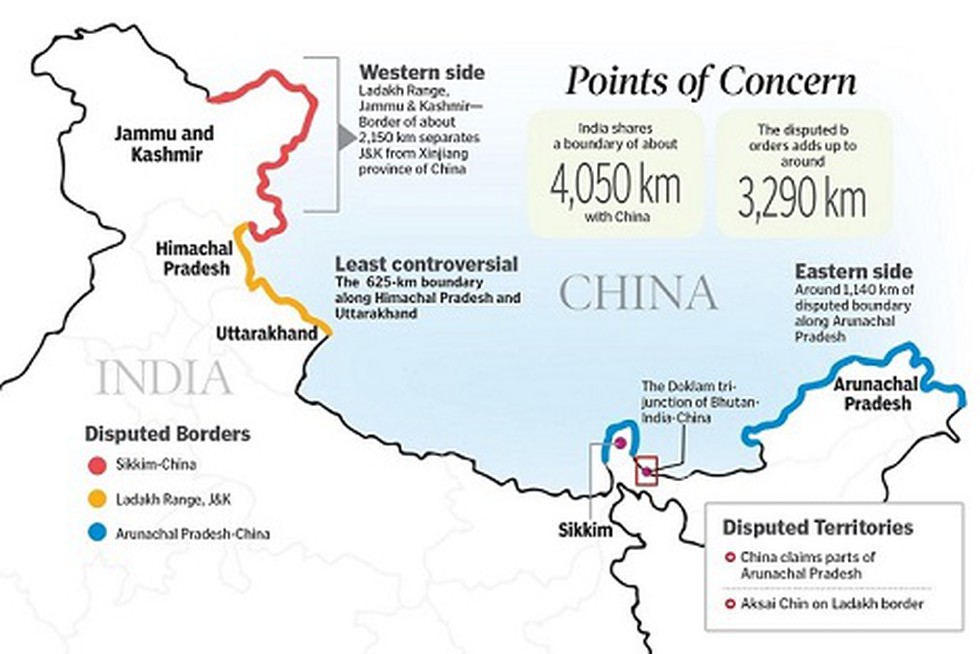
- The Line of Actual Control (LAC) is the de facto military boundary separating Indian-controlled and Chinese-controlled territories.
- India considers the LAC to be approximately 3,488 kilometres long.
- China considers it to be around 2,000 kilometres.
- The boundary is divided into three sectors:
- Western Sector – Ladakh, including Aksai Chin, Depsang, Galwan, Pangong Tso, and Demchok.
- Middle Sector – Himachal Pradesh and Uttarakhand, where disputes are relatively limited.
- Eastern Sector – Arunachal Pradesh and Sikkim, where China disputes the McMahon Line and claims Arunachal Pradesh as “South Tibet.”
Important Border Areas
Depsang Plains
- Depsang is a high-altitude plateau in eastern Ladakh, near the border with China, with the LAC passing through it.
- It is in the southeast of the strategically important Daulat Beg Oldie post near the Karakoram Pass in the north
- Its flat terrain makes it strategically important for military mobility.
Demchok
- Demchok lies in southern Ladakh, adjacent to the LAC and close to the Tibetan Plateau.
- It has traditionally been used for grazing and civilian movement and remains a sensitive border point.
- It is home to a predominantly Buddhist population and is known for its scenic beauty and rich cultural heritage.
Economic Dimension of India–China Relations
Despite strategic tensions, economic ties remain strong.
- China is one of India’s largest trading partners.
- India’s imports from China have continued to rise, particularly in electrical machinery, electronic components, industrial machinery, chemicals & pharmaceutical ingredients.
- India’s exports largely consist of: mineral fuels, ores, organic chemicals, marine products.
This has resulted in a large bilateral trade deficit in favour of China.
Why Does China Matter for India’s Economy?
India depends on China for several critical sectors.
- More than 60% of Active Pharmaceutical Ingredients (APIs) used in India’s pharmaceutical industry are imported from China.
- China supplies a significant share of India’s electronic components and semiconductor-related inputs.
- It is also a major supplier of rare earth magnets, which are essential for: Electric vehicles, wind turbines, defence equipment & consumer electronics
This dependence makes supply chain diversification a strategic priority.
Government Initiatives to Reduce DependenceIndia is simultaneously strengthening domestic manufacturing through:
These initiatives seek to reduce import dependence while maintaining stable international supply chains. |
Challenges in India–China Relations
- The boundary dispute remains unresolved.
- China continues to claim Arunachal Pradesh.
- India faces a large trade deficit with China.
- Strategic competition continues in the Indian Ocean Region and the Indo-Pacific.
- Concerns remain regarding cybersecurity, critical technologies and supply chain dependence.
Way Forward
- Both countries should continue dialogue through diplomatic and military mechanisms to maintain peace along the Line of Actual Control.
- Economic engagement should continue while reducing dependence in critical sectors through domestic manufacturing.
- Confidence-building measures should be strengthened to prevent border incidents.
- Cooperation in areas such as climate change, green technology, public health, tourism, and multilateral forums can create greater trust.
- India should continue diversifying supply chains while pursuing strategic autonomy in foreign policy.
Exam Hook
Key Takeaways
- India and China are strategic competitors as well as major economic partners.
- The recent thaw in relations aims to restore stability without resolving all boundary disputes.
- Border peace remains essential for expanding bilateral trade and economic cooperation.
- India’s long-term strategy combines engagement with China and self-reliance through domestic manufacturing.
Mains Practice Question
“India–China relations are characterised by strategic competition and economic interdependence. Examine the recent efforts to normalise bilateral ties and discuss the challenges that continue to shape the relationship.” (250 words)
One-line Wrap
The future of India–China relations will depend on maintaining peace along the border while balancing economic cooperation with strategic security and long-term national interests.



Start Yours at Ajmal IAS – with Mentorship StrategyDisciplineClarityResults that Drives Success
Your dream deserves this moment — begin it here.