
WhatsApp Channel Join Now
Telegram Group Join Now
Researchers from Gauhati University have developed a fungus-based biological technique that significantly accelerates the formation of high-quality agarwood in Aquilaria malaccensis, offering a sustainable solution for the agarwood industry.
Key Findings of the Study
- The study was conducted by researchers from the Department of Bioengineering and Technology, Gauhati University and published in the journal Microbiological Research.
- Functionally screened fungal isolates obtained from wild agarwood were inoculated into mature Aquilaria malaccensis trees.
- Within 21 days, the trees showed dark resin deposition and activation of genes responsible for agarwood formation.
- Within 90 days, the induced agarwood contained higher levels of sesquiterpenoids (aromatic compounds) than naturally formed agarwood.
- The method provides a bio-based, eco-friendly and faster alternative to conventional techniques.
Why is this Important?
- Agarwood is a rare, fragrant resinous wood used in perfumes, incense, cosmetics and traditional medicine.
- Natural agarwood formation is slow, unpredictable and occurs only when trees are infected or injured.
- Existing artificial methods such as trunk wounding, burning and chemical induction are costly, time-consuming and may affect tree health.
About Agarwood
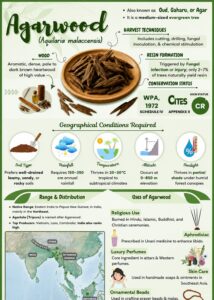
- Agarwood or Sanchi (Aquilaria malaccensis) is a highly valuable and aromatic resinous wood, native to Assam and South East Asia.
- It has a mythic reputation with a revered mention in Mahabharat, Buddhist birth stories and Hadiths in Islam.
- It requires warm humid and sub-tropical climate as well as soft and sandy soil.
- It is suitable and preferable for plantation at a temperature between 22 C to 43C with 70% sunlight and 1800-3500 mm rainfall per annum.
- Agar is classified as critically endangered on the IUCN Red List and is listed under Appendix II of the CITES.
- This listing ensures that the trade of agarwood adheres to sustainable limits, allowing export only if it does not harm the species’ survival.
- Assam is home to over 82% of India’s agarwood trees, amounting to 11.437 crore trees outside forest areas, showcasing Assam’s dominance in this sector.
- Assam’s Golaghat district holds the highest concentration of Agarwood Trees (4.5 crore trees).
- Other key districts include Jorhat, Sivasagar, Karimganj and Cachar.
- In contrast, Tripura holds the second-largest agarwood population in India with just 1.515 crore trees.
Significance for Assam
- The technology can increase plantation productivity and farmer income.
- It supports sustainable utilization of a high-value forest resource.
- It can strengthen Assam’s position in the global agarwood and essential oils market.
Exam Hook – Prelims Question
Q. Agarwood, recently seen in the news, is obtained from:
(a) Bamboo species infected by fungi
(b) Resin-infused wood of Aquilaria trees
(c) Sandalwood trees grown in dry regions
(d) Medicinal shrubs found in the Himalayas
Answer: (b)
One-Line Wrap
A Gauhati University study has developed a fungus-based eco-friendly technique that can produce premium-quality agarwood within 90 days, offering a major boost to Assam’s agarwood industry.



Start Yours at Ajmal IAS – with Mentorship StrategyDisciplineClarityResults that Drives Success
Your dream deserves this moment — begin it here.