
Syllabus: GS-V: Environment
Why in the News?
Assam’s flood situation has turned critical as the Brahmaputra and all its tributaries are flowing above the danger level.
What is Flood?
- Flood, high-water stage in which water overflows its natural or artificial banks onto normally dry land, such as a river inundating its floodplain.
- Flooding may result from the volume of water within a body of water, such as a river or lake, which overflows or breaks levees, with the result that some of the water escapes its usual boundaries.
Flood in Assam
- Assam is prone to flood and erosion which has a negative impact on overall development of the state.
- As per Rashtriya Barh Ayog (RBA) about. 39.58 % of the total land area of Assam (31.05 Lakh Hectares) is prone to flood hazard.
- The flood prone area of Assam is four times the national mark of the flood prone area of the country.
- Assam faced major floods in 1954, 1962, 1972, 1977, 1984, 1988, 1998, 2002, 2004 and 2012.
- Almost every year three to four waves of flood ravage the flood prone areas of Assam.
- As per the Assam Disaster Management Authority (ADMA) the recent flood situation in Assam has claimed 26 lives so far, affecting 161K people in 15 districts.
Reasons for floods in Assam:
Natural Factors:
- Assam’s unique topography: Assam is surrounded on 3 sides by hills, resulting in water from the hills and mountains to flow down rapidly causing rivers to overflow and flood the plains .
- Heavy Rainfall: Assam receives a high amount of rainfall especially during the monsoon season due to its location in the Himalayan foothills.
- Also, the southwest monsoon winds bring abundant moisture resulting in intense rainfall.
- For instance – Assam receives nearly 2,800–3,000 mm of annual rainfall, with almost 70% occurring during the Southwest Monsoon.
- Sedimentation and Siltation: The Brahmaputra, Barak and its tributaries carry large amounts of silt and sediment from the Himalayas.
- This sedimentation raises the riverbeds reducing their water-carrying capacity and increasing the risk of floods.
- Tectonic Activity: The region is tectonically active and earthquakes and triggering of landslides further contribute to flooding.
Anthropogenic Factors:
- Deforestation: Large-scale deforestation in the catchment areas of rivers has reduced the water-holding capacity of the soil, leading to increased runoff and flooding.
- For instance – Assam lost 17,100 hectares (171 sq km) of natural forest in 2023.
- Encroachment and unplanned settlements: This leads to wetland destruction and settlement in flood plains, reducing the natural drainage channels making the areas more susceptible to flooding.
- Embankments: While embankments are built to protect areas from floods, its failure results in worsening the situation.
- Climate Change: Climate change is expected to increase the intensity and frequency of extreme rainfall events, further exacerbating the flood problem in Assam.
Why perennial problems of flooding?
- According to reports, since the 1950s, Assam has built 423 embankments along the Brahmaputra River and its tributaries.
- Of these, 295 are believed to have outlived their intended lifespan.
- It is therefore not surprising that they are being breached regularly and are even damaged and destroyed.
- During the post-flood reconstruction phase, government agencies often resort to simply fixing damaged or destroyed embankments and do not build them back properly.
- Perennial flooding in Assam is exacerbated by the reliance on and misuse of grey infrastructure like embankments.
- These concrete structures, while intended to prevent flooding, often create more problems than they solve.
- Assam continues to remain fixated on embankments. One major reason for this is the vested interests of engineers, contractors and politicians for whom embankments are “big business.”
- Alluding to this, one expert opined that “Assam has increasingly moved towards becoming an ‘embankment economy’ – the construction of embankments along the Brahmaputra has become a business involving contractors for construction, maintenance and repair.
- He further lamented that “Floods actually mean a lot of money to a lot of people and many feed off the contractor lobby.”
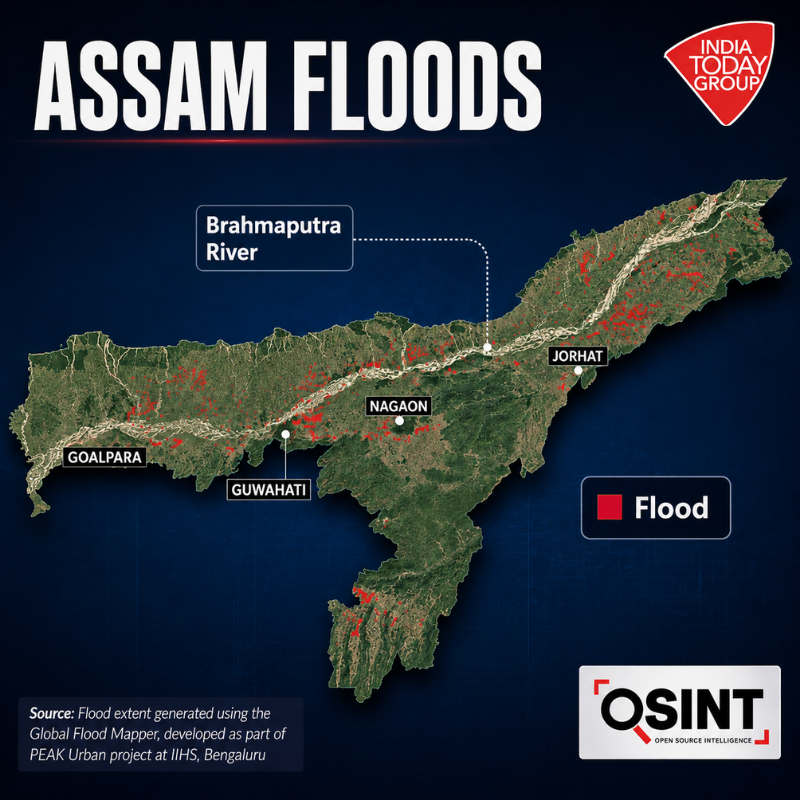
Reasons for the Recent Floods in Upper AssamThe recent floods in Upper Assam are unusual because districts such as Sivasagar, Jorhat and neighbouring areas are located away from the main channel of the Brahmaputra and normally do not experience floods of this magnitude. The major reasons are:
|
Impact of floods
- Impact on humans Health risks: Loss of lives, Displacement of people, increasing health risk like risk of waterborne borne diseases are some of the impacts of flood.
- For instance- In 2022 about 9.3 million people were impacted due to flood.
- Economic Impact: Flood causes agricultural losses due to crop damage, loss of livestock, and infrastructure damage.
- As per Assam Government the average annual loss due to flood in Assam is to the tune of Rs. 200 Crores.
- According to ASAMA, the economic loss due to 2022 floods was estimated at around Rs 10,000 crore.
- Environmental Impact: Soil erosion, habitat loss, water pollution are some of the major impacts of flood.
- For instance- Since 1950, about 4.27 lakh hectares area i.e. 7.40% of Assam has been eroded.
- Average Annual Erosion Rate of Assam is 8000 hectares.
- Long term consequence:
- Poverty and Food Insecurity: Repeated floods can push people into poverty and food insecurity due to loss of livelihoods and assets.
- Psychological Trauma: Floods can cause psychological trauma and distress, especially among children and vulnerable populations.
- Increased Vulnerability: The cumulative effects of floods make communities more vulnerable to future disasters and hinder their ability to recover.
Recent Initiatives for flood management
-
- Scheme under Flood Management and Border Areas Programme (FMBAP)
- Launched by the Ministry of Jal Shakti scheme for erosion protection of the river Aie in Chirang District.
- Assam Integrated River Basin Management Programme (AIRBMP):
- It is a World Bank and Govt of Assam collaboration.
- Under this programme, two comprehensive flood management programmes (Buridehing river and Manas-Beki river) have been started.
- Subsequently funding will be considered for other critical rivers like Jiabharali, Gainadi- Jiadhal, Bhogdoi, Singhla and Jatinga.
- Brahmaputra Flood and Erosion Risk Management Project (BFERMP):
- It is an Asian Development Bank and Govt of Assam collaboration.
- It is for flood and erosion management in 4 zones of the Brahmaputra-Dibrugarh, Morigaon, Kamrup and Goalpara.
- It will include bio engineering activities using nature based solutions for embankment slope stabilization and bank protection work.
- Scheme under Flood Management and Border Areas Programme (FMBAP)
- Wetland Integration Initiative (Budget 2024–25, ₹200 Crore)
-
-
- Its objective is to divert excess floodwaters from the Brahmaputra and its tributaries into designated wetlands serving as temporary flood reservoirs.
- The Centre also approved Urban Flood Risk Management Programme (UFRMP) – Phase II for 11 Indian cities, including Guwahati.
-
- Assam’s Wetland Initiative:
-
- Assam Water Resources Department has identified nine wetlands spread across Jorhat, Dibrugarh, Lakhimpur, Morigaon, Tezpur, and Majuli divisions.
- These wetlands will serve as natural storage spaces for floodwaters, helping to divert and store excess water during the rainy season.
Way Forward
- Strengthen embankments and floodwalls: As most flood protection structures in Assam are over 50-60 years old. So focus should be on strengthening those structures.
- Dredging and Channel improvement: It should be done regularly in waterways as sedimentation gradually fills channels and harbors.
- Enact Floodplain Zoning Bill: The Law must be enacted to regulate activities in the floodplains. So that flood damage can be minimized.
- Flood plain zoning measures aim at demarcating zones or areas likely to be affected by floods of different magnitude or frequencies, probability levels and specify the types of permissible development in these zones.
- Diversion of River Channels: Interlinking rivers will transfer excess water from the regions receiving a lot of rainfall to drought-prone areas This way, it can mitigate both floods and droughts.
- Restoration and rejuvenation of wetlands of Assam: According to the North-East Space Application Centre (NESAC), 271 wetlands in Assam are suitable for floodwater diversion, capable of storing over 220 lakh cubic metres of excess water and potentially reducing flood peaks by 20–80%.
- Other measures: Measures like Afforestation, watershed management, afforestation & rejuvenation of wetlands, crop diversification and flood tolerant infrastructure can go a long way in mitigating the impact of floods.
Q. Every year, Assam experiences devastating floods that result in significant economic loss. In this context, analyze the main reasons behind the frequent floods in Assam and suggest some steps that are needed to take for effective floods management. (250 words/15 marks)



Start Yours at Ajmal IAS – with Mentorship StrategyDisciplineClarityResults that Drives Success
Your dream deserves this moment — begin it here.