
Syllabus: GS-III & V: Infrastructure, Transport, Urban Development, Inland Waterways
Why in the News?
The Union Government has proposed the introduction of Water Metro services in Assam under the Draft National Water Metro Policy, 2026. Guwahati has been included in Phase I, while Dibrugarh and Tezpur have been proposed under Phase II of the national rollout.
This initiative aims to transform India’s waterways into modern, eco-friendly urban transport corridors and strengthen connectivity in river-based cities.
What is a Water Metro?
- A Water Metro is a modern, scheduled public transport system operating on rivers, lakes, canals, backwaters, and coastal waters using specially designed passenger vessels.
- Unlike traditional ferry services, Water Metro functions as a high-frequency urban mobility network integrated with other transport systems such as buses, metro rail, and road transport.
- The model is inspired by the successful implementation of the Kochi Water Metro, India’s first integrated water-based urban transport system.
Key Highlights of the Assam Water Metro Project
- Phase-wise Rollout:
-
-
- Phase I: Guwahati
- Phase II: Dibrugarh and Tezpur
-
- Implementing Agencies:
- Ministry of Ports, Shipping and Waterways
- Inland Waterways Authority of India (IWAI)
-
- Kochi Metro Rail Limited (Feasibility Studies)
- Primary Objectives
- To reduce urban traffic congestion.
- To promote sustainable and low-emission transport.
- To improve connectivity across riverine regions.
- To support tourism and local economic development.
- To provide affordable and comfortable public transport.
About the Draft National Water Metro Policy, 2026
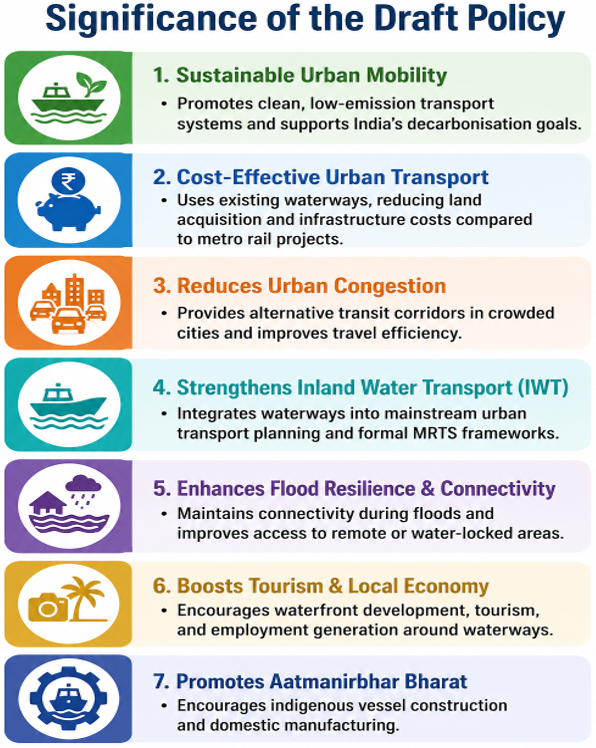
The policy seeks to establish a national framework for integrating waterways into India’s urban transportation network.
Major Features
- Promotion of electric, battery-operated and hybrid ferries.
- Development of floating jetties and modern terminals.
- Introduction of automated ticketing and passenger information systems.
- Integration with buses, metro rail, pedestrian pathways, and last-mile connectivity.
- Support for Atmanirbhar Bharat through indigenous vessel manufacturing.
- Encouragement of Public-Private Partnerships and Centre-State collaboration.
Why Assam is Ideal for Water Metro
Assam is traversed by the Brahmaputra River, one of India’s most important inland waterways.
Advantages
- Presence of National Waterway-2 (Brahmaputra River).
- Large river-based urban settlements.
- Growing traffic congestion in cities like Guwahati.
- Significant tourism potential.
- Better transport resilience during floods and natural disasters.
The project can significantly improve connectivity between riverbanks and reduce pressure on road infrastructure.
Legal and Institutional Framework
- Inland Waterways Authority of India Act, 1985: Established the Inland Waterways Authority of India for development and regulation of national waterways.
- Inland Vessels Act, 2021: Regulates vessel construction, operation, passenger safety, and pollution control.
- Constitutional Position: Shipping and navigation on National Waterways fall under the Union List.
- Other inland waterways fall under the Concurrent List.
Significance for Northeast India
- It will strengthen the Act East Policy by improving regional connectivity.
- It will support sustainable urbanisation and climate-resilient infrastructure.
- It will generate employment in transport, tourism, and shipbuilding sectors.
- It will position Assam as a leader in inland water transport in India.
Exam Hook: Key Takeaways
- Guwahati is included in Phase I of the Water Metro rollout.
- Dibrugarh and Tezpur are proposed under Phase II.
- The initiative is based on the success of the Kochi Water Metro.
- National Waterway-2 runs along the Brahmaputra River.
- The policy promotes electric and hybrid ferries for green mobility.
Mains Question
Discuss the role of inland waterways and Water Metro systems in promoting sustainable urban transport and regional connectivity in Northeast India.
One-Line Wrap
The proposed Water Metro in Assam represents a transformative step towards sustainable, affordable, and climate-resilient river-based urban transportation, leveraging the immense potential of the Brahmaputra and other navigable waterways.



Start Yours at Ajmal IAS – with Mentorship StrategyDisciplineClarityResults that Drives Success
Your dream deserves this moment — begin it here.