
WhatsApp Channel Join Now
Telegram Group Join Now
The Rubber Board of India has stated that Assam has emerged as a major player in India’s natural rubber sector, with nearly 50,000 hectares under cultivation, making it the third-largest natural rubber producing state after Kerala and Tripura.
Key Highlights
- Assam currently ranks third in natural rubber production in India.
- The Northeast region has around 1.8 lakh hectares under rubber plantations.
- Rubber cultivation is expanding rapidly due to favourable climatic conditions and growing domestic demand.
- The sector is increasingly being recognised alongside tea as an important plantation industry in Assam.
INROAD Project
What is it?
- INROAD (Indian Natural Rubber Operations for Assisted Development) is an initiative of the Rubber Board.
- It is funded by the Automotive Tyre Manufacturers Association (ATMA).
- Project INROAD is the first-of-its-kind initiative globally where the tyre industry is directly contributing to the development of rubber plantations.
- INROAD is implemented by the Rubber Board of India.
Objective
- To expand natural rubber cultivation in Northeast India and West Bengal.
- To increase domestic rubber production and reduce import dependence.
- To address critical gaps in infrastructure and training that have hampered productivity in the region.
Achievements
- Target: 2 lakh hectares of new plantations between 2021 and 2026.
- Achieved: 1.79 lakh hectares already planted.
- Beneficiaries: More than 2.07 lakh growers.
- Facilitated the planting of rubber across 1,25,272 hectares in 94 districts of the Northeast and West Bengal.
- Over 5.3 crore rubber planting materials distributed among resource-deprived populations
Recent Development
- The world’s first genetically modified rubber plant, developed by the Rubber Research Institute of India for Northeast climatic conditions, has been planted in Assam.
- The innovation aims to improve productivity and adaptability in the region.
Economic Significance
- Natural rubber is a strategic raw material for the tyre, automobile, healthcare and manufacturing sectors.
- Expansion of rubber cultivation provides additional income opportunities for farmers.
- India’s Free Trade Agreements and export promotion initiatives are expected to create new market opportunities for plantation products.
About Natural Rubber
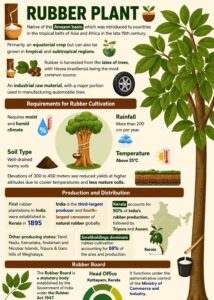
- Natural rubber is native to the Amazon basin, and is obtained from the latex of the tree Hevea brasiliensis.
- It was introduced to countries in the tropical belts of Asia and Africa in the late 19th century.
- It is mainly an equatorial crop but can also be grown in tropical and subtropical regions and thrives in regions with high rainfall, humid climate and well-drained soil.
- India is among the world’s leading producers and consumers of natural rubber.
Exam Hook – Prelims Question
Q. Consider the following statements regarding natural rubber in India:
- Natural rubber is obtained from Hevea brasiliensis.
- Kerala is the largest producer of natural rubber in India.
- The INROAD Project is funded by the Automotive Tyre Manufacturers Association.
Which of the statements given above are correct?
(a) 1 and 2 only
(b) 2 and 3 only
(c) 1, 2 and 3
(d) 1 and 3 only
Answer: (c)
One-Line Wrap
With nearly 50,000 hectares under cultivation and rapid expansion under the INROAD Project, Assam is emerging as a key centre of India’s natural rubber economy.



Start Yours at Ajmal IAS – with Mentorship StrategyDisciplineClarityResults that Drives Success
Your dream deserves this moment — begin it here.