
Syllabus: GS-II (Governance, Government Policies, Regional Development), GS-III (Infrastructure, Economy, Connectivity, Internal Security), APSC GS Paper V (North-East India)
Why in the News?
The North-East Region is increasingly emerging as a strategic growth engine of India through massive investments in connectivity, infrastructure, trade, digital inclusion, tourism, renewable energy, and industrial development. The concept of Ashtalakshmi reflects the government’s vision of placing the eight North-Eastern states at the centre of India’s journey towards Viksit Bharat.
About the Ashtalakshmi Growth Model
The term Ashtalakshmi refers to the eight North-Eastern states — Assam, Arunachal Pradesh, Manipur, Meghalaya, Mizoram, Nagaland, Tripura, and Sikkim.
Inspired by the eight manifestations of Goddess Lakshmi, the concept views the North-East as a source of prosperity, cultural richness, biodiversity, strategic strength, and economic opportunity.
The model focuses on connectivity, industrialisation, human capital development, tourism, agriculture, cross-border trade, digital transformation, and sustainable development.
The vision aligns with India’s Act East Policy, Viksit Bharat 2047, PM-DevINE, and the broader objective of integrating the North-East with national and global value chains.
Why does the North-East matter to India?
- The region shares international boundaries with Bangladesh, Bhutan, China, Myanmar, and Nepal, making it one of India’s most strategically important regions.
- The North-East acts as India’s natural gateway to Southeast Asia and the wider Indo-Pacific region.
- It is home to globally significant biodiversity hotspots such as the Eastern Himalayas and Indo-Burma Biodiversity Hotspot.
- The region possesses enormous potential in hydropower, organic agriculture, tourism, bamboo, agarwood, horticulture, oil and natural gas, and critical minerals.
Key Data and Statistics on North-East Development
Infrastructure and Connectivity
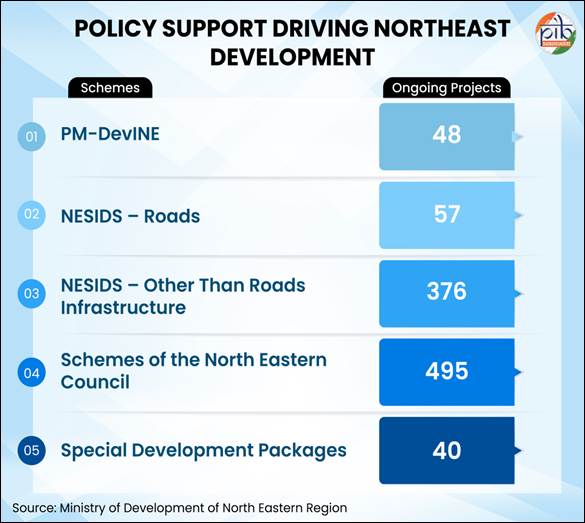
- More than 3,700 development projects have been sanctioned through the Ministry of Development of North Eastern Region, strengthening infrastructure, social services, and regional development.
- The Prime Minister’s Development Initiative for North East Region (PM-DevINE) funds high-impact projects in connectivity, healthcare, livelihoods, agriculture, and social infrastructure.
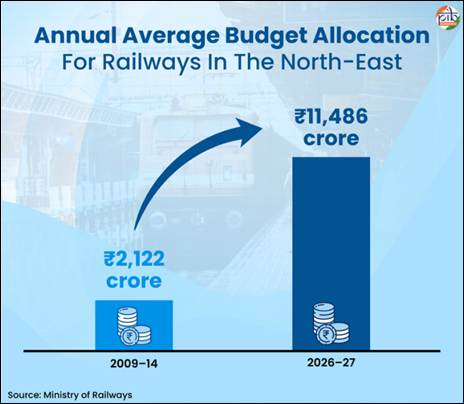
- Railway allocations have increased significantly, accelerating expansion into previously unconnected regions.
- Broad-gauge railway connectivity has now reached most North-Eastern states, integrating them with the national rail network.
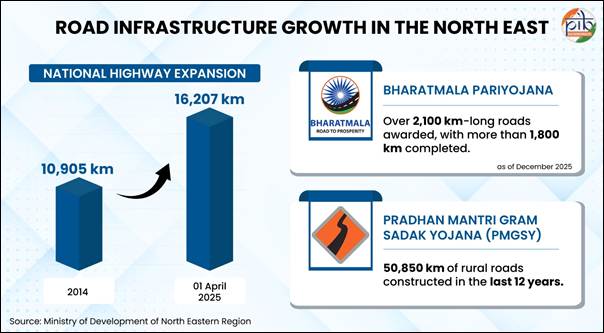
- Major projects such as Bogibeel Bridge, Bhupen Hazarika Setu, Sela Tunnel, Jiribam–Imphal Railway Project, and the North East Gas Grid are transforming regional connectivity.
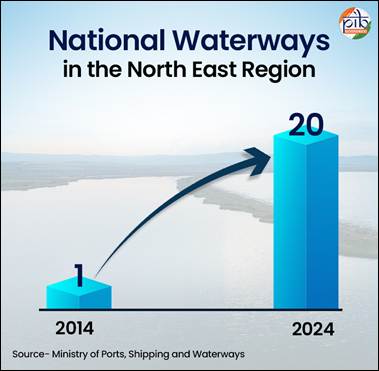
- Development of National Waterway-2 (Brahmaputra River) is strengthening inland water transport and logistics.
Air Connectivity
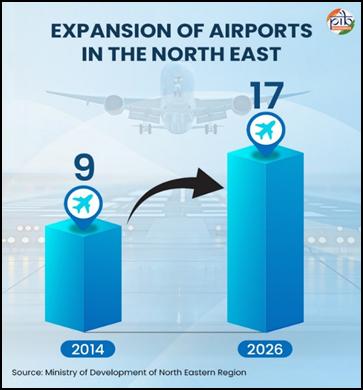
- Operational airports have increased substantially under the Ude Desh ka Aam Nagrik Scheme.
- Airports at Guwahati, Dibrugarh, Tezu, Hollongi, Agartala, Imphal, Shillong, and Pakyong have significantly improved regional and international connectivity.
Rural Welfare, Housing and Digital Inclusion
- States such as Arunachal Pradesh and Mizoram have achieved near-universal rural tap water coverage under the Jal Jeevan Mission.
- All North-Eastern states have achieved Open Defecation Free status under the Swachh Bharat Mission.
- Millions of houses have been completed under Pradhan Mantri Awas Yojana, improving housing security and living standards.
- Ayushman Bharat has expanded access to healthcare and reduced out-of-pocket expenditure.
- BharatNet, mobile tower expansion, and Digital India initiatives have significantly reduced digital isolation.
Agriculture and Allied Sectors
- Assam has emerged as the fisheries hub of the region with rising fish production.
- To strengthen fisheries development and improve fisher livelihoods, the Department of Fisheries has undertaken several initiatives, such as:
- sanctioned 3,823 Kisan Credit Cards for fishers.
- approved 70 recreational fisheries units under Pradhan Mantri Matsya Sampada Yojana (PMMSY).
- approved 501 Fish Farmers Producer Organizations (FFPOs) at a total project cost of ₹122.40 crore.
- approved 644 Ornamental Fisheries Units under Pradhan Mantri Matsya Sampada Yojana to promote diversification and income generation within the fisheries sector.
- The region has immense potential in tea, bamboo, spices, kiwi, pineapple, orange, black rice, rubber, and medicinal plants.
- Tripura and Assam possess significant agarwood resources with export potential.
- Government-Led Agricultural Transformation includes schemes like:
- National Mission on Edible Oils (NMEO), Pradhan Mantri Kisan Samman Nidhi (PM-KISAN), Pradhan Mantri Kisan Urja Suraksha evam Utthaan Mahabhiyaan (PM-KUSUM), Pradhan Mantri Fasal Bima Yojana (PMFBY), Mission Organic Value Chain Development for North East (MOVCD-NER), Krishi UDAN scheme, Van Dhan Vikas Yojana
Industrial Growth
- The upcoming Tata Semiconductor Facility at Jagiroad, Assam represents one of the largest industrial investments in North-East India.
- Growth is occurring in electronics, food processing, renewable energy, bamboo-based industries, ethanol production, and logistics.
Human Resource Development
- New educational institutions including Indian Institutes of Technology, National Institutes of Technology, central universities, and medical colleges are strengthening human capital.
- Skill development partnerships with countries such as Japan are creating employment opportunities in healthcare, hospitality, agriculture, and technology sectors.
Key Structural Trends in North-East Development
-
Connectivity-Led Growth: Improved roads, railways, airports, waterways, and digital infrastructure are reducing historical isolation and improving market access.
-
Act East Policy: The North-East has become central to India’s engagement with Association of Southeast Asian Nations (ASEAN) countries.
-
- Projects such as the India-Myanmar-Thailand Trilateral Highway and Kaladan Multi-Modal Transit Transport Project seek to connect India with Southeast Asia.
- Tourism Economy: Destinations such as Kaziranga National Park, Majuli, Tawang, Loktak Lake, Living Root Bridges, and Ziro Valley are driving tourism growth.
- Eco-tourism, cultural tourism, spiritual tourism, and adventure tourism are generating employment opportunities.
- Green Growth and Renewable Energy: The region has enormous hydropower potential, especially in Arunachal Pradesh.
- Renewable energy projects and green skill development programmes are creating opportunities for sustainable growth.
Key Institutional Challenges Facing the North-East
- Difficult terrain and dispersed settlements continue to increase infrastructure costs.
- Recurring floods, landslides, earthquakes, and climate-related disasters affect development outcomes.
- Border management remains challenging due to extensive international boundaries.
- Private investment remains uneven across states.
- Skill gaps continue in emerging sectors such as advanced manufacturing and technology.
- Ecological sensitivity requires careful balancing between conservation and development.
- Delays in project implementation and inter-agency coordination remain concerns.
Way Forward
- Infrastructure expansion should continue through climate-resilient and environmentally sustainable approaches.
- Cross-border trade and connectivity projects under the Act East Policy should be fast-tracked.
- Greater focus should be placed on value addition in agriculture, horticulture, bamboo, and forest products.
- The North-East should be developed as a hub for semiconductors, green energy, logistics, and knowledge industries.
- Skill development programmes must align with future employment opportunities.
- Local communities should be active partners in development planning.
- Conservation of biodiversity hotspots must remain a core development principle.
Conclusion
The story of the North-East is undergoing a remarkable transformation. Once viewed primarily through the lens of remoteness and connectivity challenges, the region is increasingly becoming a centre of opportunity, innovation, trade, and strategic importance. The Ashtalakshmi Growth Model recognises that the future of India’s growth is closely linked to the progress of its North-Eastern states. If supported by sustainable policies, strong institutions, and people-centric development, the North-East can emerge as one of the most dynamic growth regions of the twenty-first century.
Exam Hook: Key Takeaways
- Ashtalakshmi symbolises the eight North-Eastern states as engines of India’s future growth.
- PM-DevINE, Act East Policy, North Eastern Council, and MOVCD-NER are key institutional pillars.
- Connectivity, tourism, agriculture, semiconductors, renewable energy, and trade are major growth drivers.
- Sustainable development and ecological conservation must remain central to regional planning.
Mains Question
“The North-East Region is emerging as India’s strategic growth corridor in the Indo-Pacific. Examine the significance of the Ashtalakshmi Growth Model in achieving inclusive and sustainable development.”
One-Line Wrap
Ashtalakshmi represents a vision where the North-East evolves from India’s frontier region into a globally connected hub of prosperity, sustainability, innovation, and strategic importance.



Start Yours at Ajmal IAS – with Mentorship StrategyDisciplineClarityResults that Drives Success
Your dream deserves this moment — begin it here.