
WhatsApp Channel Join Now
Telegram Group Join Now
Syllabus: GS – III & V: Agro-based Industries
Why in the News?
Assam has constituted a Multi-Departmental Task Force to promote its agarwood sector and is working towards a dedicated policy for the industry.
- The first task-force meeting and stakeholder consultation were held recently. Assam has an estimated two lakh hectares of agarwood plantations, giving the State a significant resource base.
About Agarwood
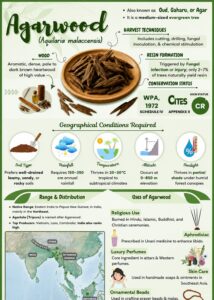
- Agarwood or Sanchi (Aquilaria malaccensis) is a highly valuable and aromatic resinous wood, native to Assam and South East Asia.
- It has a mythic reputation with a revered mention in Mahabharat, Buddhist birth stories and Hadiths in Islam.
- It requires warm humid and sub-tropical climate as well as soft and sandy soil.
- It is suitable and preferable for plantation at a temperature between 22 C to 43C with 70% sunlight and 1800-3500 mm rainfall per annum.
- Agar is classified as critically endangered on the IUCN Red List and is listed under Appendix II of the CITES.
- This listing ensures that the trade of agarwood adheres to sustainable limits, allowing export only if it does not harm the species’ survival.
- Assam is home to over 82% of India’s agarwood trees, amounting to 11.437 crore trees outside forest areas, showcasing Assam’s dominance in this sector.
- Assam’s Golaghat district holds the highest concentration of Agarwood Trees (4.5 crore trees).
- Other key districts include Jorhat, Sivasagar, Karimganj and Cachar.
- In contrast, Tripura holds the second-largest agarwood population in India with just 1.515 crore trees.
Production of Agarwood
- The cultivation of agarwood has a catch as healthy Aquilaria trees do not produce these fragrant compounds.
- Agarwood is produced when Aquilaria trees are bruised by external factors such as physical injury, insect attack, bacterial/fungal infection that they form agarwood in defense.
- The resin is produced as an immune response to attack from fungi or injury by insects called borer (Neurozerra confertal).
- Borer is naturally found in Assam’s districts of Sivasagar, Golaghat and Jorhat.
- In natural forests, only up to 10% of trees become infected and produce agarwood.
- Farmers use artificial inoculation methods to produce aromatic resins in agarwood by drilling holes in trees and injecting fungal inoculants.
- This triggers an immune response in the tree, leading to resin formation.
What is Assam planning?
- The State has constituted a Multi-Departmental Task Force for the Promotion of Assam’s Agarwood Sector, bringing together the Agriculture, Industries, Forest and other relevant departments.
- Agriculture Minister, Industry Minister and Forest Minister, along with senior officials, participated in the initial consultation with farmers, growers, traders, processors and industry representatives.
- The proposed policy approach seeks to develop the entire value chain, covering cultivation, scientific harvesting, processing, product development, branding, domestic marketing and exports.
- The initiative can help convert agarwood from a largely traditional activity into a high-value rural industry, generating employment and improving incomes for farmers and plantation owners.
Existing policy framework
- Policy Reforms:
- Assam Wood-Based Industries (Promotion & Development) Rules, 2022: Regulates sustainable growth of wood-based industries.
- Assam Trees Outside Forest (Sustainable Management) Rules, 2022: Supports the sustainable management of tree resources.
- Assam Agarwood Promotion Policy, 2020: Focuses on developing agarwood as a key economic sector.
- Trade Promotion:
- Establishment of the International Agarwood Trade Centre in Golaghat to facilitate global trade and promote the agarwood industry in Assam.
- Participation in national and international exhibitions and trade fairs is encouraged to boost marketing and attract potential buyers.
Why is the sector important for Assam?
- Assam is known as the “Agarwood Capital” of India.
- The climate and landscape of Assam are best suited for agar tree plantations.
- Assam is home to over 82% of India’s agarwood trees, amounting to 11.437 crore trees outside forest areas, showcasing Assam’s dominance in this sector.
- Assam’s Golaghat district holds the highest concentration of Agarwood Trees (4.5 crore trees).
- Other key districts include Jorhat, Sivasagar, Karimganj and Cachar.
- In contrast, Tripura holds the second-largest agarwood population in India with just 1.515 crore trees.
Significance of Agarwood
- Agar is a high value tree commodity and has a great potential for creating a new ‘Green Revolution’ in Assam after tea.
- Preferred Cash Crop: The low input for management and growth and intercropping adaptation makes agar a preferred cash crop.
- Employment Creation: It can create a large number of employment opportunities in sectors such as:
- Agarwood Oil Sector, Perfume Industry, Cosmetic Industry, Medicinal Use, Agarwood chips
- Export Potential: Agarwood has high international demand, particularly in Gulf countries.
- Example: Top-grade agarwood fetches up to $33,000/kg.
- Cultural Significance: Sanchipat, known as ‘Sanchi Puthis’, manuscripts, historically made from agarwood, are an integral part of Assamese heritage.
- Agarwood plantations promote reforestation and environmental conservation.
Key challenges
- Long Gestation period: Agarwood trees take 15-25 years to mature and produce commercially viable quantities of resin. This discourages potential investors seeking quicker returns.
- Illicit Felling and Smuggling: The high value of agarwood tempts illegal logging and smuggling posing a threat to sustainable cultivation and fairtrade practices.
- Lack of Scientific Knowledge: Limited research and knowledge about optimal cultivation practices and disease management hinder production efficiency.
Exam Hook –Prelims
Consider the following statements about agarwood:
- Aquilaria malaccensis is listed in Appendix II of the Convention on International Trade in Endangered Species of Wild Fauna and Flora.
- Agarwood is produced from the resinous heartwood of Aquilaria trees.
- International trade in the species is completely prohibited under the Convention.
Which of the statements given above is/are correct?
Answer: 1 and 2 only.
One-line takeaway: Assam’s agarwood push can turn a traditional forest-linked resource into a high-value rural industry, but only through sustainable cultivation and regulated trade.



Start Yours at Ajmal IAS – with Mentorship StrategyDisciplineClarityResults that Drives Success
Your dream deserves this moment — begin it here.