
WhatsApp Channel Join Now
Telegram Group Join Now
Prime Minister, during Mann Ki Baat, praised Assam’s successful Greater Adjutant Stork (Hargila) conservation initiative led by Dr Purnima Devi Barman and the community-driven Hargila Army, calling it an inspiring example of changing mindsets through awareness and public participation.
Key Highlights
- The Greater Adjutant Stork, locally known as Hargila, was once considered a bad omen in parts of Assam, leading to the destruction of nesting trees.
- Dr Purnima Devi Barman, a wildlife biologist from Assam, launched a community-based conservation movement to protect the species.
- She mobilised thousands of rural women, who formed the Hargila Army to protect nesting sites, spread awareness, and challenge social superstitions.
- She created the Hargila Army in 2007, an all-female conservation group involving more than 20,000 women, dedicated to protecting the species and its habitat.
- The initiative has also helped local women gain financial independence by involving them in sustainable businesses such as making textiles with stork-themed embroidery.
- Dr Barman’s unique approach to conservation—blending wildlife protection with women’s empowerment—has created a sustainable, community-driven movement.
- The campaign transformed the bird from being viewed as inauspicious to becoming a symbol of community pride.
- Her work has not only saved an endangered species and officially moved its status to “near threatened” under the IUCN list, but also transformed lives.
- The initiative demonstrates the importance of community participation, scientific awareness, and women-led conservation in protecting endangered wildlife.
About the Hargila (Greater Adjutant Stork)
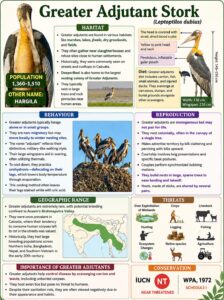
- Greater Adjutant Stork is one of the world’s rarest stork species.
- It is locally known as Hargila in Assam.
- Habitat: Wetlands, floodplains, marshes and tall trees near human settlements.
- Distribution: Mainly found in Assam and parts of Bihar in India, with small populations in Cambodia.
- Plays a vital ecological role as a scavenger, helping keep the environment clean by feeding on animal carcasses and organic waste.
- The species is currently listed as Near Threatened on the IUCN Red List, after showing population recovery.
Exam Hook – Prelims
Q. Consider the following statements regarding the Greater Adjutant Stork (Hargila):
- It is classified as Endangered by the International Union for Conservation of Nature.
- It is protected under Schedule I of the Wildlife (Protection) Act, 1972.
- Assam supports one of the largest remaining breeding populations of this species.
Which of the statements given above is/are correct?
(a) 1 and 2 only
(b) 2 and 3 only
(c) 1, 2 and 3
(d) 1 only
Answer: (c)
One-Line Wrap
Assam’s Hargila conservation movement showcases how scientific awareness and community participation can successfully protect endangered wildlife while transforming social attitudes.



Start Yours at Ajmal IAS – with Mentorship StrategyDisciplineClarityResults that Drives Success
Your dream deserves this moment — begin it here.