
WhatsApp Channel Join Now
Telegram Group Join Now
| Relevance: General Studies Paper I — Geography: Important Geophysical Phenomena and the Indian Monsoon; with strong linkages to General Studies Paper III — Agriculture and Food Security | Source: IMD, NOAA & WMO bulletins, 2026 |
| A developing El Niño in the Pacific Ocean is set to weaken India’s lifeline — the southwest monsoon. The India Meteorological Department (IMD) has forecast a below-normal monsoon in 2026, around 90–95% of the Long Period Average (LPA), because a warm Pacific tends to dry out Indian skies. To see why, we first need to understand the Pacific’s natural mood swings — El Niño and La Niña — and then how they change weather both around the world and over India. |
1 · The three faces of the Pacific
| The El Niño–Southern Oscillation (ENSO) is a natural cycle in the equatorial Pacific Ocean that swings between three moods every 2 to 7 years: El Niño (warm), La Niña (cool), and neutral (in between). These swings change rainfall and temperature across much of the world. |
- The Neutral Phase: Steady winds (the trade winds) blow across the Pacific from the Americas towards Asia, pushing warm surface water to the western Pacific near Indonesia.
Warm air rises there in a giant looping flow called the Walker Circulation. This warm western Pacific helps pull the monsoon towards India. El Niño and La Niña are simply what happen when this balance tips one way or the other.
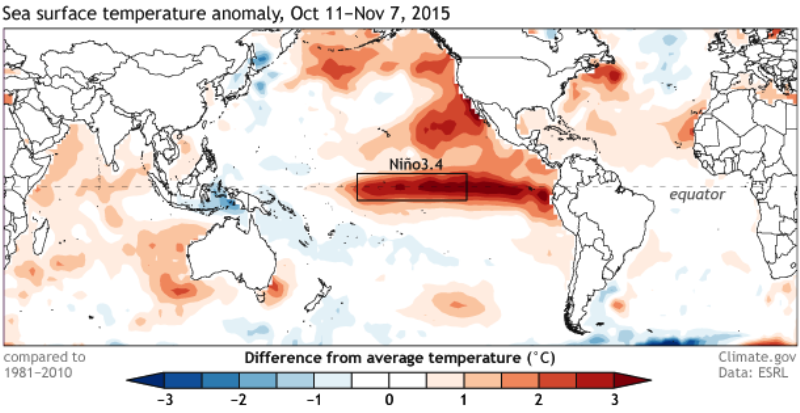
Image: The Sea Surface temperature Anomaly and the El-Nino 3.4 Region.
The Other Two Phases Of the Cycle
| Region / Phenomenon | El Niño (warm phase) | La Niña (cool phase) |
| Pacific Ocean | Central & eastern Pacific turns warmer than usual. | Central & eastern Pacific turns cooler than usual. |
| Trade winds | Weaken or even reverse. | Blow stronger than usual. |
| Indian monsoon | Usually weaker — below-normal rain. | Usually stronger — good or above-normal rain. |
| Around the world | Floods in Peru; drought in SE Asia & Australia; a warmer globe. | Floods in Australia & SE Asia; drier Peru & southern US; a cooler globe. |
In short: El Niño tends to starve the Indian monsoon, while La Niña tends to feed it.
2 · Why El Niño dries India
- Normally: the warm western Pacific and its rising air act like an engine that pulls moist monsoon winds over India.
- During El Niño: the warm water and the rising air shift eastward, towards the central Pacific. The Walker Circulation weakens, and so does the “engine” pulling the monsoon.
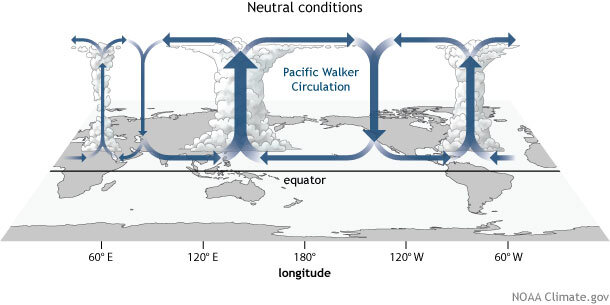
Image : The Walker Circulation: ENSO’s atmospheric buddy
- The result: weaker monsoon winds, less rain over India, and often a hotter, drier season. The measure scientists watch is the sea temperature of the Niño 3.4 region in the central Pacific — an El Niño is declared when it runs 0.5°C above normal or more.
3 · How strong is it? The El Niño scale
| Neutral (−0.5°C to +0.5°C) | normal years |
| Weak El Niño (+0.5°C to +0.9°C) | ◄ 2026 (developing) |
| Moderate to Strong (+1.0°C to +1.9°C) | 2026 may strengthen here |
| Very Strong (+2.0°C and above) | ◄ 2023–24 was here |
El Niño strength is graded by how warm the Niño 3.4 region is. In mid-May 2026, weekly readings were about +0.9°C — a developing (weak) El Niño that the WMO and NOAA expect to strengthen to at least moderate, peaking around November 2026 to January 2027.
4 · Two different impacts
A. Around the world
- Rain shifts across continents: El Niño typically brings heavy rain and floods to western South America (Peru, Ecuador), and drought to Southeast Asia and Australia, while changing rainfall across parts of Africa and the Americas.
- A warmer planet: By releasing ocean heat into the air, El Niño nudges up global average temperatures — often making an El Niño year one of the warmest on record.
B. Over India (the 2026 monsoon)
- A below-normal forecast: The IMD expects the 2026 monsoon to be below normal — about 90–95% of the LPA. Last year’s forecast was a healthier 105%.
- An uneven map: In El Niño years, the northeast and the far south usually get near-normal rain, while most of the rest of the country falls short — leaving the farming heartland the most exposed.
- Hotter, drier days: Weaker rains usually mean higher temperatures, adding heat stress for people, crops and water supplies.
5 · The IOD: no rescue this year
- India’s own Pacific: The Indian Ocean Dipole (IOD) is the Indian Ocean’s version of ENSO, with positive, neutral and negative phases.
- The missing helper: A positive IOD can sometimes cancel out El Niño’s drying effect and lift the monsoon. But in 2026 the IOD is in a neutral phase, so India cannot count on it to soften the blow.
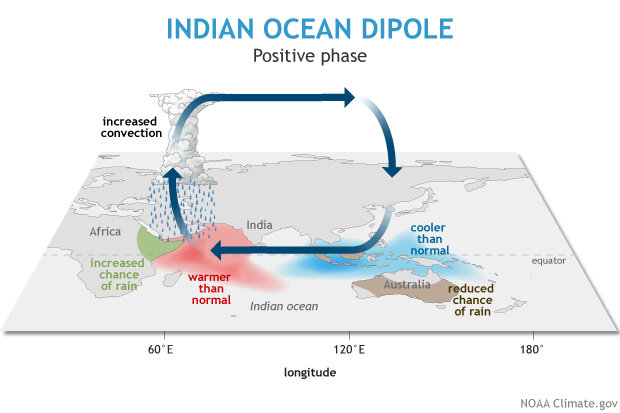
Image : The Positive Phase of Indian Ocean Dipole.
6 · What India must do
| Warn early, plan crops smart. Use early forecasts to guide farmers towards hardy, less thirsty crops — millets and pulses — through state-wise contingency crop plans. |
| Make every drop count. Push the “Per Drop More Crop” part of the Pradhan Mantri Krishi Sinchayee Yojana (PMKSY) — drip and sprinkler micro-irrigation — to stretch scarce water during dry spells. |
| Guard the water and the granary. Manage reservoirs strictly — drinking water and key irrigation first — and protect food buffer stocks to keep prices stable as the Kharif harvest comes in. |
| Protect rural incomes. Strengthen safety nets like MGNREGA to provide work and wages to farm families if the rains fall short. |
| El Niño is a natural swing of the Pacific, not a one-off disaster — but its timing this year, with no helping hand from a positive Indian Ocean Dipole, makes the 2026 monsoon a real worry. India cannot control the ocean, but it can prepare: with sharp early warnings, water-wise farming, careful reservoir use and strong rural safety nets. Turning an unavoidable climate swing into a manageable challenge is the real test of climate-ready governance. |
| UPSC Value Box | ||||||||||||||||
|
| Mains Practice Question |
| Explain the El Niño and La Niña phenomena and their contrasting effects on the Indian monsoon. In the light of a developing El Niño, suggest measures to safeguard India’s food and economic security. (15 marks · 250 words) |
Structure hint:
Introduction — define ENSO; note the developing 2026 El Niño and IMD’s below-normal monsoon forecast (~90–95% of LPA).
Body Part 1 — the science: the normal Pacific setup, El Niño vs La Niña, and the weakened Walker Circulation that dries India.
Body Part 2 — the impact: separate global effects (floods/drought worldwide, a warmer globe) from India’s below-normal, uneven monsoon; the neutral IOD giving no relief.
Body Part 3 — the response: contingency crop planning (millets/pulses), micro-irrigation (PMKSY), and reservoir and buffer-stock management.
Way Forward — early-warning systems, water-wise farming, and rural safety nets like MGNREGA.
Introduction — define ENSO; note the developing 2026 El Niño and IMD’s below-normal monsoon forecast (~90–95% of LPA).
Body Part 1 — the science: the normal Pacific setup, El Niño vs La Niña, and the weakened Walker Circulation that dries India.
Body Part 2 — the impact: separate global effects (floods/drought worldwide, a warmer globe) from India’s below-normal, uneven monsoon; the neutral IOD giving no relief.
Body Part 3 — the response: contingency crop planning (millets/pulses), micro-irrigation (PMKSY), and reservoir and buffer-stock management.
Way Forward — early-warning systems, water-wise farming, and rural safety nets like MGNREGA.
Must mention:
ENSO (El Niño / La Niña) ·
Niño 3.4 ·
Walker Circulation ·
Indian Ocean Dipole (IOD) ·
Long Period Average (LPA)
ENSO (El Niño / La Niña) ·
Niño 3.4 ·
Walker Circulation ·
Indian Ocean Dipole (IOD) ·
Long Period Average (LPA)
Conclusion hint: Stress that while El Niño cannot be prevented, smart, early and water-wise preparation can turn an unavoidable climate swing into a manageable challenge — the heart of climate-ready governance.



Start Yours at Ajmal IAS – with Mentorship StrategyDisciplineClarityResults that Drives Success
Your dream deserves this moment — begin it here.