
Why in the News?
Syllabus: GS-II & V: Education, Governance, Social Sector Development
Assam has recorded a remarkable improvement in the Performance Grading Index (PGI) 2.0 released by the Ministry of Education. The State climbed from 27th position to 12th position, improving its score from 511.5 to 593.6 and moving from ‘Akanshi-2’ to ‘Prachesta-3’ category.
What is the Performance Grading Index (PGI) 2.0?
- It is a district-level assessment framework launched by the Ministry of Education.
- It evaluates the quality of school education and implementation of the National Education Policy (NEP) 2020.
- It supports planning and monitoring under the Samagra Shiksha Scheme.
- Unlike rankings, it follows a grading system, where districts are measured against fixed benchmarks rather than competing with one another.
- Data Sources: Unified District Information System for Education Plus (UDISE+), PARAKH Rashtriya Sarvekshan 2024 & PRABANDH Portal.
Assessment Framework
- Total Score: 600 marks
- Assessment based on 70 indicators under 6 categories:
- Outcomes
- Effective Classroom Transactions
- Infrastructure and Student Entitlements
- School Safety and Child Protection
- Digital Learning
- Governance Processes
Grades under PGI-D
| Grade | Score Range |
| Utkarsh | Above 90% |
| Uttam-1 | 81–90% |
| Uttam-2 | 71–80% |
| Uttam-3 | 61–70% |
| Prachesta-1 | 51–60% |
| Prachesta-2 | 41–50% |
| Prachesta-3 | 31–40% |
| Akanshi-1 | 21–30% |

Key Findings of PGI-D 2024-25
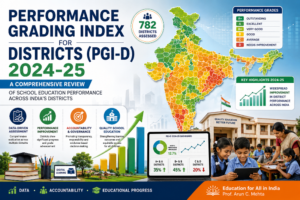
- 653 districts improved their scores compared to the previous year.
- 251 districts improved by at least one grade.
- The number of districts in Uttam-2 increased from 1 to 16.
- The number of districts in Uttam-3 increased from 40 to 75.
- The number of districts in Prachesta-1 increased from 281 to 332.
- No district has yet reached Utkarsh or Uttam-1, indicating that no district has achieved more than 81% of the total score
Why Did Assam Improve?
Strong Governance Reforms
The biggest contributor to Assam’s success has been improvement in Governance Processes, where the State secured the highest category, ‘Uttam-3’.
This reflects:
- Better school monitoring.
- Improved implementation of government schemes.
- Greater transparency and accountability.
Role of Shiksha Setu Axom
A major driver of reform has been Shiksha Setu Axom, a digital education management platform.
It enables:
- Real-time attendance monitoring.
- Digital school management.
- Centralised data collection.
- Tracking of student and teacher performance.
The platform has also received the Prime Minister’s Award for Excellence in Public Administration.
Improvement in Infrastructure
Assam has significantly expanded educational infrastructure:
- Availability of computers increased from 9.8% to 78.7%.
- Internet connectivity increased from 1.3% to 87.2%.
- More classrooms, drinking water facilities and sanitation facilities were created.
Challenges That Still Remain
Despite progress, several concerns continue:
Learning Outcomes Need Further Improvement
- Foundational literacy and numeracy remain uneven across districts.
- Pandemic-related learning losses still affect many students.
Retention Rates Remain Low
- School dropout rates remain a concern in several districts.
- Transition from primary to secondary education needs strengthening.
Educational Equity Requires Attention
Children from:
- Tea garden communities.
- Scheduled Tribe areas.
- Flood-prone and remote regions.
- Economically weaker sections.
continue to face barriers to quality education.
Way Forward
- Assam should focus on improving learning outcomes rather than only infrastructure.
- Continuous teacher training and professional development should be institutionalised.
- Digital education must reach every rural and remote school.
- School Management Committees should be empowered for local-level monitoring.
- Long-term educational planning should continue beyond political and administrative cycles.
Key Takeaways
- Assam improved from 27th to 12th rank in PGI 2.0.
- The State’s score increased from 511.5 to 593.6.
- Shiksha Setu Axom emerged as a major driver of educational governance reform.
- Digital infrastructure and school monitoring have improved significantly.
- Learning outcomes, retention rates and educational equity remain key priorities.
Mains Question
Discuss the significance of digital governance initiatives in improving educational outcomes, with special reference to Assam’s performance in the Performance Grading Index 2.0.
One-Line Wrap
Assam’s rise in PGI 2.0 demonstrates how technology-driven governance and focused reforms can transform school education, but sustained improvement will depend on better learning outcomes and inclusive growth.



Start Yours at Ajmal IAS – with Mentorship StrategyDisciplineClarityResults that Drives Success
Your dream deserves this moment — begin it here.