
WhatsApp Channel Join Now
Telegram Group Join Now
| Relevance: GS Paper II — International Relations & Neighbourhood Policy | Source: The Hindu / MEA Briefings, 2026 |
1 · What happened
| Nepal’s Prime Minister, Balendra Shah, recently told Parliament that both India and Nepal have encroached on each other’s territory. Kathmandu later clarified that he meant cross-border occupation and missing pillars in the Dasgaja (no-man’s land strip).
Nepal also asked the United Kingdom for old colonial-era survey maps to support its claims. India’s MEA rejected any third-party role, saying the boundary is strictly a bilateral matter. Around the same time, Rabi Lamichhane, chief of Nepal’s ruling RSP, held a five-day visit to India. |
2 · The Four Pillars of India–Nepal Relations
| India and Nepal share an open, porous border of over 1,850 km with five Indian states — Uttarakhand, UP, Bihar, West Bengal and Sikkim. The relationship rests on a treaty, deep social ties, two boundary disputes and a strong China shadow. |
|
The Treaty Anchor
1950 Peace & Friendship Treaty
Allows Nepali citizens equal rights in India — work, property, residence. Combined with the open border, this creates the famous “Roti-Beti ka Rishta”.
|
Cooperation
Energy & Digital Links
Motihari–Amlekhgunj — South Asia’s first cross-border oil pipeline. The Nepal–India Tech Forum (2026) pushes India’s DPI model and Nepal’s hydropower-powered data centres.
|
|
Border Disputes
Kalapani & Susta
West: Kalapani–Limpiyadhura–Lipulekh dispute from the 1816 Treaty of Sugauli — over the source of the Kali river. East: Susta dispute on the Bihar border, driven by the shifting course of the Gandak river.
|
Strategic Concern
The China Footprint
Nepal’s role in China’s Belt and Road Initiative (BRI) and Chinese infrastructure projects in northern Nepal are watched closely by India for security implications.
|
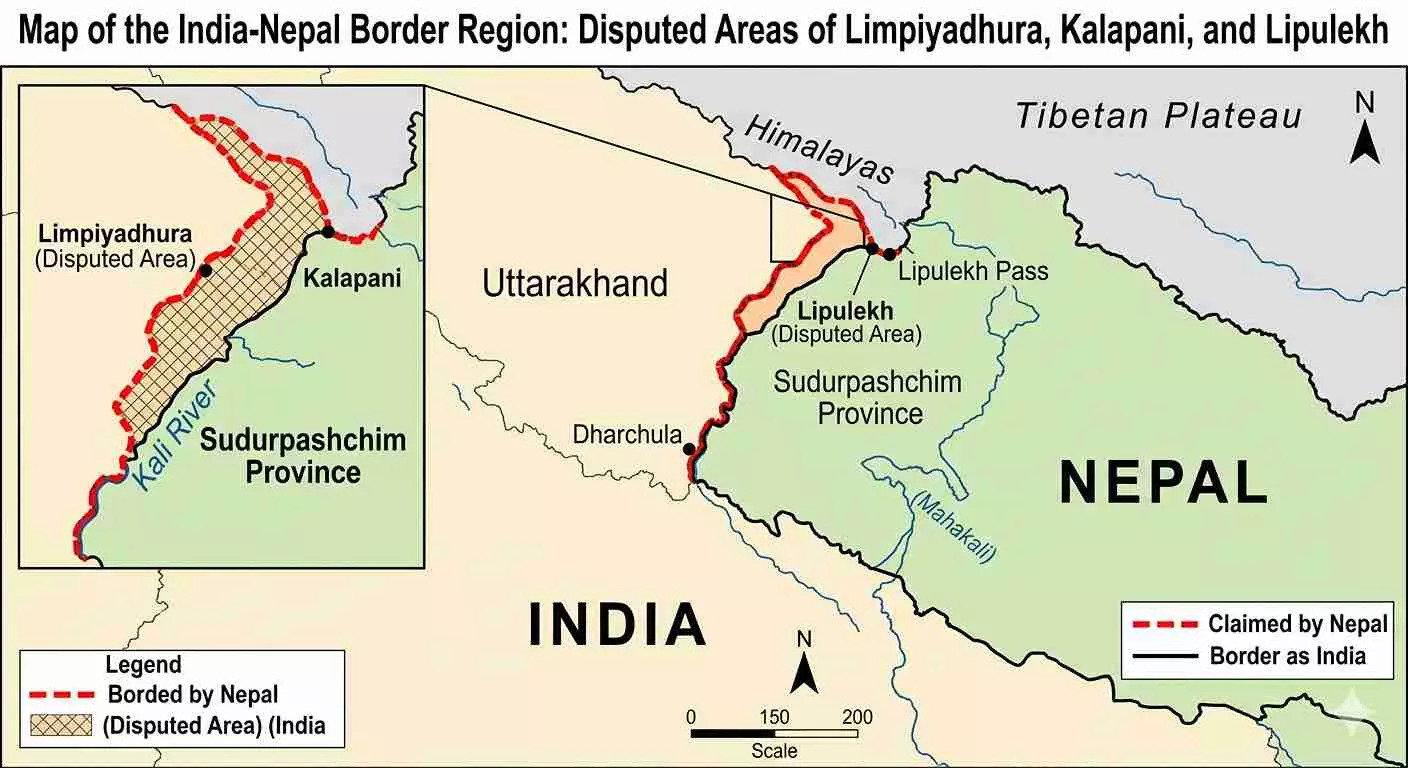
Image : India Nepal Border Dispute Areas
- Boundary Working Group (BWG): Joint technical body of both countries — has already mapped over 97% of the border and is tasked with repairing pillars and clearing encroachments.
- Eminent Persons Group (EPG): Joint panel set up to review and modernise the 1950 Treaty.
- Buffer State role: Nepal sits between India and China; its political stability is directly linked to India’s heartland security.
- Economic linkage: Nepal uses Indian ports for sea trade; India taps Nepal’s clean hydropower for its grid.
| UPSC Value Box | ||||||||||||||||
|
| MCQ Practice Question |
Q. With reference to India–Nepal relations, consider the following statements:
Which of the statements given above is/are correct? |
Answer: (a) 1 and 2 only
|



Start Yours at Ajmal IAS – with Mentorship StrategyDisciplineClarityResults that Drives Success
Your dream deserves this moment — begin it here.