
WhatsApp Channel Join Now
Telegram Group Join Now
| Relevance: GS Paper I & III — Geography, Climatology & Agriculture | Source: The Hindu / IMD, 2026 |
1 · What happened
| The India Meteorological Department (IMD) has revised the onset of the Southwest Monsoon over Kerala from May 26 to around June 4, 2026 — the first overshoot beyond the model’s ±4-day error window since 2015.
An upper-air cyclonic circulation off the southern Kerala coast is now providing the final atmospheric push for landfall. The delay is attributed to a building El Niño phase in the equatorial Pacific suppressing convection over the subcontinent. |
2 · IMD’s Three-Criteria Onset Test & Why 2026 Stalled
| Monsoon Onset over Kerala (MOK) is declared only when three meteorological conditions — rainfall, wind depth, and outgoing radiation — are simultaneously satisfied on any day after May 10. |
|
Criterion 1 — Rainfall
60% of 14 Stations
At least 60% of 14 designated stations across Kerala and adjoining coast (Thiruvananthapuram, Kochi, Kozhikode, Mangaluru) must record ≥2.5 mm rainfall for two consecutive days.
|
Criterion 2 — Wind Depth
Westerlies up to 600 hPa
Lower-tropospheric westerlies must extend up to the 600 hPa pressure level (~4.5 km altitude) over the southeast Arabian Sea — proof of a structural, deep wind system.
|
|
Criterion 3 — Mechanism
OLR below 200 W/m²
Outgoing Longwave Radiation over the southeast Arabian Sea must drop below 200 W/m² — a proxy for deep, thick cloud tops blocking heat escape, distinguishing monsoon convection from pre-monsoon showers.
|
Threat — Why 2026 Stalled
El Niño & Walker Disruption
Abnormal warming of the eastern tropical Pacific disrupts the Walker Circulation, altering upper-air winds and suppressing convection over India. Season forecast: 90% of LPA — “Below Normal”.
|
- Driver of the monsoon: Differential heating creates a low-pressure trough over Tibet/Central Asia while the southern Indian Ocean stays cool — drawing moisture-laden trade winds that the Coriolis force deflects into Southwest winds.
- Agriculture exposure: Over 50% of India’s net sown area is rain-fed, with no irrigation backup — a delayed onset shortens the Kharif cycle for rice, pulses, oilseeds, cotton.
- Inflation linkage: Below-normal rainfall directly spikes prices of vegetables, pulses and sugar — complicating RBI monetary policy.
- Hydrological stress: Reservoir depletion hits rural drinking water security and hydroelectric generation at peak summer demand.
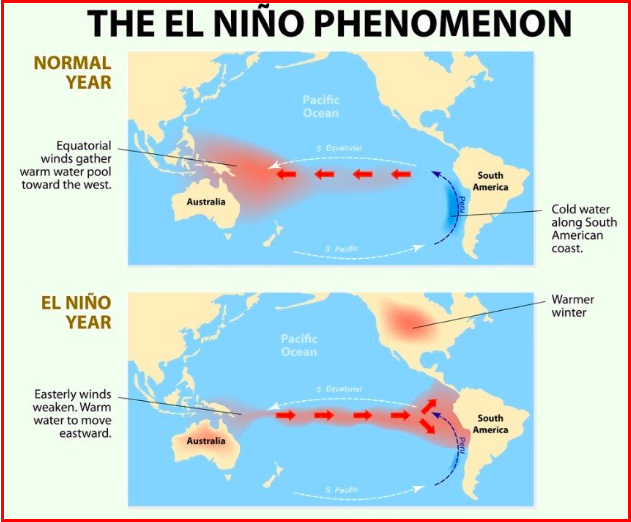
Image : Depicting El -Nino & La-Nina Phenomenon
| UPSC Value Box | ||||||||||||||||
|
| MCQ Practice Question |
Q. With reference to the Southwest Monsoon and its onset over Kerala, consider the following statements:
Which of the statements given above is/are correct? |
Answer: (c) 1 and 3 only
|



Start Yours at Ajmal IAS – with Mentorship StrategyDisciplineClarityResults that Drives Success
Your dream deserves this moment — begin it here.