
A Western Hoolock Gibbon was recently recorded using an artificial canopy bridge over a railway line in Hollongapar Gibbon Sanctuary, marking the first documented instance in the world of a hoolock gibbon using such a structure.
Key Highlights
- The crossing was recorded in the Hollongapar Gibbon Sanctuary in Assam.
- The sanctuary supports only about 120–130 Western Hoolock Gibbons, making conservation efforts crucial.
- The canopy bridge was installed across the electrified Lumding–Dibrugarh railway line, which fragments the forest habitat.
About the Artificial Canopy Bridge
- The current bridge consists of:
- Double-rope nylon structures.
- Safety nets for protection.
- Design suited to the gibbon’s natural movement.
- It was developed following consultations with the Wildlife Institute of India.
About the Western Hoolock Gibbon
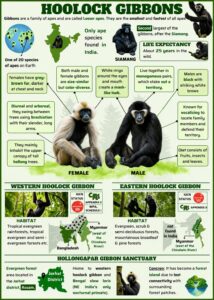
- Scientific Name: Hoolock hoolock.
- It is:
- India’s only ape.
- A completely arboreal (tree-dwelling) primate.
- Known for brachiation, a movement in which it swings from branch to branch using its arms.
- Conservation Status:
- Endangered under the International Union for Conservation of Nature Red List.
- Protected under Schedule I of the Wildlife Protection Act, 1972.
Why This Achievement Matters
- Railways, roads, and power lines often cause habitat fragmentation.
- Artificial canopy bridges help:
- Restore connectivity between isolated forest patches.
- Reduce wildlife mortality.
- Improve movement for breeding and feeding.
Global Significance
Similar canopy bridges are used worldwide for:
- Lemurs in Madagascar.
- Sloths in Costa Rica.
- Possums in Australia.
- Monkeys in South Africa.
However, experts emphasize that canopy bridges are a mitigation measure, not a substitute for conserving natural forests and wildlife corridors.
Exam Hook: Prelims Question
Consider the following statements regarding the Western Hoolock Gibbon:
- It is India’s only ape.
- It is primarily a ground-dwelling primate.
- It is protected under Schedule I of the Wildlife Protection Act, 1972.
Which of the statements given above are correct?
(a) 1 and 2 only
(b) 2 and 3 only
(c) 1 and 3 only
(d) 1, 2 and 3
Answer: (c)
One-Line Wrap
The successful use of an artificial canopy bridge by the Western Hoolock Gibbon in Assam demonstrates how innovative wildlife-friendly infrastructure can help reduce habitat fragmentation and support the conservation of endangered species.



Start Yours at Ajmal IAS – with Mentorship StrategyDisciplineClarityResults that Drives Success
Your dream deserves this moment — begin it here.