
UPSC Prelims—Geography (SCS map), International Law (UNCLOS, PCA 2016); Mains GS-II—IR (Indo-Pacific, ASEAN–China ties, freedom of navigation); GS-III—Security
What is Going On and Where
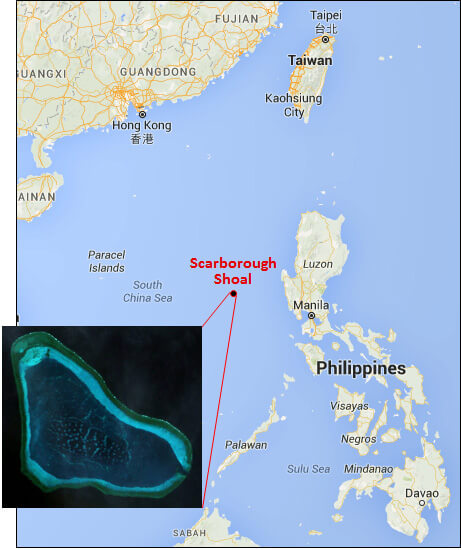
Scarborough Shoal (called Bajo de Masinloc or Panatag Shoal in the Philippines, and Huangyan Dao in China) is a triangular ring of reefs with a calm lagoon. It lies roughly 200 km off Luzon in the Philippines, close to vital shipping routes in the South China Sea. The waters are rich in fish and the lagoon offers shelter in storms, so it is crucial for local livelihoods and for navigation.
Control on the water shifted in 2012, when China established effective presence at the mouth of the lagoon after a standoff with the Philippines. Since then, Chinese coast-guard ships and state-backed trawlers have often blocked or shadowed Philippine boats.
Legally, the 2016 arbitration under the United Nations Convention on the Law of the Sea(UNCLOS) said:
- the features at Scarborough are rocks, not islands (so they can generate at most a 12-nautical-mile territorial sea, not a 200-nautical-mile exclusive economic zone),
- both Filipino and Chinese fishers have traditional fishing rights there, and
- sovereignty over the shoal was not decided by the tribunal (it was outside its scope).
China rejected the award, but it remains important for Manila’s legal position.
Note : UNCLOS is the United Nations Convention on the Law of the Sea, an international agreement that establishes a comprehensive legal framework for all marine and maritime activities. The convention defines the rights and responsibilities of nations regarding the use of the world’s oceans and governs everything from environmental protection to the exploitation of marine resources. As of October 2024, it has been ratified by 170 parties, including 169 states and the European Union.
What China is planning and why Manila is worried
- China has announced a “national nature reserve” for Scarborough Shoal, describing it as coral and marine-life protection over an area of about 3,500 hectares.
- The Philippines argues this is an administrative tool to tighten day-to-day control: once a reserve is declared, foreign vessels (including Filipino fishers) can be pushed out as “violators,” even inside the Philippine exclusive economic zone.
- This fits a wider grey-zone pattern: barriers placed at the lagoon’s mouth, close-quarter blockings and water cannons by coast-guard ships, and constant presence of large fishing fleets that work like a maritime militia. These moves change facts on the water without open naval combat.
Risks and stakes (beyond Manila and Beijing)
- Escalation risk: Many incidents have occurred, but no shots fired so far. The danger is an accident or collision at sea.
- Philippine’s 1951 Mutual Defense Treaty with the United States deters open force by saying attacks on Philippine armed forces, public vessels, or aircraft will invite American response; recent clarifications say this applies anywhere in the South China Sea.
- Food and livelihoods: The shoal is a traditional fishing ground for coastal communities; exclusion hits incomes and food security.
- Rule of law at sea: Ignoring the 2016 UNCLOS award weakens confidence in the maritime order and may encourage similar moves elsewhere.
- Trade and sea lanes: The South China Sea carries a large share of global commerce; persistent coercion raises risk and costs.
- India’s angle and interests:
- India depends on open sea lanes from the Indian Ocean through the Malacca Strait into the South China Sea for merchandise trade and energy flows.
- India supports a rules-based maritime order under the Law of the Sea, peaceful resolution of disputes, and freedom of navigation and overflight.
- Through Act East, Security and Growth for All in the Region (SAGAR), and the Indo-Pacific Oceans Initiative, India backs capacity building with Southeast Asian partners—hydrography, maritime domain awareness, coast-guard training, and disaster response.
- India-Philippines defence ties, including coastal defence cooperation, signal India’s interest in deterrence, resilience and lawful use of the seas.
- Any normalisation of coercive control at Scarborough sets a precedent that can affect wider Indo-Pacific sea spaces important to India.
What the Philippines can do
- Frequent diplomatic protests and public release of photos/videos of incidents.
- More patrols by coast guard and fisheries vessels near the shoal.
- Alliance signalling and exercises with partners.
- Legal warfare: Keep invoking the 2016 award; document environmental damage; pursue action against identified maritime-militia networks.
- Fisher protection: Equip boats with beacons and radios; create escorted corridors; expand community sea-ranger programs.
- Coalitions at sea: Coordinate search-and-rescue and incident de-confliction with friendly navies and coast guards to reduce miscalculation.
- Transparency tech: Persistent satellite monitoring and public dashboards to keep global attention on any new barriers or dredging.
Likely Chinese objectives
- Consolidate de facto control without resolving sovereignty.
- Use ecology language (“reserve”) as legal cover for patrols, permits, and penalties.
- Stay below the war threshold: keep pressure through coast guard and militia while avoiding a direct armed clash that could trigger the treaty.
- Shape compliance: daily administration on the water matters more than paper claims.
Exam Hook
Key takeaways
- Status now: China controls access; sovereignty remains unsettled.
- Law: Tribunal backs Manila on rights (rocks, not islands; traditional fishing; no historic rights), but enforcement is the challenge.
- New move: A “nature reserve” is likely a step to regulate and restrict others under the banner of conservation.
- Outlook: Continued grey-zone friction, high accident risk, low chance of declared war; alliances act as deterrent.
- India: Stakes in open sea lanes and rule-based order make Scarborough relevant to Indian diplomacy, security partnerships, and economic interests.
Mains Practice (12.5 marks)
“China’s proposed ‘nature reserve’ at Scarborough Shoal is ecological language for administrative control. Examine the legal position since 2016, the pattern of grey-zone tactics, the implications for India, and the wider stakes for the Indo-Pacific.
Hints: geography and livelihood value; 2012 effective control; 2016 findings (rocks, traditional fishing, sovereignty not decided); grey-zone tools (barriers, water cannons, militia fleets); treaty deterrence; India’s angle (sea-lane security, rules-based order, Act East, SAGAR, capacity building, India-Philippines defence ties); balanced way forward (lawfare, fisher protection, coalitions, transparency).
Prelims Practice
Consider the following statements:
- The 2016 South China Sea arbitration classified the features of Scarborough Shoal as rocks, which do not generate a 200-nautical-mile exclusive economic zone.
- The arbitration decided sovereignty over Scarborough Shoal in favour of the Philippines.
- Recent clarifications on the 1951 Mutual Defense Treaty state that attacks on Philippine public vessels anywhere in the South China Sea fall under the treaty.
- India’s official position favours freedom of navigation and respect for the Law of the Sea in the Indo-Pacific.
Which of the statements given above is/are correct?
(a) 1, 3 and 4 only
(b) 1 and 2 only
(c) 2 and 3 only
(d) 1, 2, 3 and 4
Answer: (a) 1, 3 and 4 only.



Start Yours at Ajmal IAS – with Mentorship StrategyDisciplineClarityResults that Drives Success
Your dream deserves this moment — begin it here.