
Syllabus: GS-III & V: Conservation
Why In News?
Every year on September 16, the world observes the International Day for the Preservation of the Ozone Layer, or World Ozone Day. While ozone protection is a global issue, it has deep local relevance for Assam and the Northeast, where fragile ecosystems, biodiversity, and agriculture form the backbone of life and livelihoods.
About World Ozone Day
-
Annually observed on September 16, to commemorate the adoption of the Montreal Protocol (1987) and promote ozone awareness.
-
Established by: United Nations General Assembly (1994).
-
2025 Theme: “From Science to Global Action.”
What is the Ozone Layer?
-
The ozone layer is a thin shield of ozone (O₃) molecules located in the stratosphere, around 10–30 km above the Earth’s surface.
-
Often described as “Earth’s umbrella,” the layer acts as a protective shield, blocking harmful UV radiation from the sun.
-
It absorbs 97–99% of harmful ultraviolet-B (UV-B) radiation from the sun, safeguarding human health, animals, crops, and ecosystems.
-
This natural barrier significantly reduces the risk of skin cancer, cataracts, and damage to ecosystems.
What is Ozone (O₃)?
-
Ozone is a naturally occurring gas present in the atmosphere.
-
It is basically a molecule made of three oxygen atoms (O₃).
-
It is a pale blue gas with a sharp smell (one might detect it after a thunderstorm or near electrical equipment).
-
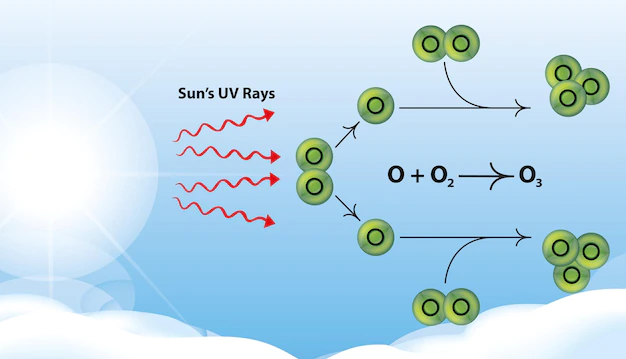
It is created when oxygen (O₂) is split into single oxygen atoms by the action of sunlight and is then joined by an O₂ molecule to make ozone (O₃).
-
Ozone is highly reactive and unstable, which makes it effective in absorbing harmful radiation but also harmful when present near the ground.
Types of Ozone: “Good Ozone” vs. “Bad Ozone”
Stratospheric Ozone (Good Ozone)
-
Found in the stratosphere (10–30 km above Earth).
-
Forms the ozone layer, which absorbs most of the sun’s ultraviolet-B (UV-B) and some UV-C radiation.
-
Acts like Earth’s sunscreen, protecting life from harmful radiation.
Tropospheric Ozone (Bad Ozone)
-
Found in the lower atmosphere (troposphere), near ground level.
-
Not emitted directly; formed by chemical reactions between nitrogen oxides (NOx) and volatile organic compounds (VOCs) in the presence of sunlight.
-
A major component of photochemical smog.
-
Harmful to human health (causes respiratory problems) and damages crops/vegetation.
Causes of Ozone Layer Depletion
Natural Causes
Although natural causes contribute, they are relatively minor and temporary compared to human-induced factors.
-
Volcanic Eruptions
-
Release gases like chlorine, bromine, and sulfur dioxide into the stratosphere.
-
Example: Mount Pinatubo eruption (1991) injected large amounts of particles and gases, temporarily disturbing ozone levels.
-
-
Stratospheric Winds and Sun Cycles
-
Natural variations in stratospheric circulation and the 11-year solar cycle can influence ozone concentration.
-
During solar minima, ozone levels may dip slightly due to reduced UV radiation needed for ozone formation.
-
-
Nitrous Oxide (N₂O) from Soils and Oceans
-
Naturally emitted by soils, oceans, and lightning.
-
Breaks down into nitrogen oxides (NO, NO₂) in the stratosphere, which participate in ozone-depleting reactions.
-
However, these natural processes usually cause short-term or localized changes and do not explain the large-scale ozone depletion observed since the late 20th century.
-
Man-Made Causes (Anthropogenic)
Human activities are the primary drivers of ozone depletion, especially since the industrial boom of the 20th century.
-
Chlorofluorocarbons (CFCs)
-
Found in refrigerators, air-conditioners, aerosols, and foam products.
-
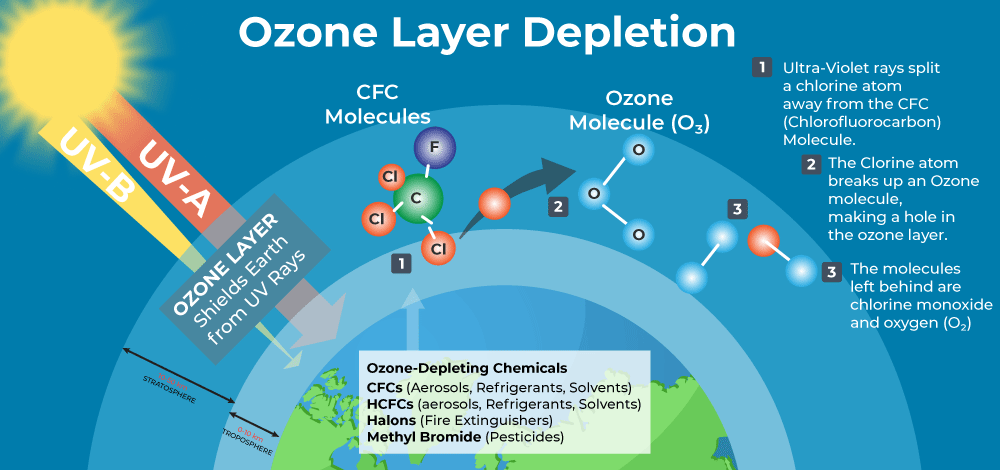
CFC molecules release chlorine atoms when broken down by UV radiation, which destroy ozone.
-
1 chlorine atom can destroy ~100,000 ozone molecules.
-
-
Halons
-
Used in fire extinguishers.
-
Contain bromine, which is 40 times more destructive to ozone than chlorine.
-
-
Carbon Tetrachloride (CCl₄) & Methyl Chloroform
-
Used as solvents and cleaning agents in industries.
-
-
Hydrochlorofluorocarbons (HCFCs)
-
Introduced as transitional substitutes for CFCs.
-
Less destructive than CFCs but still ozone-depleting.
-
-
Nitrous Oxide (N₂O) from Human Activities
-
Now considered the largest ozone-depleting emission from human activity.
-
Emitted from fertilizers, biomass burning, and industrial processes.
-
-
Improper Disposal of Electronics
-
Old refrigerators, ACs, and cooling equipment release stored ODS gases when discarded without proper recycling.
-
This is a major issue in Assam and Northeast India, where informal sectors handle e-waste.
-
Impacts of Ozone Layer Depletion
1. Human Health Impacts
-
Skin Cancer
-
Increased UV-B radiation leads to higher rates of melanoma and non-melanoma skin cancers.
-
Example: WHO estimates that a 10% decrease in ozone leads to a 4% increase in skin cancer cases worldwide.
-
Assam/Northeast: A 2021 ICMR study found the highest incidence of non-melanoma skin cancer in India in the Northeast (75.6 per 100,000 males, 43.6 per 100,000 females).
-
-
Eye Damage
-
UV rays cause cataracts, leading to blindness. WHO reports up to 15 million people worldwide suffer vision impairment due to UV exposure annually.
-
-
Immune System Suppression
-
UV radiation weakens immune response, making humans more vulnerable to infectious diseases like measles or malaria.
-
2. Agricultural Impacts
-
Crop Productivity Loss
-
UV radiation disrupts photosynthesis, reduces growth, and lowers yields in crops like rice, wheat, maize, soybean, and tea.
-
Northeast India Context: As a tea-growing hub, Assam’s economy and livelihoods suffer as UV-B levels increase further.
-
-
Nutrient Quality Decline
-
UV stress can reduce protein and nutrient content in crops, affecting food quality.
-
3. Environmental and Biodiversity Impacts
-
Forests & Terrestrial Ecosystems
-
UV rays damage sensitive plant species, reducing forest growth and affecting biodiversity.
-
-
Aquatic Ecosystems
-
Phytoplankton, the foundation of the marine food chain, are highly sensitive to UV radiation.
-
Reduced phytoplankton impacts fisheries and carbon sequestration.
-
Northeast Ecosystems: Fragile Himalayan and Northeast ecosystems are particularly at risk, as biodiversity hotspots can be destabilized.
-
4. Climate Change Linkages
-
Many Ozone-Depleting Substances (ODS) are also potent greenhouse gases (GHGs).
-
Example: CFCs are 10,000 times more powerful than CO₂ in warming potential.
-
While Hydrofluorocarbons (HFCs) (substitutes for CFCs) don’t harm ozone, they still intensify global warming.
-
Hence, ozone depletion and climate change are interconnected challenges.
5. Material and Economic Impacts
-
Material Degradation
-
UV radiation accelerates the breakdown of plastics, rubber, paints, and wood, increasing replacement costs.
-
-
Economic Burden
-
Increased healthcare costs due to cancer and cataracts.
-
Lower agricultural yields affect food security and farmers’ income.
-
Tourism sectors in sensitive regions (like Northeast’s eco-tourism) may face threats due to environmental degradation.
-

Global Efforts to Protect the Ozone Layer
1. Vienna Convention for the Protection of the Ozone Layer (1985)
-
Background: In the late 1970s, scientists (like Molina and Rowland) showed that CFCs (chlorofluorocarbons) were destroying the ozone layer.
-
Adoption: Signed in Vienna (Austria) in 1985. Entered into force in 1988.
-
Nature of Agreement: Framework convention with no binding targets, but facilitated research and cooperation.
-
Importance: Paved the way for the legally binding Montreal Protocol (1987).
-
Participation: Near-universal ratification (198 countries).
2. Montreal Protocol on Substances that Deplete the Ozone Layer (1987)
-
Adoption: Signed in Montreal, Canada (1987), effective from 1989.
-
Nature: A legally binding treaty to phase out the production and consumption of ODS.
-
Key Features:
-
Binding reduction targets.
-
Differentiated Responsibilities.
-
Adjustable Mechanism.
-
-
Achievements:
-
Global ODS consumption reduced by over 98%.
-
Ozone layer on track to recover to pre-1980 levels by 2040–2060.
-
Prevents an estimated 2 million cases of skin cancer annually worldwide.
-
-
Called the most successful environmental treaty due to universal participation and strong global cooperation.
3. Kigali Amendment to the Montreal Protocol (2016)
-
Adoption: Agreed in Kigali, Rwanda, October 2016. Came into force in 2019.
-
Purpose: Address HFCs, which do not harm ozone but are potent greenhouse gases.
-
Key Provisions:
-
Developed countries began reductions in 2019.
-
Developing countries (including India) will freeze HFC consumption by 2028 and gradually reduce.
-
Target: Cut HFC consumption by over 80% by 2047.
-
-
Expected Impact: Avoid up to 80 billion tonnes of CO₂-equivalent emissions by 2050 and prevent 0.4–0.5°C of global warming by the end of the century.
India’s Efforts in Ozone Protection
1. International Commitments
-
Vienna Convention (1985): India is a party.
-
Montreal Protocol (1987): India ratified in 1992 and met obligations ahead of schedule.
-
Kigali Amendment (2016): India ratified in 2021.
2. Institutional Framework
-
Ozone Cell (1991) under the Ministry of Environment, Forest and Climate Change (MoEFCC).
-
Coordinates with industries, state governments, and research institutions.
3. Key Policy & Regulatory Measures
-
Ozone Depleting Substances (Regulation and Control) Rules, 2000.
-
National Action Plans for ODS phase-out.
-
HCFC Phase-out Management Plan (HPMP).
-
Preparing national strategy to reduce HFC use.
4. Awareness and Industry Transition
-
Government and Ozone Cell run awareness campaigns.
-
Technical and financial support for SMEs to adopt ozone-friendly technologies.
5. Achievements
-
ODS consumption reduced by over 95%.
-
Energy efficiency improved and global recognition received.
Assam’s Efforts in Ozone Protection
1. Policy and Institutional Initiatives
-
Assam implements India’s commitments under the Montreal Protocol through state-level action plans.
-
Assam Science, Technology and Environment Council (ASTEC) is the nodal agency for creating awareness and mobilizing stakeholders.
-
The Department of Science, Technology and Climate Change coordinates with MoEFCC to implement ODS rules.
2. Awareness and Education Programmes
-
Eco Clubs in Schools and Colleges: Run by ASTEC under the National Green Corps (NGC).
-
World Ozone Day Observance: Seminars, workshops, poster competitions, and campaigns.
-
Community Outreach: NGOs and local environmental groups conduct grassroots-level awareness.
3. Regulation and Industrial Monitoring
-
ODS Monitoring: Assam government inspections ensure compliance.
-
Promotion of Ozone-Safe Refrigeration: Training workshops for AC/refrigeration technicians.
-
Industry Awareness: Encouragement to switch to HCFC-free and HFC-low alternatives.
Challenges in Ozone Protection
1. Global Challenges
-
Illegal Production and Trade of ODS.
-
Slow Recovery Timeline.
-
Emergence of Substitute Chemicals (HFCs).
-
Climate Change Linkages.
-
Developing Country Constraints.
2. National (India) Challenges
-
Informal Sector Dominance.
-
E-Waste Mismanagement.
-
Financial and Technical Gaps for SMEs.
-
Need for Safe Alternatives.
-
Awareness Deficit among small operators and farmers.
3. Assam and Northeast-Specific Challenges
-
Improper Refrigerant Disposal.
-
Cost Barriers for Small Enterprises.
-
Weak Enforcement.
-
Awareness Gaps in Rural Areas.
Proactive Measures in Ozone Layer Protection
Global-Level Measures
-
Strict Enforcement of Protocols.
-
Accelerate Kigali Commitments.
-
Strengthen Global Cooperation.
-
Integrate with Climate Action.
-
Expand Scientific Research & Monitoring.
India-Level Measures
-
Strengthen the Ozone Cell.
-
Tighten ODS Regulation Enforcement.
-
Provide subsidies/loans for SMEs and cold storage units.
-
Scale up Technician Training.
-
Create Formal E-Waste Recycling Mechanisms.
-
Promote Natural Refrigerants.
-
Public Awareness Campaigns.
Assam and Northeast-Specific Measures
-
Expand Awareness Beyond Urban Areas.
-
Special Health Interventions for UV-related diseases.
-
Support Tea Industry & Cold Storage.
-
Technician Training and Certification.
-
E-Waste Collection Drives.
-
Collaboration with Universities for local research.
Summary (For Quick Recall)
-
Enforce treaties + prevent illegal ODS trade.
-
Phase down HFCs with affordable alternatives.
-
Financial & technical support for SMEs and rural areas.
-
Formalize e-waste collection & recycling.
-
Mass awareness + technician training.
-
Assam focus: Tea sector, cold storage, high cancer vulnerability.
Conclusion
The recovery of the ozone layer is one of humanity’s greatest environmental successes, proving that global cooperation, scientific innovation, and public awareness can reverse ecological damage. Yet, challenges remain—especially in regions like Assam, where fragile ecosystems, growing electronic waste, and high cancer rates underline the urgency of action.
Protecting the ozone layer is not just a government responsibility but a collective duty. By adopting eco-friendly technologies, recycling responsibly, and spreading awareness, Assam can ensure that the blue skies above remain a shield for generations to come.
Mains Practice Question
Q. The Northeast, including Assam, reports the highest incidence of non-melanoma skin cancer in India. Evaluate the role of ozone depletion in this context.



Start Yours at Ajmal IAS – with Mentorship StrategyDisciplineClarityResults that Drives Success
Your dream deserves this moment — begin it here.