
Syllabus: GS-III & V– Biodiversity conservation, protected areas and human-wildlife conflict.
Why in the News?
Kaziranga National Park, one of Assam’s most important ecological landscapes, is facing a complex conservation challenge. Its future depends not only on protecting iconic species, but also on safeguarding its wetlands, grasslands, forests, wildlife corridors and surrounding communities.
About Kaziranga National Park
Major Rivers & Wetlands
Administrative Ranges
Major Fauna (Big Five of Kaziranga)
Other Important Species
Conservation Significance
Important Timeline
|
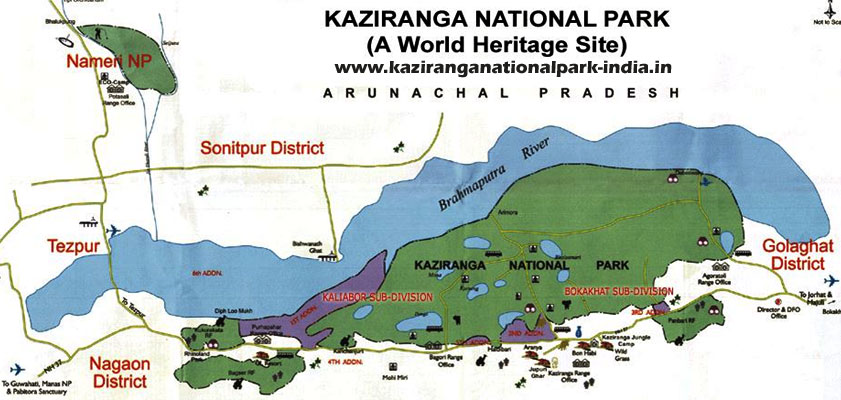
Floods: A Lifeline That Can Also Become a Threat
Flooding is a natural part of Kaziranga’s ecosystem. Seasonal floods replenish wetlands, deposit nutrient-rich sediments and help maintain the grasslands on which herbivores depend. However, extreme or prolonged flooding can create serious risks.
- Animals may be forced towards elevated areas, increasing their exposure to roads and human settlements.
- Prolonged inundation can reduce access to food and shelter and disturb breeding and feeding patterns.
- Floods can damage habitats and increase the risk of wildlife mortality when animals cannot reach safe ground.
This creates a crucial conservation lesson: floods cannot simply be “stopped” in Kaziranga because they are also ecological processes. The objective should instead be to manage extreme flood impacts while allowing natural river and wetland processes to continue.
Pollution Is a Growing Pressure
- Increasing tourism, highway traffic and development around the park can create air, noise, plastic and light pollution.
- Vehicles can generate exhaust emissions and traffic noise, while discarded plastic can enter natural habitats and water bodies.
- Artificial lighting around hotels and resorts may also disturb nocturnal wildlife.
- Pollution can affect aquatic organisms, vegetation, animal behaviour and reproductive processes, making pollution control an important part of wildlife conservation.
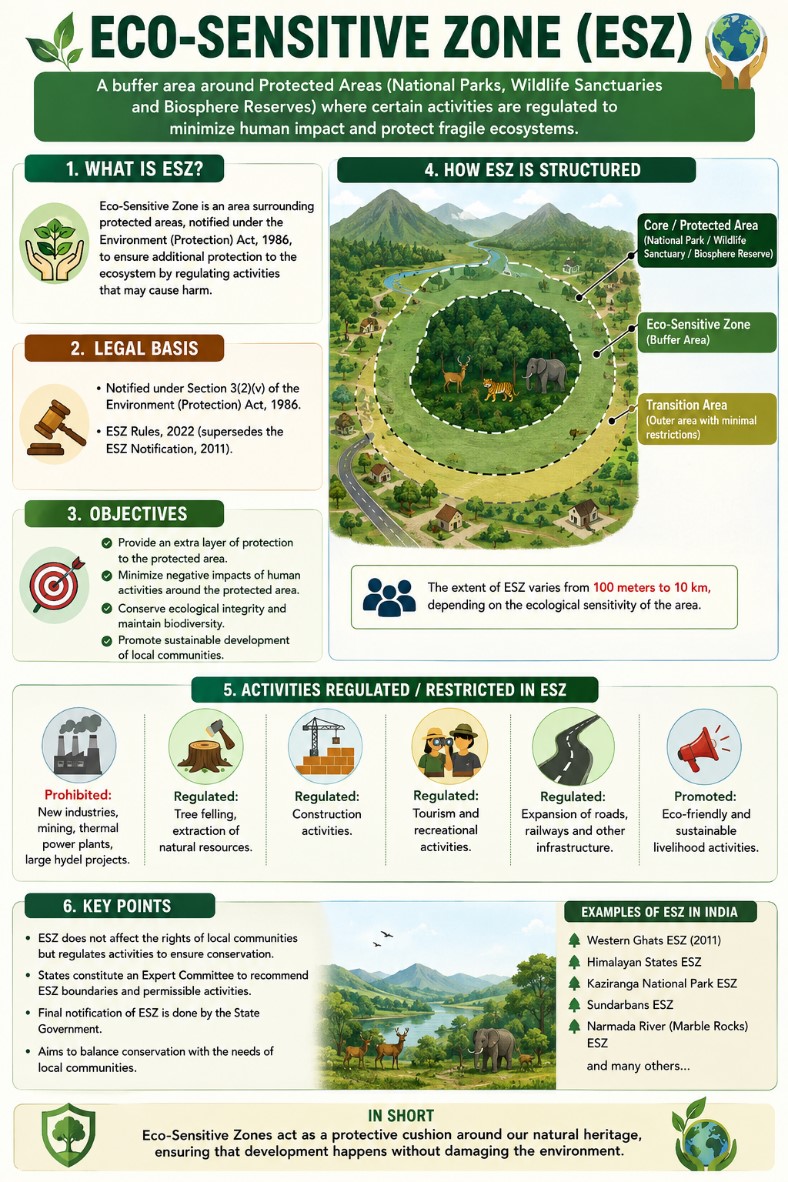
Why the Eco-Sensitive Zone Matters
- The Eco-Sensitive Zone around a protected area acts as a regulatory buffer between ecologically fragile habitats and intensive human activity.
- Under the Environment (Protection) Act, 1986, such zones can regulate or restrict activities that may harm sensitive ecosystems.
- For Kaziranga, effective management of the surrounding landscape is particularly important because wildlife does not recognise administrative boundaries.
- The focus should be on:
- Controlling unplanned construction and land conversion around critical habitats.
- Regulating tourism infrastructure so that economic activity does not cause excessive ecological disturbance.
- Protecting wildlife corridors connecting Kaziranga with the Karbi Anglong landscape.
- Involving local communities in conservation and developing environmentally responsible livelihoods.
Conservation Must Go Beyond the Park Boundary
Kaziranga’s ecological security is closely connected with its surrounding landscape. Assam has notified the Kaziranga–Karbi Anglong Elephant Reserve, highlighting the importance of maintaining connectivity between protected habitats.
A landscape-level approach should therefore combine anti-poaching, habitat management, wetland restoration, grassland management and corridor protection.
Artificial highlands can also provide animals with safer elevated areas during severe floods.
Technology and Preparedness Can Save Lives
Climate variability makes preparedness increasingly important. Authorities and communities can strengthen conservation through:
- Rainfall and river-level monitoring for early flood warnings.
- Camera traps and satellite imagery for wildlife and habitat monitoring.
- Global Positioning System telemetry to understand animal movement and identify important corridors.
- Drones and remote sensing for surveillance, habitat assessment and anti-poaching operations.
- Adequate boats, rescue equipment and trained volunteers for emergency wildlife rescue.
- Appropriate vehicle-speed regulation on roads passing through or near wildlife movement zones.
Tourism: Opportunity and Responsibility
Kaziranga has become an important tourism destination and generates economic opportunities for local communities. Assam’s tourism and conservation framework recognises the park’s importance as a major wildlife destination.
But tourism must follow the principle of responsible tourism.
The focus should be on reducing plastic waste, controlling noise and artificial lighting, promoting energy-efficient infrastructure and ensuring that local communities receive a fair share of tourism benefits.
A Collective Conservation Model
Kaziranga cannot be protected by the Forest Department alone. Forest authorities, district administration, tourism agencies, pollution-control authorities, researchers, local communities, businesses and tourists all have a role.
The larger objective should be to create a model where conservation and livelihoods reinforce each other, rather than treating people and wildlife as competing interests.
Exam Hook: Key Takeaway
Kaziranga’s conservation challenge is no longer limited to protecting animals inside the park; it requires landscape-level management of floods, pollution, corridors, tourism and community livelihoods.
Mains Question
“Conservation of Kaziranga requires managing the entire landscape rather than merely protecting the national park.” Discuss.
One-line wrap: The long-term survival of Kaziranga depends on finding a balance where rivers can flow, wildlife can move, communities can prosper and tourism can grow without destroying the ecosystem that sustains them.



Start Yours at Ajmal IAS – with Mentorship StrategyDisciplineClarityResults that Drives Success
Your dream deserves this moment — begin it here.