
Syllabus: GS–II: International Relations
Why in the news?
Bangladesh is heading for parliamentary elections amid prolonged political turmoil, the exclusion of the Awami League, the death of former Prime Minister Khaleda Zia, and the return of Tarique Rahman to active politics—developments with direct implications for India, especially the Northeast.
A critical election after political upheaval
Bangladesh is preparing for one of its most consequential elections since 1991. After nearly 18 months of unrest, marked by political violence and attacks on minorities—particularly Hindu communities—the country’s Election Commission has barred the Awami League from contesting.
This is unprecedented. The Awami League, which led the 1971 Liberation War under Sheikh Mujibur Rahman, has been a central force in Bangladeshi politics for decades. Under Sheikh Hasina, it secured steadily rising vote shares, touching 48 % in 2024. Its absence has created a political vacuum with wide regional consequences.
The rise of the Bangladesh Nationalist Party
The main contender now is the Bangladesh Nationalist Party. The recent passing away of Khaleda Zia, Bangladesh’s first woman Prime Minister, has reshaped party dynamics. Her son, Tarique Rahman, has returned after 17 years in exile and is leading the campaign.
- Historically, the BNP was seen as less minority-friendly and inclined towards political Islam.
- Under Tarique Rahman, the party is repositioning itself as more moderate and pragmatic, appealing to both centrist voters and sections uneasy with radical forces.
In the absence of the Awami League, the BNP is increasingly viewed as the only viable national alternative, including from India’s strategic perspective.
Jamaat-e-Islami and the Islamist question
The BNP has broken its alliance with Jamaat-e-Islami, a party with a controversial legacy. Jamaat leaders were accused of collaborating with the Pakistani Army in 1971, and several were later tried by war crimes tribunals.
Jamaat has now aligned with the National Citizens Party, an offshoot of recent protests that led to Sheikh Hasina’s exit. However, early indications suggest that:
- Jamaat may have overestimated its mass appeal.
- The BNP, riding on sympathy after Khaleda Zia’s death and Tarique Rahman’s return, is emerging as the frontrunner.
Jamaat has accused the interim government led by Muhammad Yunus of favouring the BNP, raising concerns about the fairness of the electoral environment.
Why Bangladesh matters deeply to India
The outcome of these elections is strategically crucial for India.
- Minority security: Hindus form nearly 8 % of Bangladesh’s population, around 13 million people. Their safety and political space are a key Indian concern.
- Economic ties: Bangladesh is a major trading partner. India exports cotton, petroleum products, vehicles, engineering goods, chemicals and food items, earning significant foreign exchange.
- Geopolitics: A hostile regime in Dhaka could tilt towards Pakistan and China, altering the regional balance in South Asia.
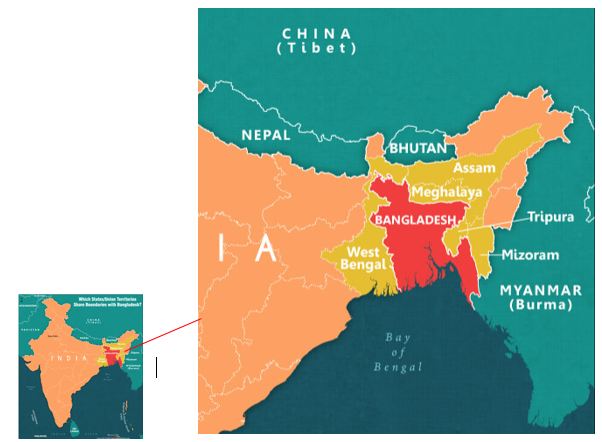
- Northeast security: A non-cooperative Bangladesh may once again become a sanctuary for extremist and separatist groups, threatening peace in Assam and the wider Northeast.
- Migration pressures: Political instability could worsen illegal migration, a long-standing and sensitive issue for Assam.
Humanitarian and strategic spillovers
Over 9,000 Indian medical students currently studying in Bangladesh face serious uncertainty about safety and continuity of education. For India, instability in Bangladesh is not a distant foreign issue—it has direct human, economic and security costs.
India’s dilemma lies in balancing principles and pragmatism:
- Open support for Sheikh Hasina is no longer feasible.
- A “soft Islamic but pragmatic state” led by the BNP may be seen as a less risky option than hardline Islamist forces.
India is therefore likely to pursue quiet diplomacy, focusing on stability, minority protection and continuity in bilateral cooperation rather than overt political alignment.
About Bangladesh
|
Conclusion
Bangladesh stands at a crossroads, and so does India’s neighbourhood policy. The February elections will determine whether Dhaka moves towards relative moderation or deeper uncertainty. For India, especially Assam and the Northeast, the stakes are extraordinarily high. Diplomatic finesse, constant monitoring and strategic patience will be essential as India navigates this evolving and delicate situation.
Exam Hook
Mains :
“Political instability in Bangladesh has direct implications for India’s security, economy and neighbourhood policy.” Discuss in the context of the upcoming Bangladesh parliamentary elections and India’s strategic interests.



Start Yours at Ajmal IAS – with Mentorship StrategyDisciplineClarityResults that Drives Success
Your dream deserves this moment — begin it here.