
Syllabus: GS-II & V: Bilateral Relations
Why in the News?
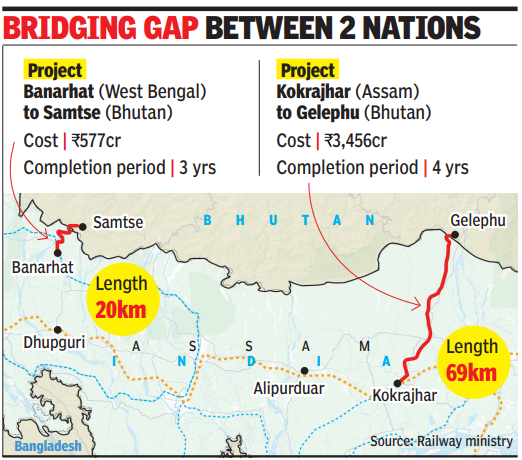
India has announced its first-ever cross-border railway links with Bhutan through the Kokrajhar–Gelephu line (Assam) and Banarhat–Samtse line (West Bengal), worth ₹4,033 crore, aimed at boosting connectivity, trade, tourism, and strategic ties.
Key Details of the Rail Projects
- Kokrajhar–Gelephu Line: 70 km, 6 stations, ~100 bridges; connects Bodoland to Bhutan’s Gelephu Economic Hub.
- Banarhat–Samtse Line: 20 km, 2 stations, ~25 bridges; links WB with Bhutan’s industrial hub in Samtse.
- Bhutanese segments (~2 km each) funded by India under ₹10,000 crore aid for Bhutan’s 13th Plan.
- Indian Railways to construct Indian side; coaches manufactured under Make in India.
- Modern features: electrification, signalling, Vande Bharat-compatible; passenger + freight use.
Bhutan’s Gelephu Economic Hub
- Planned as an autonomous economic hub with legislative, executive, and judicial powers.
- Focus sectors: green industries, IT, wellness tourism, education, sustainable manufacturing.
- 7,000+ volunteers engaged in shaping infrastructure.
- Strategic goal: connect with Indian ports, transit to Nepal & Bangladesh, become a South Asian/global investment hub.
Benefits for Assam
- Trade & Logistics: Assam as gateway for Bhutanese exports (hydropower, agro-products, handicrafts) and imports.
- Tourism Synergy: Kaziranga, Manas, Bodoland linked with Bhutan’s eco-cultural circuits.
- Employment & Skills: Jobs in logistics, transport, IT, hospitality; training in renewable energy and eco-tourism.
- Strategic Edge: Counters Chinese influence, strengthens Act East Policy by linking with Bangladesh, Nepal, SE Asia.
Challenges
- Land acquisition and ecological clearances in fragile foothills.
- Need for inclusive planning with BTC and local communities.
- Border security management at new ICPs.
Broader India–Bhutan Relations (Assam’s Role)
- Historical & Cultural: Deep civilizational ties; Assam’s 267 km border is traditional trade route.
- Economic: India ≈84% of Bhutan’s trade; Assam hubs (Guwahati, Kokrajhar) key for cement, dolomite, hydropower exports.
- Connectivity: Rail links + roads + ICPs strengthen cross-border ties.
- Energy: Assam as corridor for Bhutanese hydropower to Indian grid.
- Security: Joint operations against insurgents; border coordination crucial.
- Tourism & Culture: Bhutanese tourists visit Kaziranga, Kamakhya; Assam is cultural bridge to India.
Way Forward
- Adopt Bhutan’s community-participation model in Assam’s development.
- Develop industrial/logistics clusters in Kokrajhar, Chirang, Baksa.
- Create border haats and eco-tourism circuits with joint branding “Assam–Bhutan Gateway”.
- Ensure strong environmental safeguards for rail and industrial growth.
Conclusion
The India–Bhutan railway projects are transformative corridors linking Assam with Bhutan’s Gelephu hub and global markets. By combining trade, sustainability, and people’s participation, Assam can cement its role as the gateway to Bhutan and a pillar of India’s Act East Policy.
Mains Question
“The proposed India–Bhutan rail links are being seen as a transformative corridor for Assam’s economy. Discuss the opportunities and challenges this connectivity project presents in the context of Bhutan’s Gelephu Economic Hub.” (250 words)



Start Yours at Ajmal IAS – with Mentorship StrategyDisciplineClarityResults that Drives Success
Your dream deserves this moment — begin it here.