
How ‘Hybrid Terrorism’ is Testing Security Forces in Kashmir
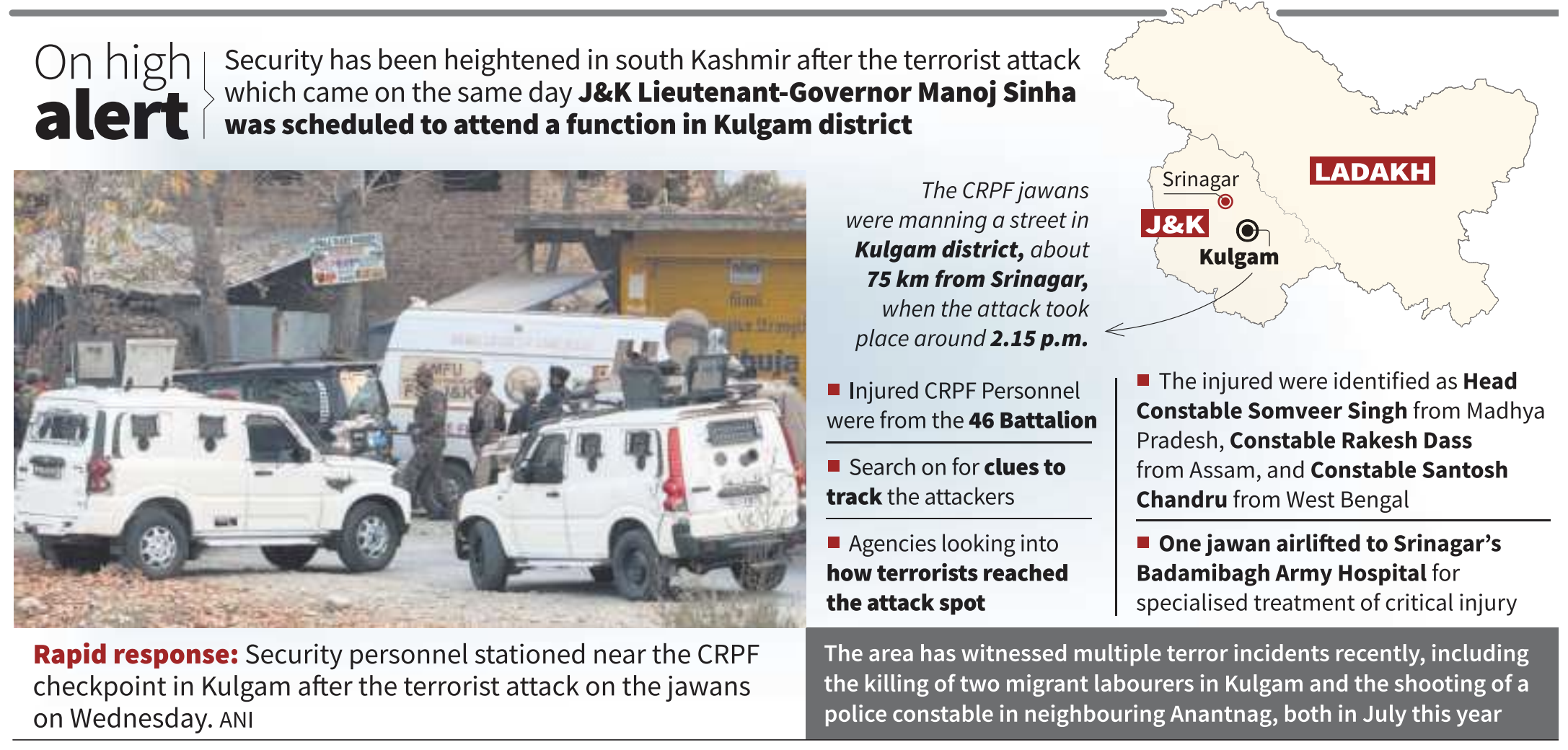
1. The Hit-and-Run in Kulgam
In a brazen daytime attack, terrorists opened fire on CRPF personnel from the 46 Battalion conducting routine checking in south Kashmir’s Kulgam district, critically injuring jawans from Madhya Pradesh, Assam, and West Bengal.
- A Pattern of ‘Soft Targets’: This wasn’t an isolated incident. Recently, south Kashmir has seen a disturbing trend of targeted killings focusing on vulnerable, unarmed people—including the tragic shooting of migrant labourers in Kulgam and an off-duty local policeman in Anantnag.
- The ‘Free Hand’ Response: Following the attack, J&K Lieutenant-Governor Manoj Sinha assured the public that security forces have been given a “free hand.” In security terms, this means the military and police have the political green light to hunt down terror networks aggressively, backed by laws like the Armed Forces (Special Powers) Act (AFSPA).
2. Understanding ‘Hybrid Terrorism’
The security grid has successfully eliminated many traditional, high-profile militant commanders. In response, terror handlers across the border have changed their strategy.
- The Part-Time Terrorist: A “hybrid terrorist” is often an unlisted, radicalized youth with no previous police record. They are handed a pistol, ordered to assassinate a specific target, and then seamlessly melt back into normal life as a student or shopkeeper. Because they aren’t on any police radar, they are incredibly hard to track.
- The Checkpoint Trap: Static checkpoints (nakas) are vital for stopping the movement of weapons, but standing in one spot on a busy street leaves jawans exposed. Attackers often use a crowded market, slip in on a motorcycle, fire at close range, and use the panicked civilian crowd as a shield to escape.
3. How the Security Grid Must Adapt
To fight a faceless enemy, security forces are rethinking how they operate on the streets.
- Upgrading the Shield: Sandbag bunkers are being replaced with bulletproof Mobile Bunker Vehicles (MBVs) and high-resolution body cameras. This allows forces to dominate areas without sitting like ducks on open roads.
- Hunting the Helpers: A hybrid terrorist cannot strike without a local Over Ground Worker (OGW) who scouts the target, provides the weapon, and arranges the getaway bike. Central intelligence is aggressively mapping and arresting these OGWs to cut off the tactical oxygen that keeps terrorism alive.
As terrorism in Kashmir morphs from prolonged gunfights into swift, cowardly assassinations, the security response must also evolve. Defeating hybrid terror requires moving beyond just guns on the street—it requires flawless local intelligence and community trust to identify radicalized youth before they pull the trigger.
Mains Practice Question
“The rise of ‘hybrid terrorism’ and targeted killings in Jammu & Kashmir has shifted the security challenge from conventional counter-insurgency to complex urban policing.” In this context, discuss how the multi-agency security grid should recalibrate its intelligence and operational tactics. (15 marks · 250 words)
Introduction: Define “hybrid terrorism”—unlisted, radicalized individuals carrying out targeted hit-and-run attacks (like the Kulgam CRPF attack or killings of migrant labourers) and blending back into civilian life.
Body Part 1 (The Changing Nature of the Threat): Explain why static checkpoints (nakas) are vulnerable. Highlight how handlers use Over Ground Workers (OGWs) to scout soft targets, creating a climate of fear without engaging in traditional, prolonged forest gunfights.
Body Part 2 (Recalibrating Tactics): Suggest solutions: shifting from purely technical intelligence (TECHINT) to deeper human intelligence (HUMINT) by engaging the local community. Discuss modernizing SOPs with Mobile Bunker Vehicles (MBVs), CCTV/drone integration, and giving the NIA a stronger role in dismantling terror financing and OGW networks.
Conclusion: Conclude that defeating a faceless enemy requires a balance—maintaining strong area domination (“free hand” to forces) while ensuring community outreach to prevent the radicalization of youth.



Start Yours at Ajmal IAS – with Mentorship StrategyDisciplineClarityResults that Drives Success
Your dream deserves this moment — begin it here.