
Syllabus GS-II & V– International Relations
Why in the News?
India–Bhutan trade is expanding rapidly, while Assam is emerging as an important alternative gateway to Bhutan alongside the traditional Jaigaon–Phuentsholing route in West Bengal.
Bilateral trade crossed US$1.9 billion in 2024–25, registering more than 46% growth over the previous year. India continues to account for around 80% of Bhutan’s total trade.
The growing importance of Gelephu in southern Bhutan, especially the proposed Gelephu Mindfulness City, makes Assam’s border infrastructure increasingly significant.
India–Bhutan Trade
India and Bhutan have a long-standing economic relationship based on the Agreement on Trade, Commerce and Transit.
- The agreement provides for free trade between India and Bhutan, with no basic customs duty on imports from or exports to Bhutan.
- It also provides transit facilities to landlocked Bhutan for trade with third countries.
- Trade is conducted in Indian Rupees and Bhutanese Ngultrum.
The institutional relationship is strengthened through the Commerce Secretary Level Meeting and the Joint Group of Customs, where both countries discuss customs procedures, border infrastructure, transit cargo and trade facilitation.
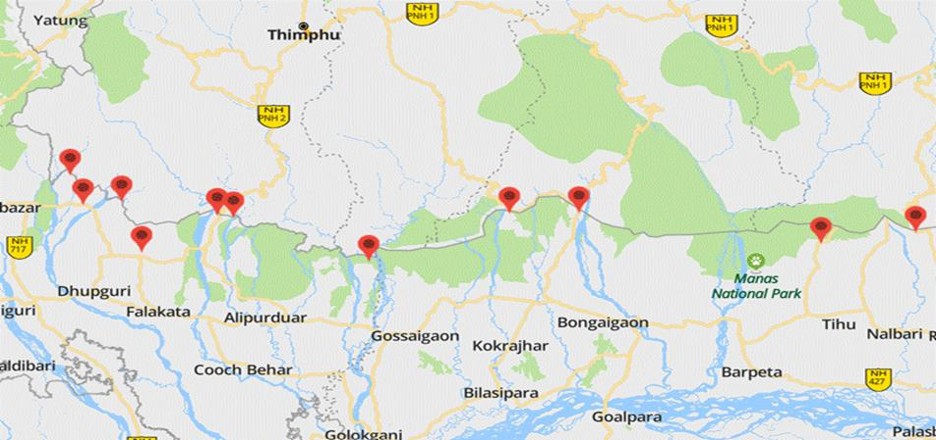
Why Assam Is Becoming Important
For decades, Jaigaon in West Bengal has been the principal land gateway to Bhutan. However, increasing trade has created a need for multiple and efficient trade corridors.
Assam has a 267-kilometre border with Bhutan, providing a natural geographical advantage. Its emerging trade points include Darranga and Hatisar, while newer connectivity initiatives are expanding the network.
The Darranga Land Port is particularly important. It is only about 700 metres from the Bhutan border and was taken over by the Land Ports Authority of India in 2024. Its recorded trade increased sharply from about ₹188 crore in 2024–25 to ₹1,457 crore in 2025–26.
Darranga shows how a border crossing can become an economic corridor.
- Darranga has been designated as an additional route for certain areca nut imports from Bhutan.
- It has also been designated as an additional entry point for food imports from Bhutan.
- An Immigration Check Post has strengthened the movement of people.
- Phyto-sanitary inspection facilities are being strengthened to support agricultural trade.
Gelephu Mindfulness City: The New Economic Driver
The emergence of Gelephu Mindfulness City gives Assam’s border connectivity a new economic dimension.
Gelephu is located in southern Bhutan, close to Assam, and is being developed as a new economic and investment centre.
This can create demand for:
- Construction materials and engineering products from Assam.
- Food, agricultural and processed products from the Northeast.
- Warehousing, logistics and transport services.
- Tourism, hospitality and professional services.
- Banking, education and other higher-order services from cities such as Guwahati.
Thus, Assam’s opportunity is not merely to transport Bhutan-bound goods, but to participate in the value chain created around Gelephu.
Kokrajhar–Gelephu Railway: A Major Connectivity Link
A major proposed development is the 69-kilometre Kokrajhar–Gelephu railway link.
Under the India–Bhutan intergovernmental understanding signed in September 2025, India and Bhutan agreed to develop the Kokrajhar–Gelephu and Banarhat–Samtse railway links, with a combined estimated cost of about ₹4,033 crore.
For Assam, this could:
- Provide Bhutan with direct access to India’s railway network.
- Reduce transportation costs and improve freight movement.
- Strengthen Kokrajhar and neighbouring areas as logistics and industrial centres.
- Connect the Bhutanese economy more closely with India’s wider market.
The Multimodal Advantage of Assam
Assam’s advantage is not based on a single road or railway. It lies in the possibility of combining road, rail and inland waterways.
The Jogighopa Inland Waterway Terminal, inaugurated in January 2025, adds another layer to this network. Together with National Highway 27, the proposed railway connection and the state’s land ports, Assam can potentially provide Bhutan with access to a multimodal logistics network.
This is important because Bhutan is landlocked. Efficient access to external markets therefore depends heavily on reliable transit infrastructure through neighbouring countries.
Relevant Government Frameworks
1. Agreement on Trade, Commerce and Transit
This provides the basic framework for free trade and transit connectivity between India and Bhutan.
2. Act East Policy
Better connectivity through Assam can strengthen India’s wider economic links with Bangladesh and Southeast Asia, making the Northeast an important gateway rather than a peripheral region.
3. Neighbourhood First Policy
Bhutan is an important neighbour for India, and improved connectivity supports India’s objective of strengthening economic and people-to-people relations with neighbouring countries.
4. Land Ports Authority of India
The authority develops and manages modern land-border infrastructure to improve trade facilitation, passenger movement and border management. Darranga is an important example on the India–Bhutan border.
5. Joint Group of Customs
The Joint Group of Customs provides an institutional platform for India and Bhutan to address customs cooperation, digitisation, coordinated border management and movement of transit cargo. In its April 2026 meeting, both countries discussed pre-arrival exchange of customs data, electronic cargo tracking and streamlined customs procedures.
What Does This Mean for Assam?
The opportunity extends beyond border trade.
Assam can potentially develop an economic ecosystem around the Bhutan corridor.
- Border districts such as Kokrajhar, Chirang and Bongaigaon can develop logistics, warehousing, hospitality and manufacturing activities.
- Agricultural producers can access new markets for processed food, fruits, vegetables and other products.
- Small and medium enterprises can become suppliers of construction materials, furniture, engineering products and services.
- Guwahati can function as a higher-order centre for banking, healthcare, education, technology and professional services.
However, infrastructure alone will not create these benefits. Assam would need efficient customs procedures, industrial land, warehouses, cold chains, skilled workers and reliable last-mile connectivity.
Exam Hook: Key Takeaway
The India–Bhutan trade corridor is gradually moving from a single dominant gateway towards a more diversified network, with Assam gaining importance through Darranga, Hatisar, Kokrajhar–Gelephu railway connectivity and multimodal infrastructure.
Mains Question
How can Assam’s emerging connectivity with Bhutan transform the Northeast from a peripheral region into a gateway for regional trade?
One-line wrap: The emerging Assam–Bhutan corridor shows how border connectivity can move beyond security and transit to create manufacturing, logistics, employment and regional economic opportunities.



Start Yours at Ajmal IAS – with Mentorship StrategyDisciplineClarityResults that Drives Success
Your dream deserves this moment — begin it here.