
Syllabus: GS Paper III & V– Agriculture, Inclusive Growth, Infrastructure
Why in the News?
The Asian Development Bank (ADB) has approved a USD 42.2 million Small Expenditure Financing Facility (SEFF) to strengthen the bamboo industry in six Northeastern states. The initiative aims to boost rural livelihoods, promote women-led enterprises, strengthen value chains, and reduce India’s dependence on imported bamboo products.
Why is this important?
- The North-East accounts for nearly 60% of India’s bamboo resources, making it the country’s bamboo hub.
- Despite this natural advantage, the region has been unable to fully benefit due to weak processing facilities, poor market linkages, limited value addition, and inadequate investment.
- The new ADB assistance seeks to transform bamboo from a traditional forest resource into a modern green industry.
About the ADB Bamboo Development Project
- Asian Development Bank (ADB) is providing a USD 42.2 million loan under the Small Expenditure Financing Facility (SEFF).
- The project covers Assam, Manipur, Meghalaya, Mizoram, Nagaland and Tripura.
- It is aligned with the National Bamboo Mission under the Ministry of Agriculture and Farmers’ Welfare.
- The project will finance multiple community-based sub-projects for bamboo cultivation, processing and marketing.
- It aims to build private sector-led bamboo value chains that encourage investment, exports and employment.
Major Objectives of the Project
- Increase bamboo cultivation using scientific management and sustainable harvesting practices.
- Promote bamboo-based industries through better processing and value addition.
- Generate rural employment and diversify farmers’ income beyond climate-sensitive crops.
- Reduce imports of bamboo products by strengthening domestic production.
- Improve market access through digital value chains and better infrastructure.
- Strengthen institutional capacity of bamboo-related agencies and technical institutions.
Key Components of the Initiative
- Community-based bamboo resource management will improve sustainable utilisation of bamboo forests.
- Bamboo resource mapping using modern technologies will help identify production potential.
- Research, training and skill development will enhance productivity and entrepreneurship.
- Digital value chain solutions will improve market information, traceability and supply chain efficiency.
- Access to finance will be expanded for bamboo entrepreneurs and private investors.
- Project planning and procurement systems will be strengthened for efficient implementation.
Focus on Women Empowerment
A unique feature of the project is its emphasis on gender-inclusive development.
- Women will be encouraged to participate across the bamboo value chain, from cultivation to marketing.
- At least one women-led bamboo manufacturing facility will be established in each participating state.
- The project aims to increase women’s entrepreneurship, employment and financial independence.
About the National Bamboo Mission
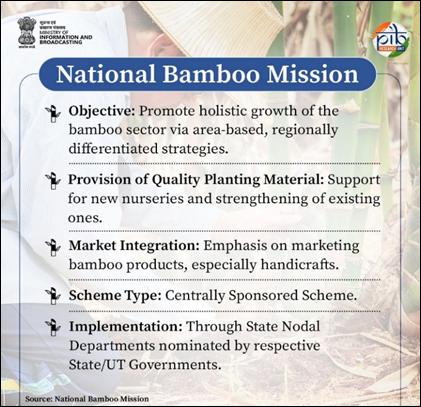
- Launched: Originally in 2006–07; restructured in April 2018.
- Approved by: Cabinet Committee on Economic Affairs (CCEA).
- Ministry: Ministry of Agriculture and Farmers’ Welfare.
- Type: Centrally Sponsored Scheme (CSS).
- Implementation: Through State Bamboo Missions/State Bamboo Development Agencies under the designated State/Union Territory nodal departments.
- Coverage: Currently implemented in 24 States and Union Territories.
- Objectives:
- Promote holistic development of the bamboo sector through an area-based and region-specific strategy.
- Increase the area under bamboo cultivation, especially with quality and commercially suitable species.
- Improve the availability of quality planting material by establishing new nurseries and strengthening existing ones.
- Support primary processing, treatment and value addition to make Indian bamboo products competitive in domestic and global markets.
- Strengthen marketing and branding of bamboo products, particularly handicrafts and value-added products.
- Enhance farmers’ income, generate rural employment and encourage private investment in the bamboo value chain.
- Key Features
- Supports bamboo cultivation outside forest areas.
- Promotes nursery development for quality seedlings.
- Encourages processing units, treatment facilities and value-addition centres.
- Facilitates market linkages through branding, exhibitions and trade promotion.
- Provides financial assistance to eligible beneficiaries through State Bamboo Missions.
Why is Bamboo Important?
- India possesses nearly 39% of the world’s bamboo-growing area, yet the bamboo processing industry remains underdeveloped.
- The North-East has abundant bamboo resources suitable for construction, furniture, handicrafts, paper, textiles, bioenergy and engineered bamboo products.
- Bamboo is often called “Green Gold” because it grows rapidly, regenerates naturally and absorbs significant amounts of carbon dioxide.
- It supports the objectives of sustainable development, climate resilience, and the green economy.
Challenges Facing the Bamboo Sector
- Limited processing infrastructure results in low value addition.
- Weak market connectivity reduces farmers’ profitability.
- Inadequate access to finance discourages private investment.
- Poor quality planting material affects productivity.
- Fragmented supply chains limit competitiveness in global markets.
Way Forward
- Develop integrated bamboo clusters connecting farmers, industries and exporters.
- Promote bamboo-based Micro, Small and Medium Enterprises through easier credit and skill development.
- Expand research and innovation in engineered bamboo and sustainable products.
- Improve logistics, storage and export infrastructure under the Act East Policy.
- Strengthen Farmer Producer Organisations and cooperatives to enhance bargaining power and market access.
- Integrate bamboo development with rural livelihood programmes and climate action strategies.
Important Terms Explained
- Asian Development Bank (ADB): A multilateral development bank established in 1966 that promotes sustainable economic growth in Asia and the Pacific.
- Small Expenditure Financing Facility (SEFF): An ADB financing mechanism that supports multiple small-scale development projects through a single loan framework.
- National Bamboo Mission: A Central Government scheme aimed at promoting bamboo cultivation, processing and marketing across India.
- Bamboo Value Chain: The complete process covering cultivation, harvesting, processing, manufacturing, marketing and exports.
- Value Addition: Converting raw bamboo into higher-value products such as furniture, flooring, handicrafts and engineered wood.
Exam Hook
Key Takeaways
- ADB approved a USD 42.2 million loan for bamboo development in the North-East.
- Six states—Assam, Manipur, Meghalaya, Mizoram, Nagaland and Tripura—will benefit.
- The project is aligned with the National Bamboo Mission.
- Each participating state will establish at least one women-led bamboo manufacturing unit.
- The initiative aims to strengthen rural livelihoods, private investment, exports and sustainable development.
Mains Question
“Discuss the role of the bamboo sector in promoting sustainable rural livelihoods and green economic growth in India’s North-Eastern Region. Examine how initiatives such as the National Bamboo Mission and multilateral financing can transform the sector.” (250 words)
One-Line Wrap
The ADB-supported bamboo initiative has the potential to transform the North-East into India’s bamboo economy hub by combining sustainable resource management, women-led entrepreneurship, private investment and value-added industries.



Start Yours at Ajmal IAS – with Mentorship StrategyDisciplineClarityResults that Drives Success
Your dream deserves this moment — begin it here.