
Despite recording its highest-ever production, Assam’s famous GI-tagged Tezpur Litchi has become significantly expensive this season due to rising domestic and international demand, particularly from export markets such as Dubai and Singapore.
About Assam’s GI-Tagged Tezpur Litchi
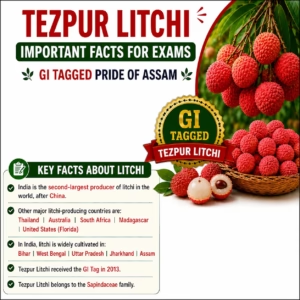
Tezpur Litchi is one of Assam’s most celebrated horticultural products, renowned for its exceptionally sweet taste, bright-red skin, juicy translucent pulp, delicate aroma and superior quality. It is considered one of the finest litchi varieties produced in India.
- Tezpur Litchi received the Geographical Indication (GI) Tag in 2013, recognising and protecting its unique geographical identity and distinctive characteristics.
- The fruit is primarily cultivated in Sonitpur district and neighbouring areas of Assam, particularly around Tezpur, which is regarded as the state’s litchi hub.
- Popular varieties grown in the region include Bombaya, Bilati, Elaichi, Piyaji and Sahi.
- The history of Tezpur’s litchi cultivation dates back to 1923, when noted Assamese litterateur and former Tezpur Municipality Chairman Padmanath Gohain Baruah established organised litchi orchards in the town.
- The fertile alluvial soil of the Brahmaputra Valley, favourable subtropical climate, adequate rainfall and suitable temperature conditions provide an ideal environment for high-quality litchi cultivation.
- However, irregular rainfall, rising temperatures, prolonged dry spells and extreme weather events linked to climate change are increasingly affecting flowering, fruit setting and overall productivity.
- The Agricultural and Processed Food Products Export Development Authority facilitated the first international export consignment of Tezpur Litchi to Dubai and Singapore, opening new opportunities for global market expansion.
- Today, Tezpur Litchi has emerged as an important agricultural export product of Assam, contributing to horticultural diversification, rural livelihoods and the state’s growing agri-export economy.
Key Highlights
- Assam produced about 62,755 tonnes of litchi in 2025, compared to 51,206 tonnes in 2024, marking the highest production recorded in the state.
- Assam ranks among India’s major litchi-producing states after Bihar, West Bengal, Jharkhand and Punjab.
- Large-scale exports to international markets have increased demand and significantly pushed up local prices.
- Retail prices in some markets have reached as high as ₹1,800 per kilogram, transforming the fruit into a premium commodity.
Significance of Tezpur Litchi
- It enhances farmers’ income through premium pricing and export opportunities.
- It strengthens Assam’s horticultural economy and agricultural exports.
- It promotes brand recognition of Assam’s agricultural products in global markets.
- It supports rural livelihoods and value-chain development.
Challenges
- Rising exports have reduced local affordability despite record production.
- Farmers require better cold storage, processing facilities and export infrastructure to maximise benefits.
- Price volatility may affect local consumer access to the fruit.
Exam Hook – Prelims Question
Q. With reference to Geographical Indication (GI) Tags, consider the following statements:
- A GI Tag is granted to products whose qualities are linked to a specific geographical region.
- GI Tags in India are governed by the Geographical Indications of Goods (Registration and Protection) Act, 1999.
- A GI Tag can only be granted to agricultural products.
Which of the statements given above are correct?
(a) 1 and 2 only
(b) 2 and 3 only
(c) 1 and 3 only
(d) 1, 2 and 3
Answer: (a)
One-Line Wrap
Tezpur Litchi showcases how a GI-tagged agricultural product can boost exports, farmer incomes and Assam’s global agricultural identity.



Start Yours at Ajmal IAS – with Mentorship StrategyDisciplineClarityResults that Drives Success
Your dream deserves this moment — begin it here.