
Syllabus: GS – III & V: Border Management
Why in the News?
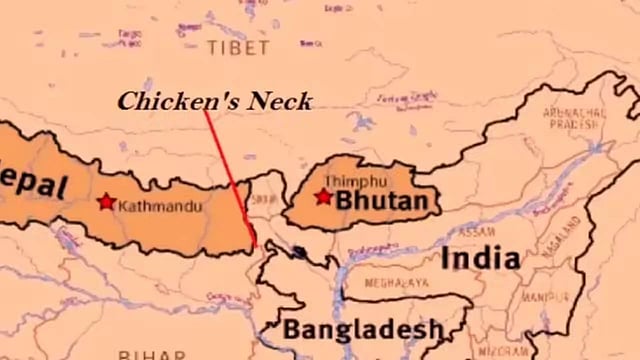
The Siliguri Corridor, popularly called the Chicken’s Neck Corridor, has once again drawn attention in strategic discussions due to growing geopolitical tensions, border infrastructure development, and concerns over connectivity to the Northeast. Security experts frequently highlight its vulnerability because this narrow land strip is the only land link between mainland India and the eight Northeastern states.
What is the Chicken’s Neck Corridor?
- The Siliguri Corridor is a narrow stretch of land in northern West Bengal connecting the Northeast region with the rest of India.
- It is approximately 22 kilometres wide at its narrowest point.
- The corridor is surrounded by Nepal in the west, Bhutan in the north, and Bangladesh in the south, making it geopolitically sensitive.
- It is centred around the city of Siliguri, an important transportation and trade hub.
The corridor became strategically important after the Partition of India in 1947, when the creation of East Pakistan (now Bangladesh) separated the Northeast from mainland India.
Strategic and Military Significance
The corridor is considered a critical strategic lifeline for India.
- If this narrow passage is blocked during a conflict, the entire Northeast could be cut off from the mainland.
- This would disrupt military logistics, troop movement and supply chains.
- Essential supplies such as food, fuel, medicines and equipment would face severe shortages in the region.
A major concern for India comes from the Chumbi Valley, a narrow wedge of land in Tibet controlled by China, located close to the corridor between Sikkim and Bhutan. Chinese infrastructure development in this region, including roads, tunnels and air bases, has heightened strategic concerns.
Key Security Challenges
The corridor faces multiple security and internal challenges:
- Border vulnerabilities due to proximity to three international borders.
- Illegal infiltration and smuggling across open borders with Nepal and Bangladesh.
- Drug trafficking and human trafficking networks operating in the region.
- Possible use of the corridor by insurgent groups for movement of arms and personnel.
Ensuring security here requires strong coordination between the Army, border guarding forces and local police agencies.
Economic Importance for the Northeast
The Chicken’s Neck Corridor is the economic lifeline of Northeast India.
- Most goods entering or leaving the region pass through this route.
- Important commodities such as Assam’s tea, petroleum, timber and agricultural products travel through this corridor to reach national markets.
- Similarly, essential supplies such as food grains, industrial goods and consumer products reach the Northeast through this route.
Any disruption in the corridor could lead to economic instability and supply shortages in the region.
Efforts to Reduce Strategic Vulnerability
Recognising the risks of overdependence on a single corridor, India has adopted several initiatives.
- The Act East Policy aims to strengthen connectivity between Northeast India and Southeast Asia.
- The PM Gati Shakti National Master Plan promotes integrated infrastructure development including highways, railways and logistics networks.
- The India–Bangladesh transit agreement allows movement of goods through Bangladesh’s road and inland waterway networks.
- Access to Chattogram and Mongla ports in Bangladesh has provided alternative trade routes.
- The Kaladan Multi Modal Transit Transport Project connects Mizoram with Myanmar’s Sittwe port, reducing dependence on the corridor.
Large infrastructure projects such as the Bogibeel Bridge and the Bhupen Hazarika Bridge have also improved connectivity and military mobility within the Northeast.
Important Terms Explained
- Siliguri Corridor: The narrow land passage linking mainland India with the Northeast.
- Chumbi Valley: A strategic valley in Tibet near the borders of Sikkim and Bhutan where China maintains military presence.
- Act East Policy: India’s strategic initiative to strengthen economic and strategic ties with Southeast Asia through the Northeast.
- Kaladan Multi Modal Transit Transport Project: A connectivity project linking India with Myanmar through sea, river and road routes.
- Transit Agreement with Bangladesh: A bilateral arrangement allowing India to transport goods to the Northeast through Bangladesh.
Way Forward
To strengthen this strategic corridor, experts recommend:
- Enhanced border surveillance using drones, satellites and artificial intelligence systems.
- Improvement of railway and highway capacity to enable faster military movement.
- Integrated security command involving the Army, border guarding forces and local administration.
- Socio-economic development of local communities to ensure stability and cooperation in security efforts.
- Climate-resilient infrastructure to address natural disasters such as floods and landslides.
Transforming the corridor into a robust connectivity hub rather than a vulnerability is essential for India’s long-term strategic stability.
Exam Hook
Key Takeaways
- The Siliguri Corridor is the only land connection between mainland India and the Northeast.
- Its geographical narrowness makes it strategically vulnerable.
- Infrastructure development and regional connectivity projects are reducing dependence on a single route.
- Security of the corridor requires military preparedness, diplomatic engagement and regional development.
Mains Question
Discuss the strategic importance of the Siliguri Corridor for India’s national security and connectivity with the Northeastern region.
One-Line Wrap
The Chicken’s Neck Corridor remains one of India’s most sensitive strategic lifelines, where geography, security, and connectivity converge to shape the future of the Northeast.



Start Yours at Ajmal IAS – with Mentorship StrategyDisciplineClarityResults that Drives Success
Your dream deserves this moment — begin it here.