Economy, Social Issues, Indian Society, Employment & Labour Policies, Current Affairs, and Gender Studies.
What the latest numbers say
- India’s overall unemployment rate for people aged 15 years and above fell to 5.1 percent in August, the lowest in five months.
- The fall came mainly from rural areas and among men.
- Inside the headline, there is a worry: female youth unemployment (15–29 years) increased.
- Urban young women: about 25.7 percent unemployed.
- Rural young women: about 14.3 percent unemployed.
- Urban young men: eased to roughly 15–16 percent.
- Urban young women: about 25.7 percent unemployed.
- The labour market therefore shows two tracks: overall improvement, but young women—especially in cities—are not benefitting equally.
Key ideas and definitions
- Working-age population: People old enough to work (in India, usually 15 years and above).
- Labour force: People who are either working or looking for work.
- If you are studying and not seeking work, you are outside the labour force.
- If you are studying and not seeking work, you are outside the labour force.
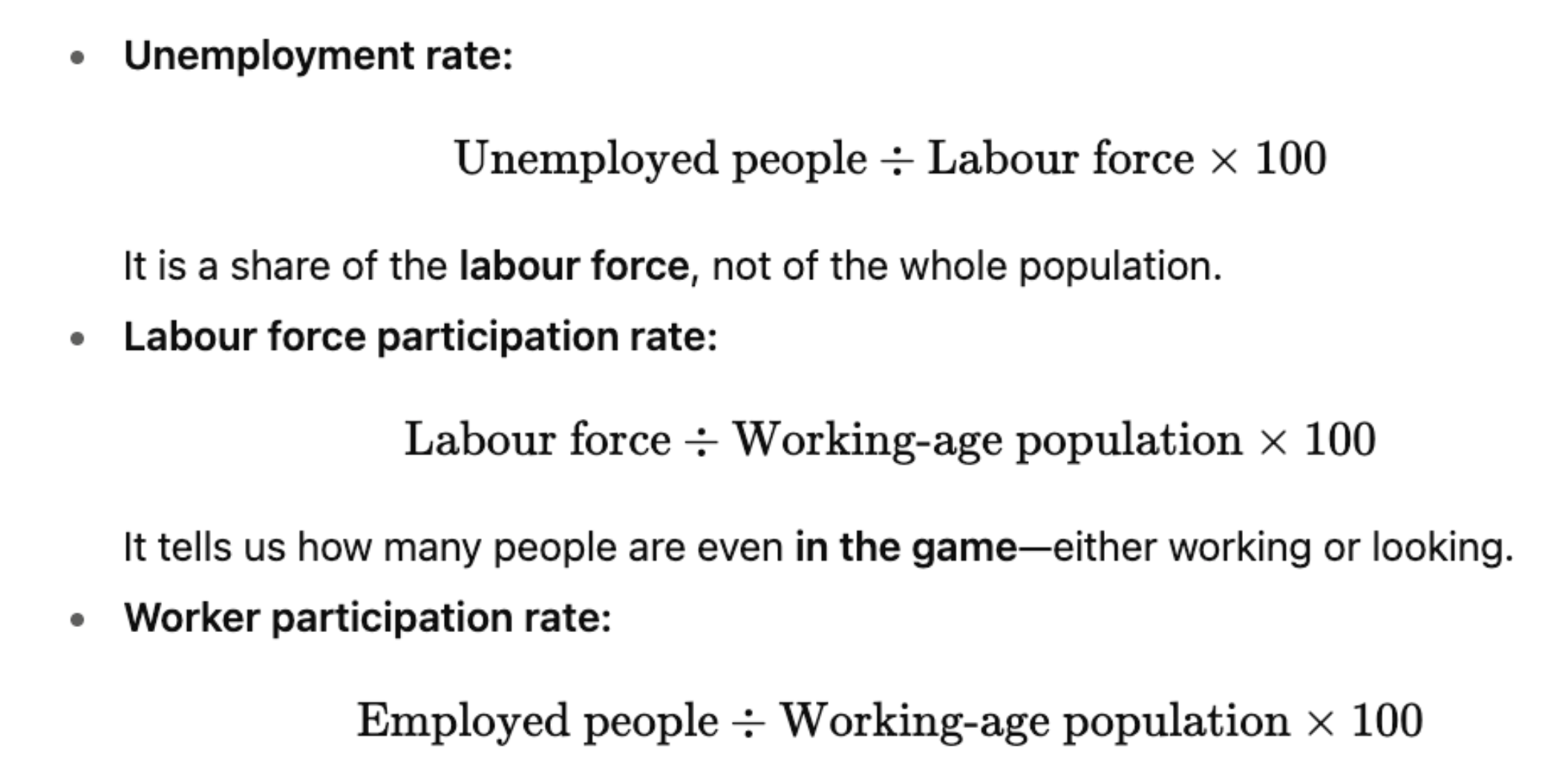
- Employed: You did any economic work—as a wage worker, self-employed, helper in family enterprise, or casual worker—for at least one hour in the reference period. Small, irregular, or part-time work still counts as employment in labour surveys.
- Unemployed: You did not work, were available to work, and actively tried to find work in the reference period.
- Weekly-status approach (used for monthly numbers): The survey asks about the last seven days—did you work, seek work, or stay out? This captures short-term churn in jobs.
- Types of unemployment you can cite in essays:
- Frictional: short gaps while people shift jobs or move cities.
- Seasonal: off-season in farming, tourism, construction.
- Cyclical: falls in demand during slowdowns.
- Structural: skills do not match the jobs available.
- Disguised / under-employment: too many people share too little work, common in low-productivity self-employment.
- Frictional: short gaps while people shift jobs or move cities.
Ten-year picture — level and quality of jobs
- Over the last decade India saw: pre-pandemic tightening → pandemic shock → recovery. In the last two years monthly unemployment has generally stayed near 5–6 percent, with August at 5.1 percent continuing that trend.
- Quality of work is the bigger challenge. A large part of India’s workforce remains informal: small self-employment, unpaid family helpers, and casual daily wage. Formal payrolls have grown in pockets (manufacturing linked to incentives, information technology services, finance, logistics), but many new entrants still do not get stable, written-contract jobs.
- Gig and platform work (ride-hailing, delivery, home services) has expanded. It offers quick entry but often brings variable hours, low social security, and weak bargaining power unless policy improves.
- Gender gap: Women’s labour force participation is lower than men’s. Young women face higher unemployment than young men, especially in cities—exactly what the August data shows. Reasons: safety and travel constraints, lack of childcare, social norms, and sectoral segregation
Why does unemployment persist?
- Skills mismatch: Education often teaches theory; employers need job-ready digital, shop-floor, and customer skills.
- Slow formal job creation: Smaller firms face credit, compliance and market-access barriers, so they hire few.
- Women-specific barriers: Safety in commuting, absence of creches, unpaid care burden, and early exits after marriage or childbirth.
- Regional imbalance: Jobs cluster in a few states and big cities. Moving is costly and risky for many.
- Under-employment trap: People accept very low-pay self-employment due to lack of better options; they count as “employed”, but earn little.
- Demand shocks: Weak exports or poor monsoons hit hiring in manufacturing and construction.
The challenge of artificial intelligence
- New tools are replacing tasks, not all jobs. Routine desk tasks, basic coding, simple content and back-office roles face pressure.
- At the same time, demand grows for data-aware technicians, customer-facing roles, creative work, field maintenance, solar and electric-vehicle services, and healthcare support.
- If training does not keep pace, India could see job and wage polarisation—a few high-skill winners and many stuck in low-pay work.
The way ahead — who should do what
Government (Union and States)
- Build labour-intensive assets: housing, city renewal, rural roads, logistics parks, clean-energy projects—tie contracts to local hiring and skill training.
- Help small firms scale: faster payments, simpler compliance, cheaper working capital, and links to larger supply chains and exports.
- Active labour policies: outcome-based apprenticeships, first-job hiring incentives, relocation help for migrant youth, and strong job-matching platforms.
- Women-first design: safe public transport, creche norms in industrial parks, hostels near work, and targeted training for retail, care, digital and green jobs.
- Gig-worker protections: portable social-security accounts funded by a small platform contribution; accident insurance and grievance systems.
Private sector
- Hire-train-deploy: recruit, run short boot-camps aligned to the role, and certify skills.
- Gender-smart workplaces: safe commute, predictable shifts, clean facilities, return-to-work paths after maternity.
- Local vendor development: spread jobs beyond big hubs by mentoring supplier clusters.
Education and skilling institutions
- Curriculum to career: communication, problem-solving, data basics for all diplomas; embed credit-bearing apprenticeships.
- District skill maps: align seats with real vacancies; measure placements and six-month retention, not just enrolment.
Society and individual
- Career readiness: build a portfolio (projects, internships, volunteering), practise interviews, and learn to search for jobs effectively.
- Continuous learning: short, stackable modules in spreadsheets, coding basics, digital marketing, electrical repair, customer service, or machine maintenance can lift wages quickly.
Exam hook
Key takeaways
- The Situation improved—overall unemployment fell to 5.1 percent—but young women, especially in cities, are being left behind.
- Job quality is the real constraint: too much informal and unstable work.
- Skills and mobility are the bridge between growth and jobs; apprenticeships and hire-train models scale fastest.
- Women-friendly infrastructure and norms can lift both participation and household incomes.
- Artificial intelligence will reward adaptable, multi-skill workers; training must move now.
Mains practice question
“India’s unemployment has eased in recent months, yet female youth joblessness in urban areas remains high. Using recent monthly labour survey data, explain the reasons and propose a multi-level strategy—government, industry, education, and society—to raise women’s employment and job quality.”
One-line wrap
India’s job engine is turning, but unless young women find safe, formal, skill-rich work at scale, the recovery will stay half-built.
Share This Story, Choose Your Platform!
Start Yours at Ajmal IAS – with Mentorship StrategyDisciplineClarityResults that Drives Success
Your dream deserves this moment — begin it here.