
Relevance: GS-2 (Social Justice, Vulnerable Sections)
Source: PIB; Ministry of Social Justice and Empowerment; Supreme Court of India
Context
As of Census 2011, 4.87 lakh persons identified as “other” gender—reflecting the scale of India’s non-binary and transgender population. For decades, transgender persons faced social exclusion, lack of documentation, denial of health and education, and violence. Over the last decade, India has strengthened rights through judicial recognition, a dedicated law, welfare schemes, and digital access frameworks.
The turning point came with the NALSA v. Union of India (2014) judgment, which recognised transgender persons as a third gender, affirmed self-identification, and secured protections under Articles 14, 15, 16, 19 and 21.
Legal and Institutional Framework
1. Transgender Persons (Protection of Rights) Act, 2019
A landmark legislation ensuring legal recognition, non-discrimination, welfare, and accountability.
Key provisions:
- Section 2: Broad definition covering trans-men/women, intersex persons, hijra, gender-queer individuals.
- Section 3: Prohibits discrimination in education, healthcare, employment, residence, movement and public services.
- Sections 4–7: Right to self-perceived identity; Certificate of Identity through District Magistrate; option for revised certificate post surgery.
- Sections 8–12: Government duties: welfare schemes, inclusion in education and employment, complaint officers.
- Sections 16–18: Creation of National Council for Transgender Persons for policy advice, monitoring and coordination.
- Sections 19–20: Offences for discrimination—punishable up to 2 years imprisonment.
2. Transgender Persons Rules, 2020
Operational rules enabling identity certification, grievance redressal and mandates for:
- Transgender Protection Cells in States (20 established),
- Transgender Welfare Boards (25 established).
Government Initiatives
National Council for Transgender Persons
Statutory body (2020) under MoSJE with community representatives, NHRC, NCW, State governments and experts.
National Portal for Transgender Persons (2020)
A multilingual digital platform enabling end-to-end online application for identity certificates and access to schemes.
SMILE Scheme (2022)
A comprehensive welfare programme for livelihood, education and healthcare.
Components:
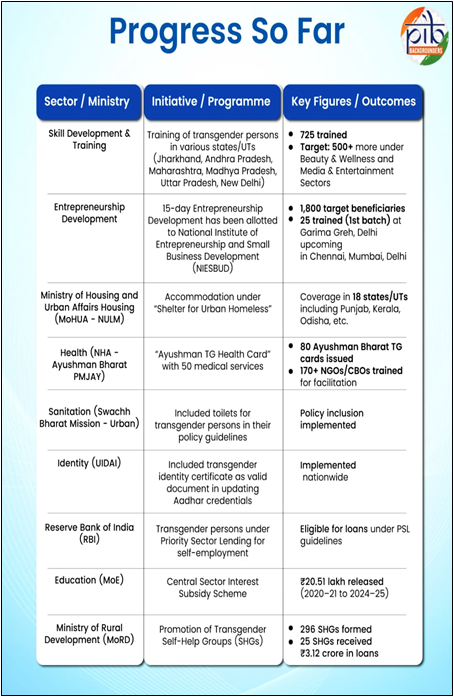
- Skill development, scholarships, and vocational training
- Ayushman Bharat TG Plus: ₹5 lakh annual coverage; gender-affirming care, hormone therapy, surgeries
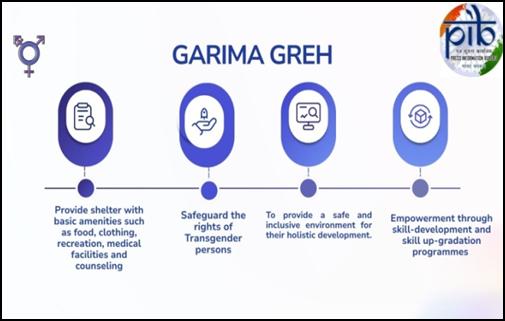
- Garima Greh: Shelter homes in 17 States (21 functional + 3 newly sanctioned)
Challenges Ahead
- Persistent social stigma, limited awareness, under-reporting of violence.
- Need for more shelters, mental health services, and inclusion in schools and workplaces.
- Better implementation of grievance mechanisms and data systems.
India’s transgender rights framework now blends constitutional guarantees, legal protections, welfare schemes, and digital access to promote dignity and inclusion.
Q. “Discuss how legal reforms and welfare initiatives in India have expanded the rights and protections of transgender persons. What gaps remain in achieving full inclusion?”



Start Yours at Ajmal IAS – with Mentorship StrategyDisciplineClarityResults that Drives Success
Your dream deserves this moment — begin it here.