
Syllabus: GS-III – Science & Technology / Economy (Innovation & Infrastructure)
Why in News?
The Global Innovation Index (GII) 2025 was released by the World Intellectual Property Organization (WIPO). It compares how countries enable innovation through policy, people, money, and infrastructure, and what outputs they produce in knowledge, technology, and creativity.
India’s Performance
- India ranks in the high-30s globally and remains the top performer in its region for its income level.
- India has shown a steady upward climb in innovation rankings over the past decade.
About the Global Innovation Index (GII)
- Publisher: World Intellectual Property Organization (WIPO)
- Structure: Divided into two broad parts — Innovation Inputs and Innovation Outputs.
Innovation Inputs (5 Pillars)
- Institutions: Rule of law, business climate, and regulatory framework.
- Human capital & research: Education quality, R&D expenditure, number of researchers.
- Infrastructure: Digital access, energy systems, and financial facilities.
- Market sophistication: Credit, investment, and competition structures.
- Business sophistication: Firm-level R&D, knowledge workers, and industry–academia collaborations.kkk
Innovation Outputs (2 Pillars)
- Knowledge & technology outputs: Patents, high-tech exports, and productivity.
- Creative outputs: Brands, designs, and creative services.
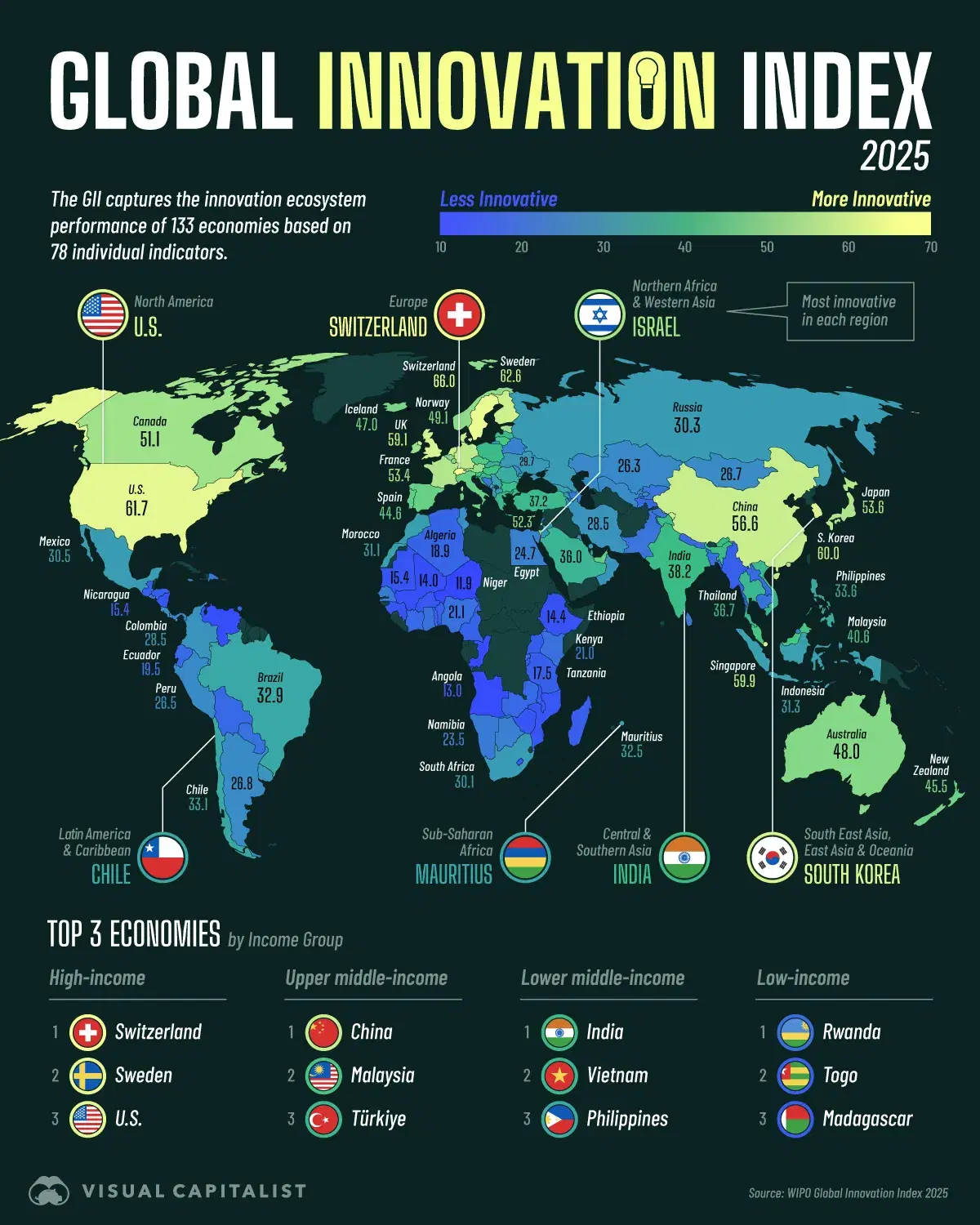
Top 10 Global Innovators (2025)
- Switzerland – Strong R&D, industry–university collaboration.
- Sweden – Deep science base and design-led sustainability.
- United States – Leading universities and venture capital strength.
- South Korea – Heavy corporate R&D and tech diffusion.
- Singapore – Targeted public funding for frontier technologies.
- United Kingdom – Global creative and life sciences clusters.
- Finland – Strong education and clean-tech focus.
- Netherlands – Agri-tech and triple-helix innovation model.
- Denmark – Clean energy innovation and institutional trust.
- China – Rising patent output and electronics leadership (replaces Germany).
India’s Strengths
- Outputs stronger than inputs: India converts limited resources into significant results.
- Digital services edge: Top global rank in ICT service exports.
- Start-up ecosystem: Active venture funding, unicorn growth, and intangible asset creation.
- Innovation vs income: Performs far above peer economies.
India’s Weaknesses
- Business sophistication: Limited firm-level R&D and weak academia–industry links.
- Human capital: Need for more researchers, modern labs, and advanced technical skills.
- Creative goods complexity: Low presence in design exports, gaming, and high-value media.
Why India’s Outputs Outpace Inputs
- Large engineering and developer base.
- Global demand for digital and software services.
- Vibrant start-up ecosystem.
- However, limited public R&D and advanced lab capacity restrict further growth.
Way Forward
- Boost private R&D to 1.5–2% of GDP with tax incentives and co-funding.
- Launch deep-tech missions in chips, batteries, green hydrogen, and med-tech.
- Bridge universities and industry through shared labs and PhD–industry programs.
- Build 100 innovation clusters with infrastructure and quick regulatory approvals.
- MSME tech vouchers for access to design, testing, and automation services.
- Regulatory sandboxes for fintech, health, and climate sectors.
- Support women innovators via childcare at tech parks, safe transport, and women-led seed funds.
- Creative economy push: Promote gaming, craft-tech, and design exports.
- State innovation compacts: Link funding with reform outcomes and dashboards.
- India GII Tracker: A public dashboard tracking each innovation pillar and progress quarterly.
Exam Hook – Key Takeaways
- India converts ideas into outputs efficiently but needs more private R&D and top-end skills.
- Top countries show varied innovation paths — R&D (Switzerland), manufacturing (Korea), venture capital (US), clean tech (Denmark).
- Transparent dashboards and state-level innovation compacts are vital for progress.
UPSC Mains Question
“India’s innovation is strong in services and start-ups but shallow in firm-level R&D.”
Using GII 2025, assess India’s performance and propose a plan to lift India into the top-25 within five years.
UPSC Prelims Questions
Q1. The Global Innovation Index classifies indicators into:
(a) Three input pillars and four output pillars
(b) Five input pillars and two output pillars
(c) Four input pillars and three output pillars
(d) Only output pillars
Answer: (b)
Q2. In the GII framework, “Business sophistication” mainly tracks:
(a) Patent grants by the government only
(b) Number of incubators in universities only
(c) Firm-level R&D, knowledge workers, and industry–academia linkages
(d) Public expenditure on school education
Answer: (c)
One-Line Wrap
India’s next innovation leap will come from higher private R&D, tighter university–industry collaboration, and advanced skill development—to strengthen the base beneath its strong innovation outputs.



Start Yours at Ajmal IAS – with Mentorship StrategyDisciplineClarityResults that Drives Success
Your dream deserves this moment — begin it here.