
WhatsApp Channel Join Now
Telegram Group Join Now
Located on the eastern edge of Guwahati, the Amchang Wildlife Sanctuary (WLS) has once again drawn attention due to concerns over encroachment and habitat loss.
- As Guwahati expands rapidly, conservationists warn that protecting Amchang is vital for maintaining the ecological stability and environmental health of Assam’s capital.
About Amchang Wildlife Sanctuary
- Location: Eastern fringe of Guwahati, Kamrup (Metro) district, Assam.
- Area: 78.64 sq. km, covering hilly terrain and dense forests.
- Formation: Declared as a Wildlife Sanctuary on June 19, 2004, by merging three reserve forests —
- South Amchang Reserve Forest (15.50 sq. km)
- Amchang Reserve Forest (53.18 sq. km)
- Khanapara Reserve Forest (9.96 sq. km)
- Administrative Divisions:
- Amchang Wildlife Range (Bonda)
- Khanapara Wildlife Range (10th Mile)
- The sanctuary acts as an ecological corridor connecting the forested hills of Assam with Meghalaya, forming part of the larger Kaziranga–Karbi Anglong–Rani–Meghalaya Elephant Landscape.
- Amchang Wildlife Sanctuary was also recognised as an Important Bird & Biodiversity Area.
- Fauna:
- Mammals: Chinese pangolin, Flying fox, Slow loris, Assamese macaque, Rhesus macaque, Capped langur, Hoolock gibbon, Jungle cat, Leopard cat, Leopard, Elephant, Wild pig, Sambar, Barking deer, Gaur, Porcupine etc.
- Birds: Lesser Adjutant, Greater Adjutant, White-backed Vulture, Slender-billed Vulture, Khaleej Pheasant Green Imperial Pigeon, Lesser Pied Hornbill etc.
- Reptiles: Pythons, monitor lizards, and various snakes.
- Flora:
- Dominated by teak, white siris, axlewood, terminalia, beechwood, bitter champa, and black dammer trees.
- Rich in medicinal plants that enhance the sanctuary’s ecological and scientific value.
- Ecological Importance
- Serves as the “green lungs” of Guwahati, purifying air and regulating microclimate.
- Prevents soil erosion and flash floods by stabilising hill slopes.
- Maintains biodiversity and groundwater recharge.
- Historically served as an elephant corridor, linking forests from Sonapur and Marakdola to Deepor Beel and Rani Reserve Forest.
- Challenges
- Encroachment and illegal settlements have reduced forest cover.
- Urbanisation, deforestation, and industrial expansion threaten wildlife habitats.
- Human–elephant conflict has intensified as elephants lose access to traditional migration routes.
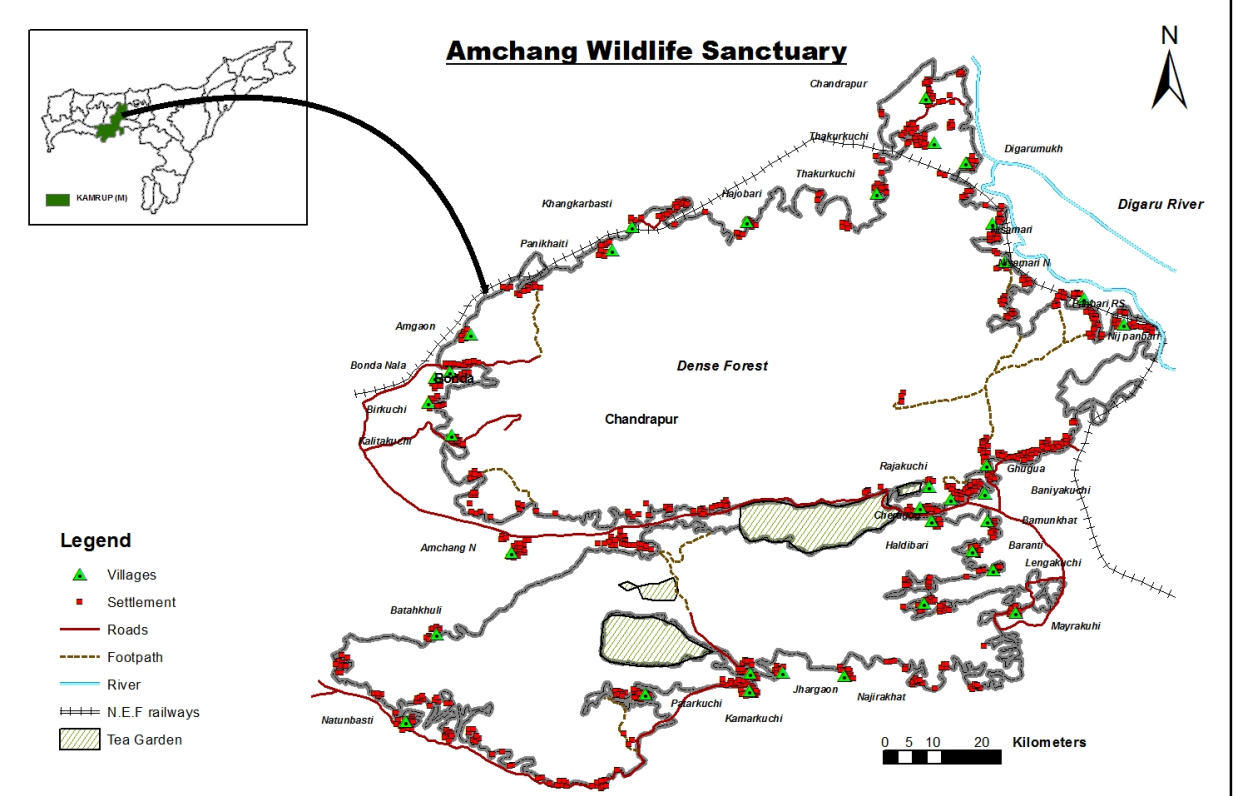
Image Source: Forest Cover Change in Amchang Wildlife Sanctuary, Assam, India, Trishna Changkakati
Exam Hook – UPSC Prelims Question
Q. Which of the following statements about Amchang Wildlife Sanctuary is/are correct?
- It was created by merging South Amchang, Amchang, and Khanapara Reserve Forests.
- It serves as an ecological corridor between Assam and Meghalaya.
- It is located in the Cachar district of Assam.
Select the correct answer:
(a) 1 and 2 only (b) 2 and 3 only (c) 1 and 3 only (d) 1, 2 and 3
Answer: (a)
One-line wrap:
Amchang Wildlife Sanctuary is not just Guwahati’s green shield — it is the living heartbeat of a city whose survival depends on the forests that surround it.



Start Yours at Ajmal IAS – with Mentorship StrategyDisciplineClarityResults that Drives Success
Your dream deserves this moment — begin it here.