
WhatsApp Channel Join Now
Telegram Group Join Now
Syllabus: GS- II & V: Indian Constitution
Why in the news?
Recent unrest in Karbi Anglong has revived debates on the erosion of Sixth Schedule autonomy, shifting attention from law-and-order responses to deeper constitutional and governance failures.
The Sixth Schedule: A promise, not an experiment
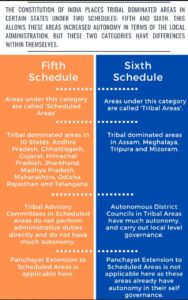
- The Sixth Schedule of the Constitution was crafted to protect tribal self-governance in culturally distinct regions of the Northeast.
- It recognised that uniform administration cannot work where land relations, customs, and authority structures differ fundamentally.
- Autonomy under the Sixth Schedule was meant to be substantive, not symbolic.
Experts’s constitutional warning
- In his famous Anundoram Barooah Law Lecture, M. Mohammed Hidayatullah described the Fifth and Sixth Schedules as a matter of constitutional trust.
- He rejected:
- Complete isolation of tribal areas from the Union.
- Excessive centralised executive control.
- His core idea was clear:
- Autonomy must coexist with accountability, not be reduced by political convenience.
- Powers under the Sixth Schedule are fiduciary, held in trust for tribal communities.
Judicial interpretation and its unintended effects
- A key turning point came with the Supreme Court’s ruling in Pu Myllai Hlychho v. State of Mizoram.
- The Court held that:
- The Sixth Schedule is not a constitution within the Constitution.
- The Governor remains bound by the cabinet system and executive responsibility.
- While legally sound, the ruling had complex long-term consequences:
- The governor’s discretionary role increasingly merged with executive advice.
- Autonomous District Councils began functioning like extensions of State departments.
- Autonomy was diluted procedurally, not confrontationally.
Karbi Anglong: A constitutional stress signal
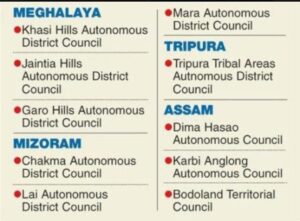
- Karbi Anglong is governed by an autonomous council envisaged as a living institution of self-rule.
- Over time:
- Control over land, resources, development priorities, and administration has weakened.
- Councils face responsibility without real power.
- This imbalance has:
- Undermined public confidence in institutions.
- Shifted grievance expression from council chambers to the streets.
Why law-and-order framing is insufficient
- Violence against police or public property is unjustifiable and must be condemned.
- However:
- Treating unrest purely as a security issue ignores constitutional erosion.
- Policing may restore calm, but cannot restore trust.
- The Sixth Schedule was designed to:
- Absorb dissent.
- Enable negotiation and accommodation.
- Prevent alienation within the constitutional framework.
Key constitutional concepts explained
- Sixth Schedule
- A constitutional arrangement granting legislative, executive, and limited judicial powers to tribal councils in select Northeastern regions.
- Autonomous District Council
- A body meant to reflect local self-governance, not administrative subordination.
- Governor’s fiduciary role
- Acting as a constitutional trustee, not merely a state executive agent.
- Constitutional trust
- Faith that constitutional promises will be honoured in practice, not just in text.
- Institutional dilution
- Gradual weakening of authority through lawful procedures that erode original purpose.
Development versus autonomy: A false binary
- The Sixth Schedule is increasingly portrayed as an obstacle to development.
- Justice Hidayatullah viewed it as a stabilising constitutional device, not a hindrance.
- Dilution of autonomy may offer short-term administrative efficiency but risks:
- Recurrent unrest.
- Loss of legitimacy.
- Weakened federal trust.
The way forward
- Restore meaningful authority to autonomous councils.
- Treat Sixth Schedule governance as continuous, not crisis-driven.
- Balance development goals with constitutional respect for diversity.
- Reinforce the Governor’s role as a neutral constitutional guardian, not an executive conduit.
Exam Hook
Key takeaways:
- Karbi Anglong’s unrest reflects institutional erosion, not sudden lawlessness.
- Sixth Schedule autonomy is central to constitutional faith in tribal regions.
- Legal compliance without constitutional purpose can be corrosive.
Mains:
“The Sixth Schedule is a constitutional promise, not an administrative concession.” Discuss in the context of recent unrest in Karbi Anglong.
One-line wrap:
Karbi Anglong shows that when constitutional autonomy is honoured in form but hollowed in substance, the Constitution itself begins to fail quietly.



Start Yours at Ajmal IAS – with Mentorship StrategyDisciplineClarityResults that Drives Success
Your dream deserves this moment — begin it here.