
WhatsApp Channel Join Now
Telegram Group Join Now
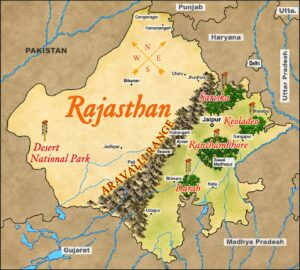
Recently four captive-bred Great Indian Bustards (GIB) were released into Rajasthan’s Desert National Park under Project Great Indian Bustard.
More About the News
- This was the first rewilding exercise under the GIB programme.
- One bird reportedly died within 12 days, suspected to have been killed by foxes, highlighting the challenges of helping captive-bred birds survive in the wild.
|
Why is the Great Indian Bustard important?
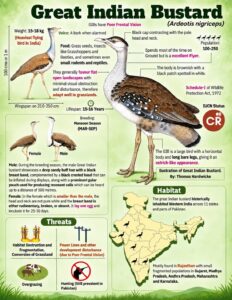
- The Great Indian Bustard (Ardeotis nigriceps), locally known as Godawan, is one of the heaviest flying birds and a flagship species of India’s dry grassland ecosystems.
- It is the state bird of Rajasthan and is found mainly in Rajasthan and parts of Gujarat.
- They displayed wariness towards humans and approaching vehicles, hid in vegetation upon seeing foxes, and exhibited fission-fusion flocking with one another and wild birds.
- In nature, animals or insects aggregate into a cohesive group to gain some survival advantages.
- Group size and composition may change frequently during the lifetime of members by group splitting or merging, which is usually referred to as the “fission-fusion” behavior.
- Conservation status: It is listed as Critically Endangered on the International Union for Conservation of Nature Red List.
- It is also included in Schedule I of the Wild Life (Protection) Act, 1972, and Appendix I of the Convention on International Trade in Endangered Species and the Convention on Migratory Species.
- Major threats: Habitat loss, conversion of grasslands, overhead power-line collisions and predation of eggs and chicks have contributed to its decline.
- Population: A recent Wildlife Institute of India assessment estimated around 130 birds in Rajasthan. The species was found in only 16 % of the surveyed landscape.
Project Great Indian Bustard
- The programme is spearheaded by the Ministry of Environment, Forest and Climate Change, in collaboration with the Wildlife Institute of India and the Rajasthan and Gujarat Forest Departments.
- It receives financial support through the National Compensatory Afforestation Fund Management and Planning Authority.
- Objectives: The programme aims to increase the wild population through conservation breeding, restore grassland habitats, reduce threats and involve local communities.
- Major interventions: Conservation breeding centres have been established at Sam and Ramdevra in Rajasthan.
- Rewilding challenge: One released bird was suspected to have been killed by a fox, highlighting the need for careful predator management and post-release monitoring.
Important Legal Development
- In M.K. Ranjitsinh v. Union of India, the Supreme Court addressed the conflict between Great Indian Bustard conservation and renewable energy infrastructure.
- Its December 2025 directions recognised revised priority areas of 14,013 square kilometres in Rajasthan and 740 square kilometres in Gujarat, along with power-line mitigation measures.
About Desert National Park (DNP)
|
Exam Hook: Great Indian Bustard conservation requires balancing grassland protection, renewable energy development and species recovery.What the Ayodhya-Janakpur train says about India’s railway diplomacy | Explained News – The Indian Express https://share.google/6vVNSFuDhyVhtw5he


Start Yours at Ajmal IAS – with Mentorship StrategyDisciplineClarityResults that Drives Success
Your dream deserves this moment — begin it here.