
Assam Agriculture Minister has announced an experimental initiative to promote makhana (fox nut) cultivation in the State’s natural wetlands and beels. The Agriculture Department has set a target of bringing 30,000 hectares under makhana cultivation across Assam to diversify agricultural activities and increase the income of fishing communities.
Key Highlights of the Initiative
- Existing cultivation: Makhana cultivation is already being undertaken in seven to eight beels in Assam.
- Pilot project: The initiative will initially cover 30% of the 186 fisheries managed by the Assam Fisheries Development Corporation (AFDC) Limited.
- Expansion target: The Agriculture Department aims to bring 30,000 hectares under makhana cultivation across the State.
- Income potential: According to the Agriculture Minister, a 25-bigha beel could generate annual revenue of up to ₹25 lakh through makhana farming. This is a projected figure and actual returns will depend on productivity, costs and market conditions.
- Government support: Interested farmers are expected to receive specialised training and assistance.
- Departmental coordination: The initiative requires cooperation between the Agriculture and Fisheries Departments, along with participation from beel lessees and fishing communities.
What is Makhana?
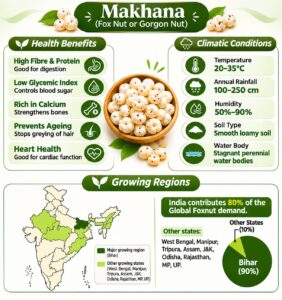
Makhana, commonly known as fox nut or gorgon nut, is the edible seed of Euryale ferox, an aquatic plant belonging to the water-lily family.
- It grows in freshwater ponds, wetlands and shallow water bodies.
- Its seeds are processed, dried and roasted or popped to produce the familiar edible makhana.
- It is valued as a nutritious food containing protein, carbohydrates and minerals.
- Rising demand for healthy snacks has increased its commercial potential in domestic and international markets.
Why is Makhana Cultivation Suitable for Assam?
Assam has numerous natural wetlands, locally known as beels, which provide opportunities for integrating aquatic crop cultivation with fisheries.
- Wetland availability: Assam’s freshwater wetlands offer potential areas for expanding makhana cultivation, subject to ecological and technical suitability.
- Climate suitability: The State’s humid climate and availability of freshwater bodies can support the growth of this aquatic crop.
- Income diversification: Makhana cultivation can provide an additional source of income for traditional fishing communities.
- Integrated farming: With proper water management, makhana cultivation and fisheries can contribute to a diversified wetland-based livelihood system.
- Market opportunities: Growing demand for healthy and plant-based food products may create opportunities for processing, packaging and marketing.
Major Requirements and Challenges
- Water hyacinth removal: The Minister has urged beel lessees to clear water hyacinth because excessive growth can obstruct sunlight, restrict water movement and affect aquatic productivity.
- Scientific water management: Suitable water depth, water quality and seasonal water availability are essential for successful cultivation.
- Technical training: Farmers need training in planting, harvesting, seed processing and post-harvest management.
- Market access: Storage, processing facilities, transportation and market linkages are necessary to ensure profitable returns.
- Ecological safeguards: Water hyacinth removal and makhana expansion must be carried out without damaging native aquatic vegetation, fish habitats and wetland biodiversity.
- Protection of traditional fisheries: Regular stocking of fish fingerlings, as emphasised by the Minister, remains important for sustaining fish production and local livelihoods.
Exam Hook: Key Takeaway
- Crop: Makhana or fox nut.
- Scientific name: Euryale ferox.
- Assam’s cultivation target: 30,000 hectares.
- Existing cultivation: Seven to eight beels.
- Pilot coverage: 30% of 186 AFDC-managed fisheries.
- Key objective: Diversification of wetland-based livelihoods and improvement of fishing communities’ income.
- Key concern: Balancing commercial cultivation with wetland biodiversity and sustainable fisheries.
One-line wrap: Makhana cultivation offers Assam an opportunity to turn its wetland resources into sustainable livelihood assets while protecting the ecological value of its beels.



Start Yours at Ajmal IAS – with Mentorship StrategyDisciplineClarityResults that Drives Success
Your dream deserves this moment — begin it here.