
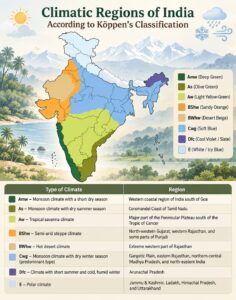
A study by scientists from the India Meteorological Department and the Indian Institute of Tropical Meteorology, Pune, has reported a shift in the climate classification of Northeast India from Tropical Savannah to Temperate.
Key Findings
- The study analysed temperature and rainfall records for 1951–2020, comparing historical and recent climate periods to identify long-term changes in India’s climate zones.
- Nearly 7 % of the area in the Northeast and Northwest homogeneous regions shifted towards a drier climate category, associated with rising temperatures and declining rainfall.
- The study also found increasing summer maximum temperatures and winter minimum temperatures across India, although rainfall trends varied regionally.
- In contrast, around 15 % of Peninsular India’s area shifted from the hot steppe climate category to Tropical Savannah, associated with increasing rainfall trends.
Why Is This Significant for Northeast India?
The shift raises concerns for a region dependent on monsoon rainfall for agriculture, water availability and livelihoods.
- Agriculture: Changes in temperature and rainfall may affect crop calendars, productivity and irrigation requirements.
- Water resources: Changing monsoon patterns may influence river flows, groundwater recharge and seasonal water availability.
- Ecosystems: Altered climatic conditions may affect forests, biodiversity and species distribution.
- Disaster management: Climate-informed planning is essential for managing floods, droughts and other weather-related risks.
A climate-classification shift does not mean that the entire Northeast has suddenly acquired a temperate climate. It indicates a change in the region’s classification based on long-term climatic data.
Exam Hook: Key Takeaway
The reported climate-zone shift highlights the need for climate-resilient agriculture, improved water management and region-specific adaptation planning in Northeast India.
Prelims Practice Question
Consider the following statements:
- The recent study was conducted by scientists from the India Meteorological Department and the Indian Institute of Tropical Meteorology.
- The study reported a shift in Northeast India’s climate classification from Tropical Savannah to Temperate.
- The National Mission for Sustainable Agriculture promotes climate-resilient farming practices.
Which of the statements given above are correct?
A. Only 1 and 2
B. Only 2 and 3
C. Only 1 and 3
D. 1, 2 and 3
Answer: D. 1, 2 and 3
One-line wrap: Northeast India’s changing climate classification underlines the importance of planning for long-term changes in temperature, rainfall, agriculture and water security.



Start Yours at Ajmal IAS – with Mentorship StrategyDisciplineClarityResults that Drives Success
Your dream deserves this moment — begin it here.