
WhatsApp Channel Join Now
Telegram Group Join Now
Syllabus: GS– III & V: Agriculture, Environment & Economy
Why in the News?
With growing aquaculture production and technological advancements, the importance of strict implementation of fishery rules in Assam has come into focus to ensure sustainability.
Aquaculture Potential in Assam
- Assam has rich water resources:
- Beels (wetlands), ponds, rivers (Brahmaputra and Barak)
- Home to diverse freshwater fish species
- Aquaculture supported by:
- Modern technology (feeding systems, solar aeration)
- Government initiatives promoting productivity
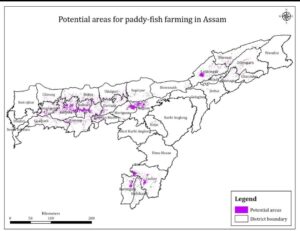
Key Fishery Regulations in Assam
- Governed by Assam Fishery Rules 1953
- Major provisions:
- Fishing ban during breeding season (April–July)
- Prohibition on:
- Use of small mesh nets
- Catching of brood fish (breeding fish)
- Capture of undersized fish
- Ban on invasive species like:
- Thai Magur, Tilapia, Bighead carp
- Supported by Assam Fish Seed Act 2005
- Ensures quality fish seed production
- Mandatory registration and licensing of fish seed producers
Why Implementation is Important
- Ensures natural breeding and fish population growth
- Prevents overfishing and depletion of resources
- Maintains biodiversity and native fish species
- Supports sustainable livelihoods of fishers
- Boosts Blue Economy and rural economy
Challenges in Implementation
- Lack of awareness in remote areas
- Poor monitoring of illegal fishing practices
- Issues in fish seed quality:
- Inbreeding and hybridisation
- Use of undersized brood stock
- Limited enforcement capacity
Important Concepts Explained
- Aquaculture: Farming of fish and aquatic organisms
- Brood Fish: Mature fish used for breeding
- Fish Seed: Young fish used for farming
- Invasive Species: Non-native species harming ecosystem
- Blue Economy: Sustainable use of aquatic resources
Government Initiatives
- Promotion of quality fish seed and hatcheries
- Awareness programmes for farmers and fishers
- Alignment with national schemes like:
- Pradhan Mantri Matsya Sampada Yojana (fisheries development)
Way Forward
- Strengthen awareness and community participation
- Improve monitoring and enforcement mechanisms
- Promote scientific fish farming practices
- Ensure balance between economic growth and ecological sustainability
Exam Hook
Key Takeaways:
- Fishery rules are essential for sustainable aquaculture
- Assam’s rich resources require strict conservation measures
- Quality fish seed is key to long-term productivity
Mains Question:
“Discuss the importance of fishery regulations in ensuring sustainable aquaculture in Assam. Highlight the challenges in their implementation.”
One-line Wrap
Strong fishery rules and their effective implementation are the backbone of sustainable aquaculture and biodiversity conservation in Assam.



Start Yours at Ajmal IAS – with Mentorship StrategyDisciplineClarityResults that Drives Success
Your dream deserves this moment — begin it here.