
WhatsApp Channel Join Now
Telegram Group Join Now
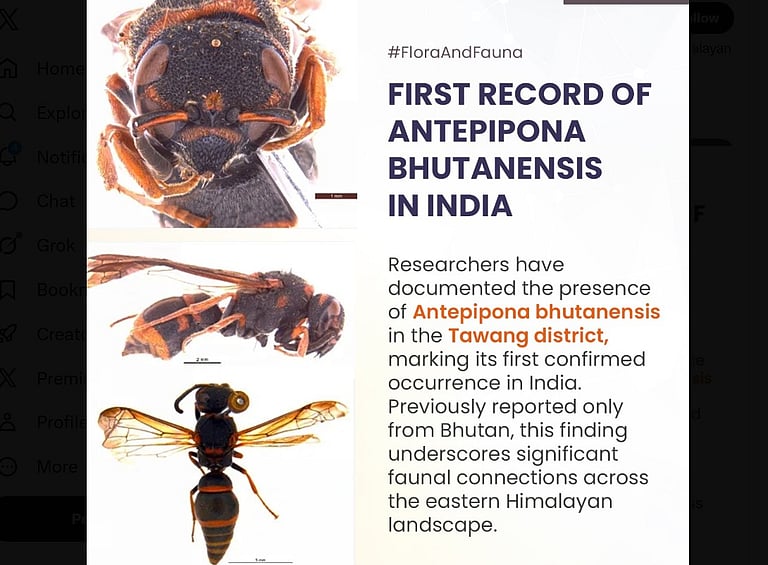
- A new species record for India, Antepipona bhutanensis, has been discovered in Tawang district of Arunachal Pradesh, earlier known only from Bhutan.
Key Highlights
- The species belongs to potter wasps, a group of solitary insects known for mud nest building.
- This marks the first confirmed presence of the species in India.
- The discovery highlights faunal linkages across the Eastern Himalayan region.
- It was acknowledged by the Deputy Chief Minister of Arunachal Pradesh as an important biodiversity milestone.
About Antepipona bhutanensis
- It is a solitary wasp species belonging to the family Vespidae.
- Commonly called a potter wasp due to its pot-shaped mud nests.
- Plays an important ecological role as a natural pest controller, helping maintain ecosystem balance.
Important Terms Explained
- Potter Wasp: A type of wasp that builds mud nests and feeds on insect larvae, aiding pest control.
- Faunal Linkages: It refers to distribution of animal species across geographical regions, indicating ecological connectivity.
- Biodiversity Hotspot: A region rich in species diversity but under threat.
- Transboundary Conservation: Conservation efforts involving multiple countries sharing ecosystems.
- Ecosystem Balance: Maintenance of natural interactions between species and environment.
Significance of the Discovery
- It strengthens India’s biodiversity database and species documentation.
- It highlights the Eastern Himalayas as a rich ecological corridor connecting India, Bhutan, Nepal, and Myanmar.
- It supports the need for cross-border conservation strategies.
- It reinforces Arunachal Pradesh’s position as a biodiversity-rich frontier region.
Exam Hook
Prelims Question:
Which of the following correctly describes potter wasps?
(a) Social insects that build large colonies
(b) Solitary insects known for constructing mud nests
(c) Aquatic insects found in wetlands
(d) Pollinators found only in deserts
One-line wrap: The discovery of Antepipona bhutanensis in Arunachal Pradesh highlights the ecological richness of the Eastern Himalayas and the need for stronger conservation efforts.



Start Yours at Ajmal IAS – with Mentorship StrategyDisciplineClarityResults that Drives Success
Your dream deserves this moment — begin it here.