

Syllabus: GS-I & V: Geophysical Phenomena
Why in the News?
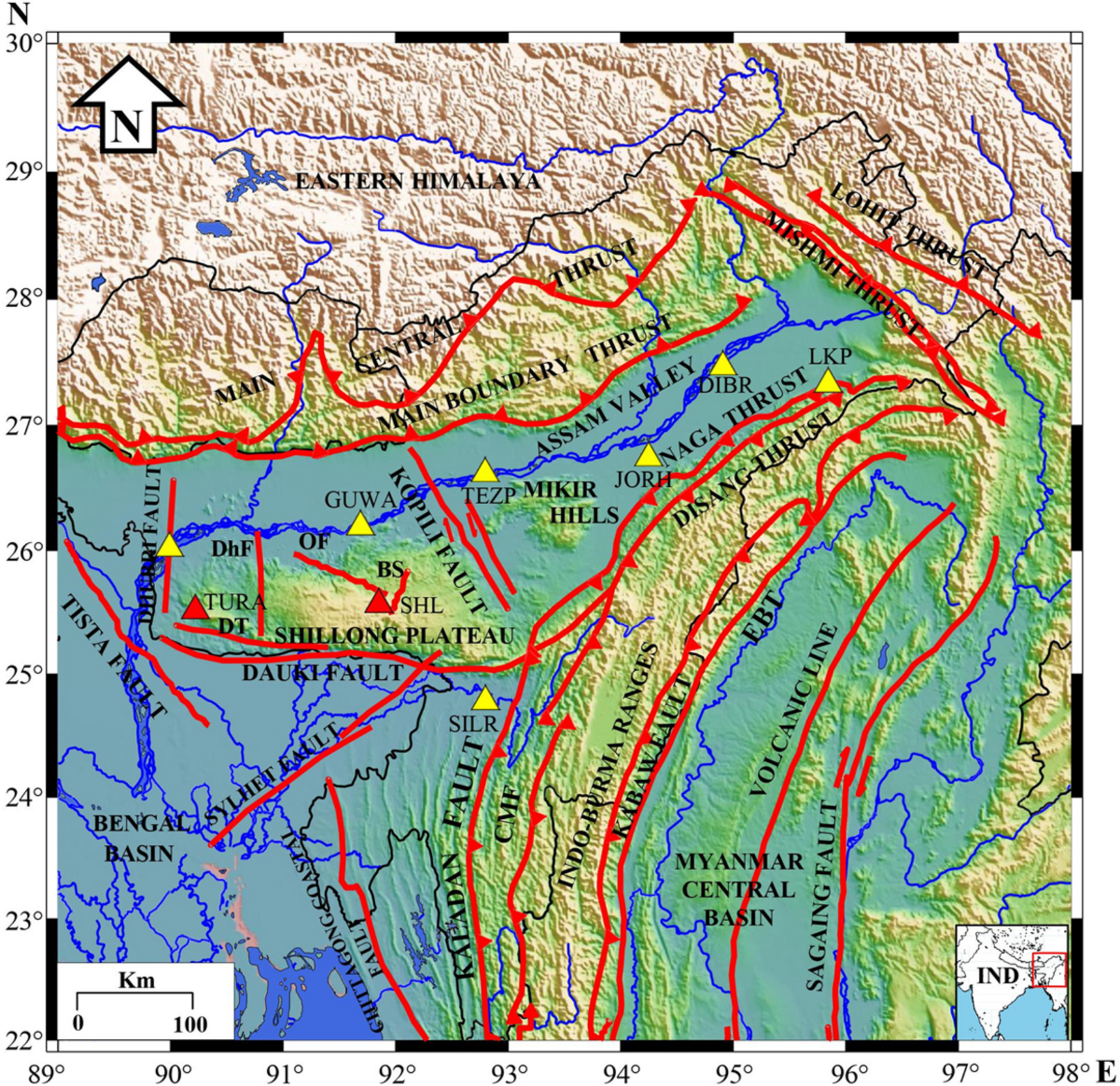
On September 14, 2025, a moderate earthquake (magnitude 5.8) struck Udalguri district in Assam, shaking vast parts of the Northeast and neighbouring countries. As per the National Centre for Seismology (NCS), the tremor’s epicenter lay near the Kopili Fault Zone — one of India’s most active seismic belts. The incident once again highlighted the high earthquake vulnerability of Northeast India.
About the Earthquake:
- Epicentre: Udalguri, Assam (26.78°N, 92.33°E)
- Depth: 5 km (shallow-focus)
- Magnitude: 5.8 (NCS) / 5.5 (USGS)
- Felt in: Assam, Arunachal Pradesh, West Bengal, Manipur, Tripura, Bhutan, Nepal, China, and Bangladesh
- Impact:
- Tremors felt for a few seconds; intensity between MMI II–VI on the Modified Mercalli scale.
- Minor injuries reported; three students hurt due to a ceiling collapse.
- Landslides in Hojai and cracks in walls across Biswanath, Darrang, and Nagaon.
- Nine aftershocks were recorded (magnitude 2.5–3.5).
- Tremors felt for a few seconds; intensity between MMI II–VI on the Modified Mercalli scale.
The Kopili Fault Zone: A Seismic Hotspot
- Extent: ~300 km long, 100 km wide; stretches from western Manipur to the Bhutan–Arunachal–Assam tri-junction.
- Type: Right-lateral strike-slip fault, where crustal blocks slide horizontally past each other.
- Cause: Stress from the collision between the Indian Plate and the Eurasian Plate, compounded by the Indo-Burma subduction zone activity.
- Major Earthquakes Linked to Kopili Fault:
- 1869 Cachar earthquake (Mw 7.4)
- 1943 Mikir Hills earthquake (Mw 7.2)
- 2009 Bhutan earthquake (Mw 6.3)
- 2021 Sonitpur earthquake (Mw 6.1)
- 2025 Udalguri earthquake (Mw 5.8)
- 1869 Cachar earthquake (Mw 7.4)
These recurring quakes reflect cyclical stress accumulation and release along the fault, revealing the region’s active crustal deformation.
Why Northeast India Experiences Frequent Earthquakes
- Tectonic Collision Zone:
- The region lies at the junction of three major tectonic plates — the Indian Plate, Eurasian Plate, and Burmese Plate.
- The ongoing collision between the Indian and Eurasian plates forms the Himalayas, continuously generating seismic stress.
- The region lies at the junction of three major tectonic plates — the Indian Plate, Eurasian Plate, and Burmese Plate.
- Presence of Multiple Active Faults:
- Major faults such as the Himalayan Frontal Thrust (HFT), Main Boundary Thrust (MBT), Main Central Thrust (MCT), and Kopili Fault crisscross the region.
- These faults store and release tectonic strain periodically, causing frequent quakes.
- Major faults such as the Himalayan Frontal Thrust (HFT), Main Boundary Thrust (MBT), Main Central Thrust (MCT), and Kopili Fault crisscross the region.
- Subduction and Folding:
- The Indo-Burma range to the east is a subduction zone, where the Indian Plate moves beneath the Burmese Plate, generating shallow and intermediate-depth earthquakes.
- The Indo-Burma range to the east is a subduction zone, where the Indian Plate moves beneath the Burmese Plate, generating shallow and intermediate-depth earthquakes.
- Crustal Weakness and Intraplate Stress:
- The presence of ancient geological fractures and sedimentary basins like the Assam Valley amplifies the shaking intensity.
- The presence of ancient geological fractures and sedimentary basins like the Assam Valley amplifies the shaking intensity.
- Seismic Zone Classification:
- The entire Northeast falls under Seismic Zone V — the highest-risk category as per the Bureau of Indian Standards (BIS) seismic zoning map.
Way Forward:
- Establish denser seismic monitoring stations and real-time data networks along major faults.
- Strengthen building codes and earthquake-resilient infrastructure, especially in urban Assam.
- Foster cross-border seismic cooperation with Bhutan and Myanmar for data sharing.
- Promote community awareness and disaster preparedness under the National Disaster Management Authority (NDMA).
Key Takeaways:
- The Kopili Fault is a critical seismic feature driving repeated earthquakes in Assam.
- The collision of multiple tectonic plates makes Northeast India one of the most seismically active regions globally.
- Strengthened monitoring and preparedness are essential to minimize future risks.
Exam Hook – Mains Question:
Explain the tectonic factors responsible for frequent earthquakes in Northeast India. Discuss the significance of the Kopili Fault Zone in this context.
One-line Wrap:
The Udalguri earthquake reaffirms Northeast India’s restless geology — where the Indian Plate still presses against the Himalayas, keeping the earth beneath Assam in constant motion.
Share This Story, Choose Your Platform!
Start Yours at Ajmal IAS – with Mentorship StrategyDisciplineClarityResults that Drives Success
Your dream deserves this moment — begin it here.