Syllabus: UPSC / APSC – General Studies Paper I (Indian Culture & Society), Paper II (Education & Governance)
Why in the News?
Every year on 21 February, the world observes International Mother Language Day, declared by the UNESCO in 1999 at the initiative of Bangladesh. The 2026 theme – “Youth Voices for Multilingual Education in the Digital Age” – highlights the urgent need to protect languages through education and technology.
India’s Linguistic Landscape
India is one of the most linguistically diverse countries in the world.
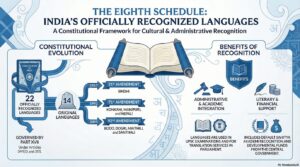
- The 2011 Census recorded 1,369 rationalised mother tongues, grouped into 121 languages.
- The Constitution recognises 22 languages in the Eighth Schedule.
- Over 190 Indian languages are endangered, according to linguistic surveys and UNESCO assessments.
When a language disappears, it carries away folklore, oral literature, ecological knowledge and community memory.
Assam as a Microcosm of Diversity
Assam reflects India’s multilingual reality.
- About 48 % speak Assamese as their mother tongue, nearly 30 % Bengali, and around 4.5 % Bodo.
- The State has mandated Assamese as the official language, while recognising Bengali and Bodo in specific regions.
- Efforts are underway to promote tribal languages in schools.
This shows the delicate balance between identity, administration and inclusion.
Role of Education
The National Education Policy 2020 recommends that children be taught in their mother tongue at least until Grade Five, preferably till Grade Eight.
- Mother tongue education improves comprehension and confidence.
- Implementation requires trained teachers, textbooks and digital content.
- Nearly 40 percent of global learners lack access to education in a language they understand well.
Without institutional support, policy goals remain incomplete.
Digital Revolution and Language Survival
India’s internet user base is rapidly expanding, with most users consuming content in regional languages.
- Digital platforms now host podcasts, videos and literature in Assamese, Tamil, Bodo and many others.
- However, smaller languages lack adequate tools like speech recognition, translation software and digital keyboards.
- Artificial Intelligence systems must incorporate diverse Indian languages to ensure inclusivity.
When technology supports local languages, preservation aligns with progress.
Key Concepts Explained
- Mother Tongue: The first language learned at home in childhood.
- Endangered Language: A language at risk of falling out of use.
- Multilingualism: Ability to use more than one language.
- Intangible Cultural Heritage: Traditions and knowledge transmitted orally.
- Linguistic Federalism: Recognition of language-based diversity within a federal structure.
Way Forward
- Strengthen implementation of mother-tongue education.
- Digitise endangered languages.
- Encourage youth-led content creation in regional languages.
- Promote inclusive language policies that protect both unity and diversity.
Exam Hook: Key Takeaways
- International Mother Language Day is observed on 21 February.
- India has 22 scheduled languages and over 190 endangered languages.
- National Education Policy 2020 promotes mother-tongue instruction.
- Digital tools are crucial for language preservation.
Mains Question
Discuss the challenges and opportunities in preserving linguistic diversity in India in the context of digitalisation and education reforms.
One-line wrap: Preserving India’s linguistic tapestry means ensuring that development and digital progress walk hand in hand with cultural continuity.
Share This Story, Choose Your Platform!
Start Yours at Ajmal IAS – with Mentorship StrategyDisciplineClarityResults that Drives Success
Your dream deserves this moment — begin it here.