Syllabus: GS -II & V: India and its Neighbourhood Relations
Why in the News?
The Prime Minister recently shared an article by Union Minister Jyotiraditya M. Scindia, highlighting the transformation of the Northeast Region (NER) into India’s natural gateway to Southeast Asia under the ‘Act East’ and ‘Viksit Bharat’ visions.
The Northeast as India’s “Forward Face”
- Once seen as India’s remote frontier, the Northeast Region is now emerging as a strategic, cultural, and commercial bridge linking India to the ASEAN and Indo-Pacific regions.
- The Union Minister described the eight northeastern states as “Ashtalakshmi”—symbols of prosperity, diversity, and resilience.
- Through new investments in connectivity, tourism, and technology, the region is being positioned as India’s gateway to Southeast Asia.
- The North Eastern Science and Technology (NEST) Cluster at IIT Guwahati, is envisioned as a hub of innovation and entrepreneurship, linking research with local livelihoods and sustainable growth.
- Aligned with India’s ‘Act East, Act Fast, Act First’ vision, the region is being reshaped into a land-linked hub of connectivity, commerce, and culture.
- Projects like the Integrated Sohra Tourism Circuit in Meghalaya (₹233 crore under PM-DevINE) and ₹635 crore worth of infrastructure projects in Assam reflect this transformation.
Thus, it is stated that the Northeast is now India’s “forward face” – a region where “nature, progress, and people breathe together.”
Strategic and Economic Significance of the NER
- Geostrategic Location:
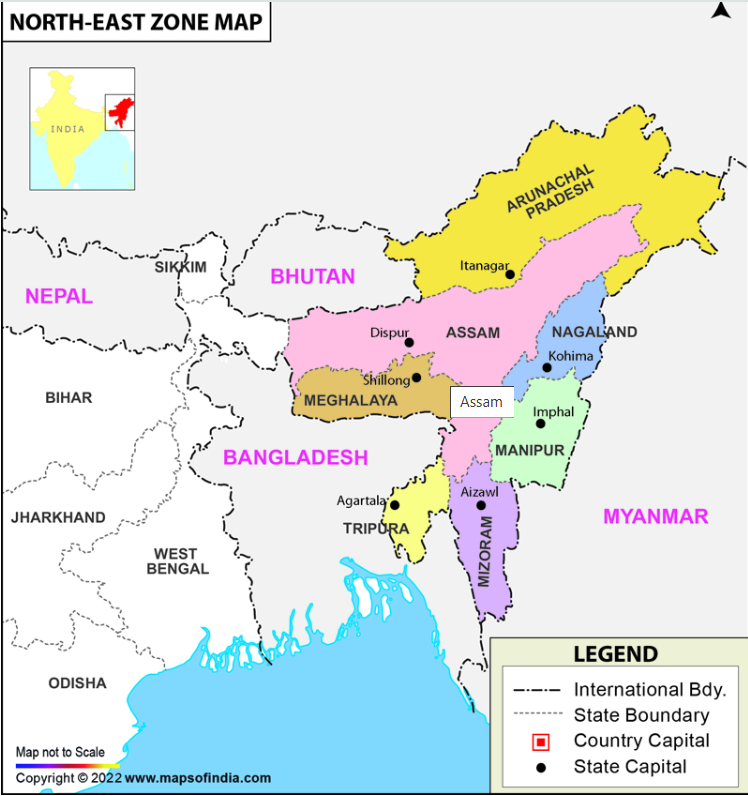
- The Northeast shares 98% of its borders with China, Bangladesh, Myanmar, and Bhutan, making it India’s gateway to ASEAN and a frontline in national security.
- The Siliguri Corridor, or “Chicken’s Neck,” is the lifeline connecting the NER with the rest of India.
- Rich Natural Resources:
- The region holds 34% of India’s water resources and 40% of the country’s hydropower potential, fertile farmlands, unique flora and fauna, and organic produce.
- Connectivity Revolution:
- Projects like the India–Myanmar–Thailand Trilateral Highway, Kaladan Multimodal Transit Transport Project, and BBIN Motor Vehicle Agreement (2015) are transforming the region from a landlocked to a land-linked hub.
- Airports in Guwahati, Imphal, and Agartala are being developed as logistics hubs, while Land Custom Stations in Meghalaya and Mizoram promote border trade.
- Economic Integration:
- The completion of major infrastructure—like the Sela Tunnel (Arunachal Pradesh) and Bhupen Hazarika Bridge (Assam)—is expected to push India-ASEAN trade from $125 billion to $200 billion within a decade.
- Powerhouse of Growth:
- The NER contributes significantly to India’s tea, bamboo, bio-economy, petroleum, sports, and eco-tourism sectors, forming a multi-dimensional growth engine for Atmanirbhar Bharat.
India–Southeast Asia Relations
- Economic Ties:
ASEAN accounts for about 11% of India’s global trade, with bilateral trade valued at $121 billion (2023–24). - Infrastructure Cooperation:
Projects like the Mekong–India Economic Corridor and the India–ASEAN Connectivity Master Plan enhance physical and digital integration. - Defense Cooperation:
Exercises like Garuda Shakti (India–Indonesia) and SIMBEX (India–Singapore) deepen maritime and strategic ties. - Cultural and Educational Links:
Through Nalanda University revival, Buddhist circuit tourism, and Indian Cultural Centres (ICCs) across ASEAN, India leverages shared heritage and people-to-people ties.
Key Takeaways
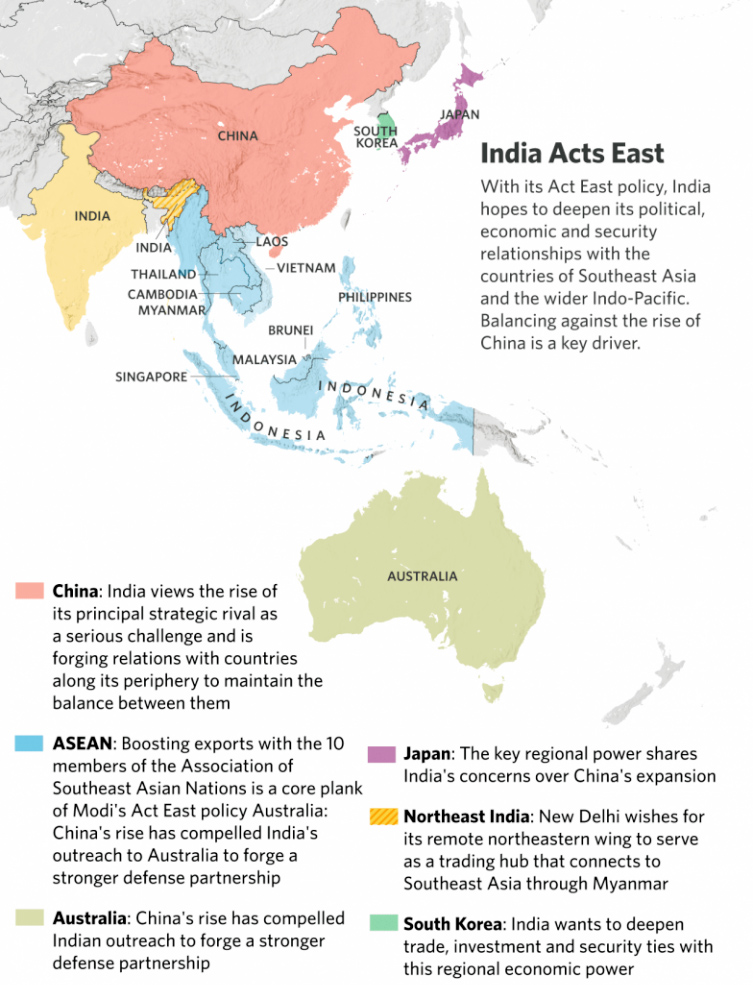
- The Northeast is central to realizing India’s Act East Policy and Indo-Pacific strategy.
- Connectivity, commerce, and culture are transforming it into India’s gateway to Southeast Asia.
- Enhanced infrastructure, tourism, and logistics will strengthen both economic integration and strategic depth in the region.
Exam Hook – Mains Question:
- “The Northeast Region of India, once viewed as a remote frontier, is now poised to emerge as a gateway to Southeast Asia.” Discuss the strategic and economic significance of the NER in enhancing India’s Act East Policy.
One-line Wrap:
The Northeast is no longer India’s borderland—it is the nation’s bridge to Southeast Asia, where geography meets growth and culture meets connectivity.
Share This Story, Choose Your Platform!
Start Yours at Ajmal IAS – with Mentorship StrategyDisciplineClarityResults that Drives Success
Your dream deserves this moment — begin it here.