

Syllabus: GS-III & V Infrastructure
Why in the news?
Union Minister of Ports, Shipping and Waterways announced major progress in expanding inland waterways in Northeast India, especially Assam, strengthening petroleum transport and regional trade corridors.
A New Era of Waterway-led Connectivity in the Northeast
The Inland Water Transport network is emerging as a game-changer for Assam and the Northeast. At the North East Oil & Gas Conclave 2025, the Union Minister highlighted how large-scale modernisation of waterways is reducing logistics costs, boosting petroleum exports, and opening trade routes to Bangladesh and Southeast Asia.
This marks a revival of the Brahmaputra–Barak river systems as low-cost, energy-efficient and sustainable transport corridors.
What Are Inland Waterways?
- Inland waterways refer to navigable rivers, canals, backwaters and creeks used for transportation of cargo and passengers.
- India has a total of about 14,500 km of navigable waterways.
- They are managed under the Inland Waterways Authority of India (IWAI).
- They offer lower fuel use, lower emissions, and cheaper freight movement compared to road or rail.
- Legislative Framework:
- Inland Waterways Authority of India Act, 1985 – established IWAI for regulation and development.
- National Waterways Act, 2016 – declared 111 National Waterways across India to strengthen multimodal transport.
- National Waterways (construction of Jetties/terminals) Regulations, 2025- aims to boost private investment and streamline terminal development.
- Criteria for Declaring a NW: A river stretch can be notified as a National Waterway only if it fulfils:
- Adequate depth (~1.5 m) and width (~45 m) of Channel
- Continuous stretch of at least 50 km.
- Navigable by mechanically propelled vessels
- Potential for commercial cargo movement
- Environmental feasibility
- Connectivity with existing transport networks
- Should serve multiple states, or connect major ports, or be strategically important, or serve underserved areas.
Inland Waterways Assam
- Assam’s rivers offer natural connectivity to Bangladesh, Myanmar, and Southeast Asia.
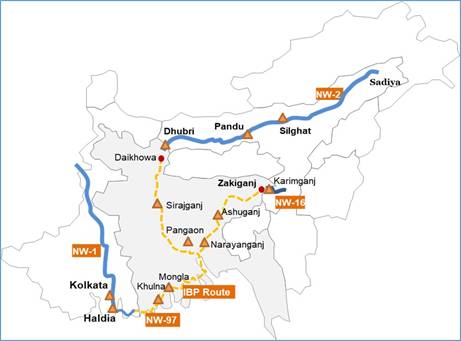
- For instance, Assam’s NW-2 & NW-16 is linked with Indo-Bangladesh Protocol (IBP) Route, enabling smooth cross-border movement of cargo between India and Bangladesh.
- In 2014, Assam had only one NW-2 (Brahmaputra) declared under the National Waterways Act, 1988.
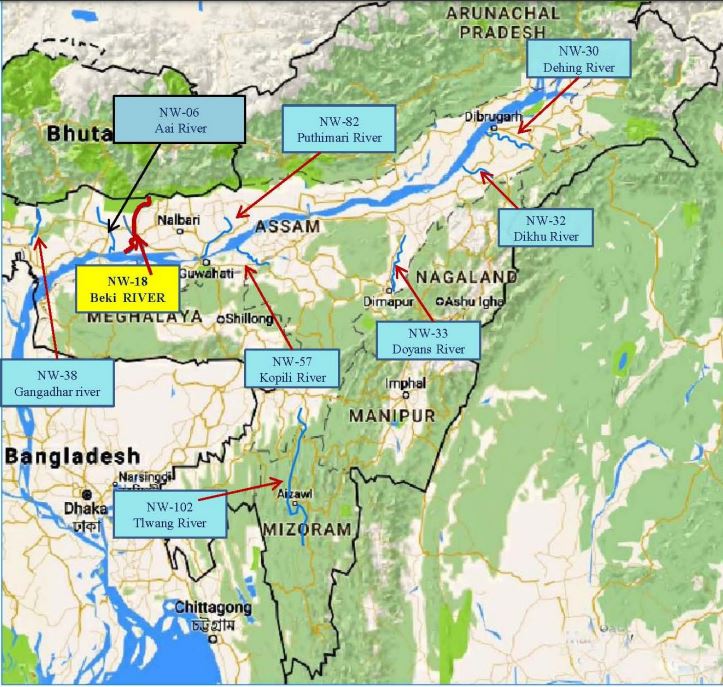
- After the National Waterways Act, 2016, eleven more inland waterways within Assam and four inter-state waterways were added.
- As a result, Assam has a total of 15 National Waterways as of 2023.
- NW-2 (Brahmaputra) and NW-16 (Barak) are crucial for petroleum, coal, cement and industrial cargo.
- Along with them, NW-57 (Kopili) and NW-31 (Dhansiri) are also operational in Assam.
Major Highlights from the Conclave
Key Infrastructure Gains
- Terminals at Pandu, Dhubri, Jogighopa, Bogibeel, Karimganj and Badarpur have become major export hubs.
- Petroleum products and industrial cargo are being shipped to Bangladesh with reduced transit time and fuel consumption.
Operational Efficiency
- Over-Dimensional Cargo for the Numaligarh Refinery expansion successfully transported via river route.
- Year-round navigation ensured through dredging and fairway maintenance.
- Cargo movement on National Waterway-2 is nearing 6 lakh tonnes annually.
Government Investment
- ₹1,000 crore invested in the last two years.
- A ₹239 crore ship repair facility coming up at Pandu will reduce dependence on Kolkata.
- Regional Centre of Excellence at Dibrugarh (₹188 crore) will train 5,000 youth in maritime skills.
Boosting Tourism and Skills
- Development of tourist jetties, lighthouses, and river-based tourism infrastructure.
- Skill development aligned with maritime careers.
Government of India’s Initiatives to Promote Inland Waterways
- Jal Marg Vikas Project (JMVP) for improving NW-1
- Arth Ganga Model for river-based livelihood
- Sagarmala Programme for port-led multimodal logistics
- MoUs worth ₹40,000 crore signed during India Maritime Week 2025 to enhance efficiency
- Target: 76 National Waterways operational by 2027
Cargo movement on national waterways has risen from 18 million tonnes to 146 million tonnes, showing dramatic growth.
Significance for India’s Act East Policy
- Waterways enhance connectivity to Bangladesh, Bhutan, Myanmar.
- Assam becomes a strategic gateway to Southeast Asia.
- Supports regional dominance in energy logistics, petroleum exports and multimodal trade.
|
State(s) |
No. of NWs | NWs in 2014 |
NWs in 2023 (Declared vide National Waterways Act, 2016) |
| Assam | 11 | NW-2 – Brahmaputra River (Dhubri–Sadiya) declared under National Waterway Act, 1988 | NW-2 – Brahmaputra River (Dhubri–Sadiya) NW-6 – Aai River NW-16 – Barak River NW-18 – Beki River NW-30 – Dehing River NW-31 – Dhansiri/Chathe River NW-32 – Dikhu River NW-33 – Doyang River NW-57 – Kopili River NW-82 – Puthimari River NW-95 – Subansiri River |
| Assam & Arunachal Pradesh | 1 | — | NW-62 – Lohit River |
| Assam & Meghalaya | 1 | — | NW-50 – Jinjiram River |
| Assam & Mizoram | 1 | — | NW-102 – Tlwang (Dhaleswari) River |
| Assam & West Bengal | 1 | — | NW-38 – Gangadhar River |
Exam Hook – Mains (One Line)
Inland Waterways are emerging as a low-cost, energy-efficient backbone of Northeast India’s logistics network. Discuss the opportunities and challenges of expanding inland waterways with reference to National Waterway-2.
Key Takeaways
- NW-2 and NW-16 are transforming Assam’s trade routes.
- Inland waterways significantly reduce logistics cost and carbon footprint.
- Heavy government investment is improving cargo handling, navigation and ship repair capacity.
- Inland Waterways are central to India’s Act East Policy.
Share This Story, Choose Your Platform!
Start Yours at Ajmal IAS – with Mentorship StrategyDisciplineClarityResults that Drives Success
Your dream deserves this moment — begin it here.