

1) What is Gaganyaan
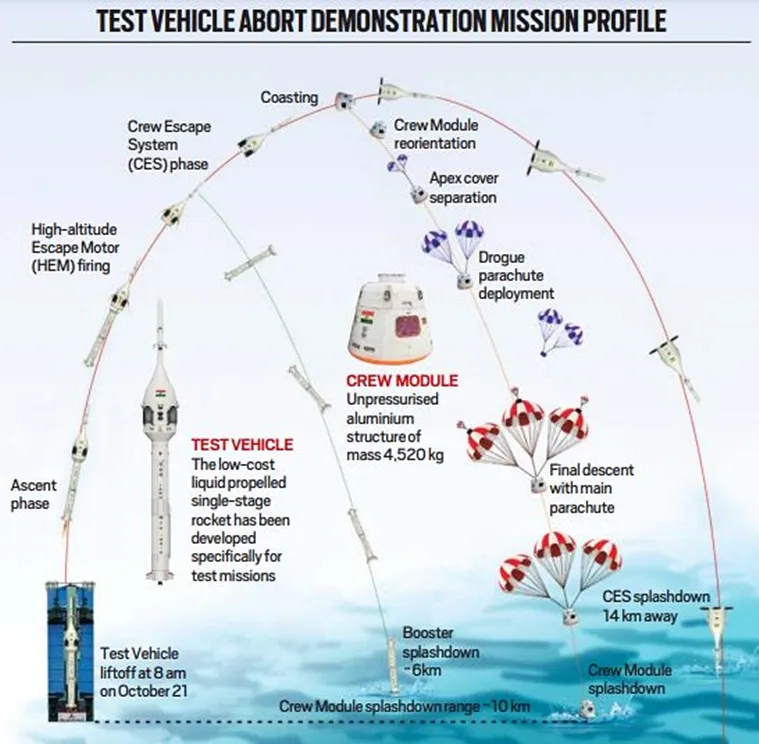
Gaganyaan Mission
2) What “simulation” means here (and what ISRO is doing now)
A simulation is a realistic rehearsal that copies launch, spaceflight, and return—without taking the real-world risk. ISRO is running simulations to practise crew procedures, communications, life-support operations, and emergency responses.
These exercises run alongside real hardware tests like escape system trials, parachute air-drops, and propulsion hot-fires. The idea is simple: find problems on the ground, not in the sky.
Why this matters
- Simulations reduce risk by catching design and procedure errors early.
- They train astronauts and mission controllers to react within seconds.
- They prove safety systems—escape tower, parachutes, flotation, recovery—before anyone flies.
3) How the rehearsals actually look
- Crew “analogs”: Astronauts live and work in a spacecraft-like module to follow checklists, keep strict comms discipline, manage sleep–work cycles, and handle stress.
- Hardware-in-the-loop: Flight computers, sensors, and life-support are connected to a virtual mission so engineers see how software + hardware behave in both normal and fault conditions.
- Abort and recovery drills:
- Launch escape tests to pull the capsule away if the rocket has trouble.
- Parachute air-drop tests with a dummy capsule to check drogue-to-main chute sequence and safe splashdown.
- Sea recovery rehearsals with the Indian Navy to locate, hook, and lift the capsule on board.
Recent milestones
- Service Module hot-fire tests to validate propulsion for orbit and de-orbit.
- Integrated Air-Drop Test of the parachute chain using a heavy dummy capsule.
- Pad/launch escape and rocket-sled trials to check escape dynamics.
- Multiple recovery drills at sea.
4) How Axiom Space links to Gaganyaan (learning by doing)
- In June–July 2025, Axiom Mission-4 (Ax-4) flew to the International Space Station with Group Captain Shubhanshu Shukla serving as pilot.
- This mission is separate from Gaganyaan but gives India real, hands-on experience with crew operations, microgravity living, emergency drills, international coordination, and post-splashdown procedures.
- These lessons feed straight into Gaganyaan training, control-room checklists, and recovery discipline—think of it as driving on a real highway before we take out our own car.
5) Quick timeline you can remember
- 2024–early 2025: Multiple escape trials, continued qualification of life-critical systems.
- July 2025: Service Module propulsion hot-fires and longer-duration qualification run cleared.
- June–July 2025: Ax-4 completes; Indian pilot gains ISS experience (helps operating culture and procedures).
- Late 2025 (planned): G1 uncrewed flight with the Vyommitra humanoid to test ascent, orbit, re-entry, and recovery end-to-end.
- Crewed mission (working target): 2027, after all uncrewed tests and safety gates are closed. (Dates can shift if tests demand more work; safety stays first.)
6) Prelims pointers
- Launcher: Human-rated LVM3.
- Stack: Crew Module (re-entry capsule) + Service Module (power, propulsion).
- Crew Escape System: Pulls the capsule away from the rocket during any serious launch emergency.
- Parachutes: Step-by-step sequence—apex cover, drogue, pilot, then main chutes—for a controlled sea landing.
- G1 goal: Full dress-rehearsal without crew to certify systems and recovery chain.
Prelims Practice (MCQ)
Q. With reference to ISRO’s Gaganyaan programme, which of the following is/are correct?
- “Analog” missions place astronauts in confined modules on Earth to practise space-like routines and communication.
- The Integrated Air-Drop Test primarily validates the launch-pad escape tower.
- The Service Module propulsion system has undergone hot-fire qualification tests.
- The first uncrewed mission aims to rehearse re-entry and sea recovery before any crewed flight.
Choose the correct answer:
A. 1, 3 and 4 only
B. 2 and 3 only
C. 1 and 2 only
D. 1, 2, 3 and 4
(Statement 2 is incorrect: the air-drop test validates the parachute recovery chain, not the escape tower.)
One-line wrap
Practise on the ground, prove safety in parts, then fly—Gaganyaan is moving step-by-step to a safe first human spaceflight, boosted by real lessons from the Axiom-4 mission.
Share This Story, Choose Your Platform!
Start Yours at Ajmal IAS – with Mentorship StrategyDisciplineClarityResults that Drives Success
Your dream deserves this moment — begin it here.