Why in the News?
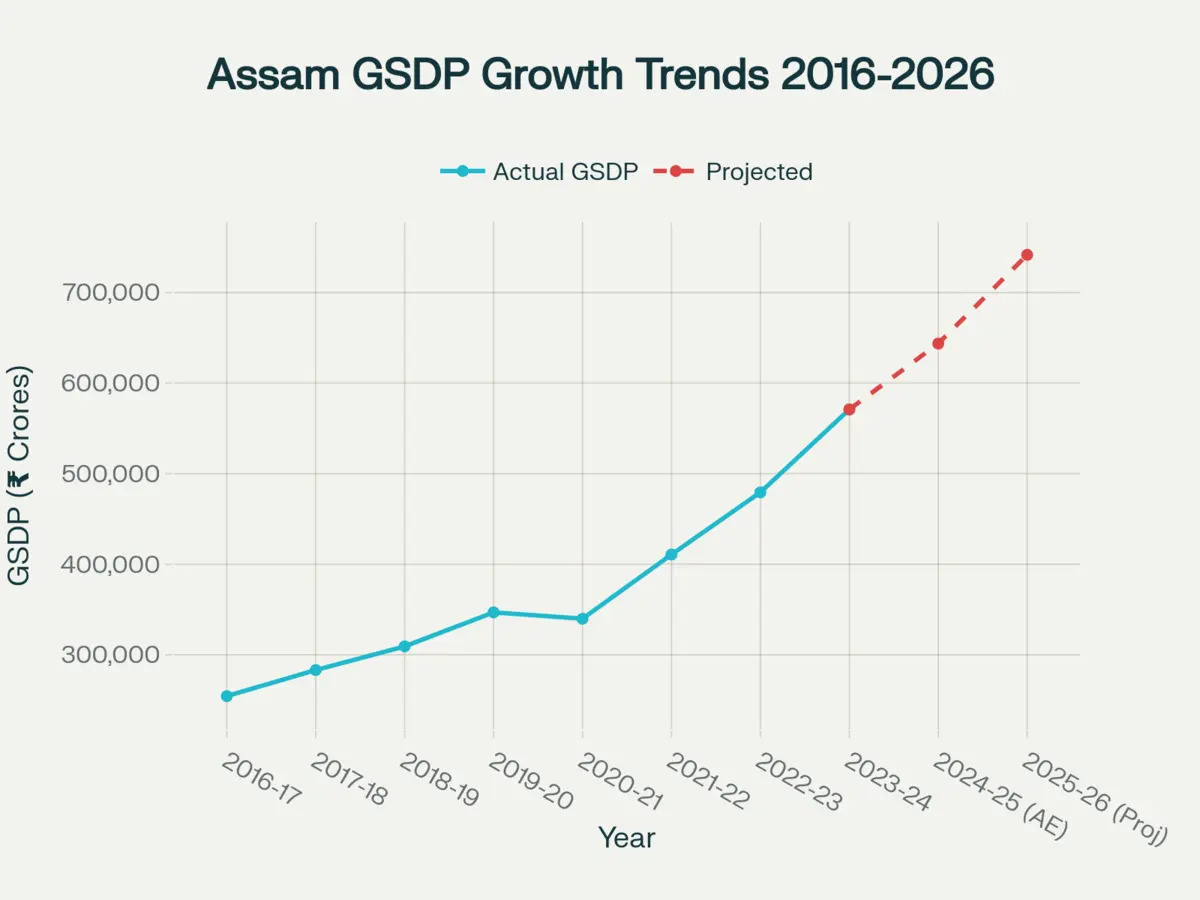
Assam’s economy is growing at 7.9% in FY 2024–25, outpacing India’s average of 6.5%. Despite this, Assam’s share in India’s GDP has fallen from 2.6% in 1960–61 to 1.9% today, averaging 1.8% over 25 years. To reverse this, Assam, in partnership with the Pahle India Foundation (PIF), launched the District-led Development Project (DDP) to empower districts as growth engines and target a $143 billion economy by 2030.
Status of Assam’s Economic Development
1. Recent Growth Momentum
- Third fastest-growing state: 7.94% GDP growth (2024–25).
- GSDP surged from ₹1.78 lakh crore (2013–14) to ₹6.44 lakh crore (2024–25).
- Per capita income improved from 61.2% to 73.7% of national average (2010–11 to 2023–24).
- Growth above national average for last three years.
2. Structural Composition
- Agriculture & allied: ~29% of GSDP
- Industry (oil, gas, manufacturing): ~23%
- Services: ~48% (trade, transport, education, tourism)
Major contributors: tea, petroleum, natural gas. Value addition and diversification remain limited.
Key Industries & Emerging Sectors
1. Tea Industry
- World’s largest tea-producing region (~50.6% of India’s tea output).
- 2024 production: 649.84 million kg; employs 10+ lakh workers.
- 783 large tea gardens; 1.18 lakh small growers.
- Exports with GI tag to Russia, Iran, UAE, UK, USA.
2. Oil & Natural Gas
- Assam contributes 15% of crude oil, 14% natural gas; ranks third in India.
- Crude oil (2023–24): 4,361 TMT; 3-year total: 12,518 TMT.
- Royalty revenues (2019–23): ₹19,291 crore (oil), ₹1,851 crore (gas).
- Key infrastructure: Digboi Refinery, Numaligarh Refinery, North East Gas Grid, Paradip–Numaligarh Pipeline.
- New development: Vedanta’s Hazarigaon Gas Field (first DSF gas flow in Northeast).
3. Handicrafts & Traditional Industries
- Bamboo & cane crafts, silk weaving, pottery, bell metal, woodcarving, mask-making.
- Policy: Assam Handicraft Policy 2022 – raw material banks, design innovation, export villages, skill development.
- High female rural participation; promotes inclusive growth.
4. Sericulture
- Produces ~2/3 of India’s non-mulberry silk (Golden Muga Silk).
- Traditional clusters: Sualkuchi, Dhemaji, Nalbari.
- Large-scale rural female employment, heritage-linked livelihood.
5. Emerging Sectors
- Agro-processing: rice, fruits, spices.
- Renewable energy: solar, bioenergy under AEDA.
- Tourism & eco-tourism: Kaziranga, Majuli, Pobitora.
- IT & startups: Guwahati emerging as an IT hub; digital innovation policies.
Key Growth Paradox
Despite robust growth, Assam’s share in national GDP and low PCI remain stagnant—reflecting “growth without proportional prosperity” due to structural and policy gaps.
Decline in Assam’s Share in National GDP: Causes
- Historical legacies: Colonial focus on extractive industries; sidelined local production & innovation.
- Political instability & insurgency: Growth averaged 3.3% (1981–2000), deterring investment.
- Missed liberalisation opportunities: Geographical isolation, weak industrial base, outmigration of skilled youth.
- Sectoral stagnation: Agriculture productivity low; tea industry competitiveness decline; oil revenues externalised.
- Demographic & migration pressures: Population growth strains resources & social cohesion.
- Infrastructure bottlenecks: Landlocked, poor transport, power, logistics, and digital connectivity.
District-Led Development Project (DDP): Visionary Blueprint
1. Key Features
- Bottom-up Data Framework: Estimates Gross District Domestic Product (GDDP).
- Sectoral Focus: Agriculture, manufacturing, services at district level.
- Micro-Level Surveys: SUSE, Labour Force, Annual Survey of Industries.
- District Vision Documents: 35 districts develop District Vision Plans.
- Decentralised Policy: Empower officials to identify infrastructure gaps, skill deficits, market linkages.
2. Significance
- Balanced regional development; reduced intra-state disparities.
- Builds local administrative capacity for data-driven planning.
- Integrates with PM Gati Shakti, Digital India, Make in India.
Way Forward
- Infrastructure & Market Access: Multi-modal transport (Act East Policy), Brahmaputra Inland Waterways.
- Diversification: Agro-processing, bamboo industries, organic farming, eco-tourism, green energy.
- Industrial & Skill Development: Guwahati–Silchar & Numaligarh–Tinsukia corridors; district skill hubs.
- Fiscal & Governance Reforms: Rationalise taxes, timely fund devolution, digital monitoring.
- Human Capital: Youth entrepreneurship, education, IT literacy, female workforce participation.
- Green & Blue Economies: Climate-resilient agriculture, flood management, fisheries modernisation.
- Cooperative Federalism: Central support: Aspirational Districts, PM-DevINE, NEIDS.
Conclusion
Assam’s economic journey reflects paradox: rich potential but slow realisation due to historical neglect, geography, and socio-political instability. The DDP empowers districts as growth engines. Effective implementation can help Assam achieve its $143 billion target by 2030 and model balanced regional development, transforming the Northeast into India’s next growth frontier.
Mains Question
“Assam’s economic story reflects the paradox of growth without inclusion.” Discuss in the context of the state’s declining GDP share and the District-led Development Project (DDP).
Share This Story, Choose Your Platform!
Start Yours at Ajmal IAS – with Mentorship StrategyDisciplineClarityResults that Drives Success
Your dream deserves this moment — begin it here.