

A group of school students recently participated in an immersive nature trail at the Hollongapar Gibbon Sanctuary in Jorhat district, a critical habitat for the threatened hoolock gibbon, the only ape species found in India. The exposure visit aimed to build ecological awareness and conservation ethics among young learners through first-hand experience.
About the programme
- The nature trail was organised under “Nature’s Wonderland – A Journey of Curiosity”, a flagship environmental education initiative of Aaranyak.
- It was jointly conducted by Aaranyak’s Environment Education and Capacity Building Division and Primate Research and Conservation Division, in collaboration with the Assam Forest Department.
- Students and teachers from Rongdoi High School, Jorhat, actively participated.
Hollongapar Gibbon Sanctuary
- The only sanctuary in India named after a primate and a critical stronghold for the nation’s only ape for its high density of Gibbon population.
- The Western Hoolock Gibbon is listed as Endangered on the IUCN Red List and protected under Schedule I of the Wildlife (Protection) Act, 1972.
- Located in the Jorhat district of Assam, the Hollongapar Gibbon Sanctuary (formerly Gibbon Wildlife Sanctuary) is a unique, isolated patch of evergreen forest.
- Despite its small size of approximately 21 square kilometers, it holds immense ecological significance and its status as a remnant of the once-vast lowland rainforests of the Brahmaputra valley.
- The Bhogdoi river creates a waterlogged region in the sanctuary covered by semi-hydrophytic plants along the border of the sanctuary.
- It is the only place in India where you can find seven species of primates sharing a single habitat:
- Western Hoolock Gibbon (India’s only ape species), Bengal Slow Loris (Northeast India’s only nocturnal primate), Stump-tailed Macaque, Northern Pig-tailed Macaque, Eastern Assamese Macaque, Rhesus Macaque, Capped Langur.
- The sanctuary is named after the Hollong tree (Dipterocarpus macrocarpus), the State Tree of Assam, which dominates the upper canopy (reaching heights of 30-40 meters).
- The middle canopy is dominated by the Nahar (Mesua ferrea).
- Historically, it was part of a larger forest range extending to the Patkai mountain range, but it is now an “island” forest surrounded by tea gardens like Dissoi and Hoollong.
Conservation Challenges
The sanctuary has been in the news recently due to critical infrastructure and environmental concerns:
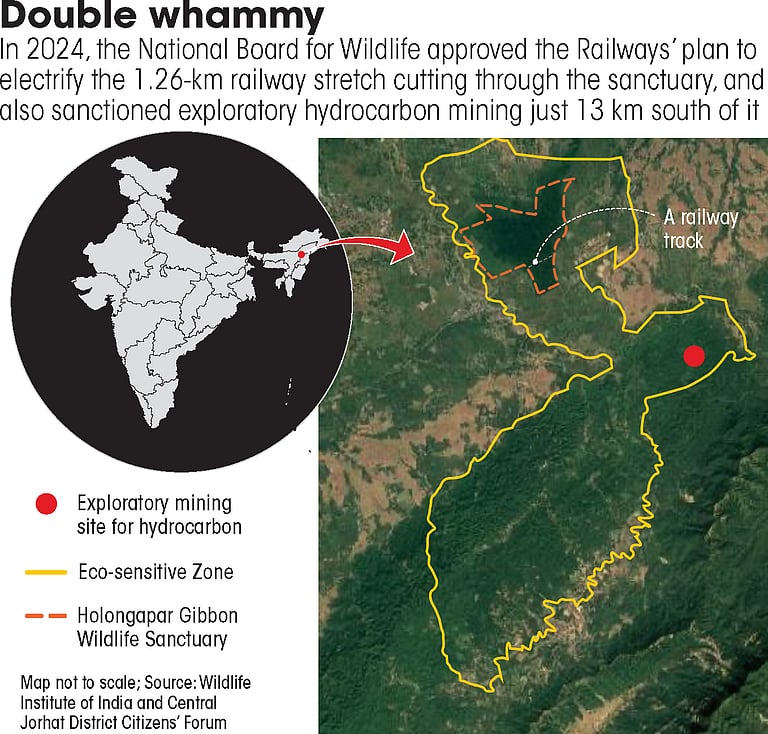
- Railway Fragmentation: A 1.65-km-long railway track (the Mariani-Dibrugarh line) bisects the sanctuary, preventing gibbons—which are strictly arboreal (tree-dwelling)—from crossing.
- In 2024 and 2025, plans for artificial canopy bridges and railway rerouting were discussed to prevent genetic isolation.
- Oil Exploration: In January 2025, the National Board for Wildlife (NBWL) considered and initially deferred exploratory drilling for oil and gas by the Vedanta Group within the sanctuary’s ESZ.
Why Hollongapar matters
- It is Assam’s only protected area exclusively dedicated to hoolock gibbons.
- The sanctuary represents fragmented evergreen forest, making conservation education especially important.
- Such experiential learning supports biodiversity conservation, aligning with national priorities under wildlife protection efforts.
Exam Hook –
Hollongapar Gibbon Sanctuary is significant as it protects the habitat of the hoolock gibbon, the only ape species found in India.
Share This Story, Choose Your Platform!
Start Yours at Ajmal IAS – with Mentorship StrategyDisciplineClarityResults that Drives Success
Your dream deserves this moment — begin it here.