

Syllabus: GS – II &V: Polity & Governance
Why in the news?
The Governments of Assam and Mizoram have resumed official correspondence to prepare for the next round of talks to resolve their long-pending inter-State boundary dispute, with discussions proposed to be held in Aizawl.
Background: How the dispute began
The Assam–Mizoram border dispute is colonial in origin and deeply rooted in historical demarcations.
- During British rule, Lushai Hills (present-day Mizoram) was part of Assam.
- Mizoram became a Union Territory in 1972 and a full-fledged State in 1987.
- Assam’s districts of Cachar, Hailakandi and Karimganj share a 165 km boundary with Mizoram.
- The core dispute involves about 1,318 square kilometres of forested hills claimed by both States.
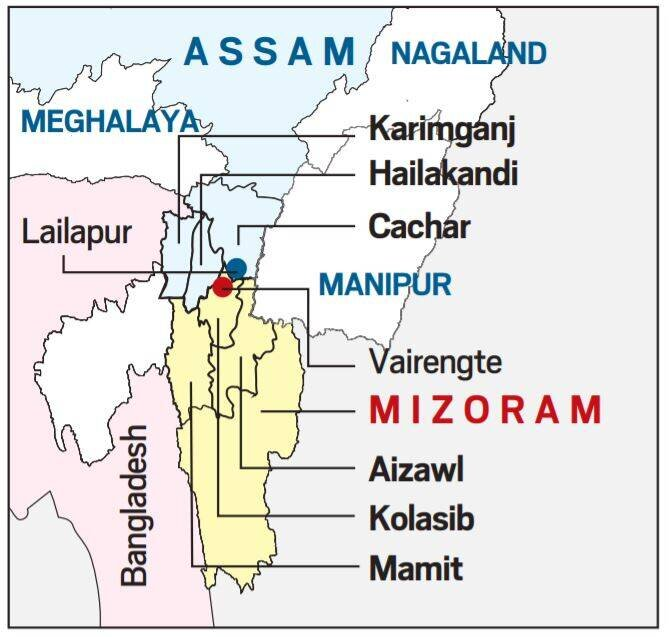
Colonial-era notifications at the core
Two British-era boundary definitions lie at the heart of the disagreement:
- 1875 Notification
- Issued under the Bengal Eastern Frontier Regulation, 1873.
- Drew an Inner Line between the Cachar plains and the Lushai Hills.
- Mizoram considers this line as the only legitimate boundary, arguing that Mizo chiefs were consulted.
- 1933 Demarcation
- Boundary redrawn between Lushai Hills and Manipur.
- Assam accepts this as the constitutional boundary, based on the Survey of India map.
- Mizoram rejects it, claiming no consultation with Mizo leaders.
Recent tensions and clashes
Despite agreements to maintain status quo, tensions have persisted.
- The 123 km disputed stretch has seen repeated confrontations.
- The most serious incident occurred on July 26, 2021, when firing between police forces led to the death of five Assam policemen.
- Incidents of alleged encroachment, destruction of plantations, and movement of security forces have fuelled mistrust.
- Issues such as illegal drug routes, forest access, and village-level land use further complicate the situation.
Why the dispute escalates
The conflict is not merely territorial; it is social, economic and political.
- Identity preservation: Both Assamese and Mizo communities fear loss of ancestral land and cultural space.
- Ethnic land rights: Strong emotional attachment to land among border residents intensifies resistance.
- Political competition: Accusations of unilateral actions by State governments raise tensions.
- Administrative ambiguity: Poorly demarcated borders increase the scope for conflict.
Efforts made so far
- Multiple official-level and ministerial-level talks held in Aizawl, Guwahati and New Delhi.
- Meetings between former Chief Ministers Zoramthanga and Himanta Biswa Sarma in the presence of the Union Home Minister.
- Agreement to continue official talks before political negotiations and to maintain strict status quo on the ground.
Why resolution is crucial
- The Northeast is central to India’s Act East Policy, connecting India to Southeast Asia.
- Ongoing disputes threaten internal security, infrastructure projects, investment, and regional integration.
- Prolonged conflicts risk turning administrative disputes into long-term security challenges.
Way forward: A realistic solution
A durable settlement requires cooperation, not confrontation.
- Strengthening the Inter-State Council (Article 263) to institutionalise dialogue.
- Using the North Eastern Zonal Council for region-wide consensus-building.
- Scientific boundary demarcation using satellite imagery, Geographic Information Systems and drone surveys.
- Confidence-building measures, including joint patrolling and local-level coordination.
- Community engagement to prevent misinformation and reduce ground-level tensions.
- Development-focused interventions in border areas to reduce economic insecurities.
Conclusion
The Assam–Mizoram boundary dispute is a reminder that colonial legacies still shape present-day governance. While history explains the conflict, the future depends on dialogue, trust, and cooperative federalism. A peaceful resolution will not only secure borders but also unlock the developmental potential of the Northeast, strengthening India’s unity and strategic depth.
Exam Hook –
“The Assam–Mizoram border dispute is rooted in colonial-era demarcations and competing claims over land and identity. Discuss the causes and suggest a way forward.”
Share This Story, Choose Your Platform!
Start Yours at Ajmal IAS – with Mentorship StrategyDisciplineClarityResults that Drives Success
Your dream deserves this moment — begin it here.