
The proposed India–European Union Free Trade Agreement has opened new export avenues for India’s tea sector, even as stringent European regulations continue to pose challenges, according to the Tea Association of India.
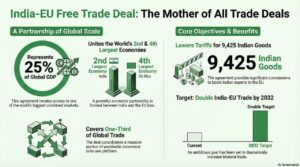
The agreement aims to deepen bilateral trade and investment by reducing tariffs, addressing non-tariff barriers, and enhancing regulatory cooperation between India and the European Union. With a combined market size of about USD 24 trillion and a population of nearly two billion, the FTA is expected to significantly boost India’s global trade footprint.
What the FTA Offers
- Provides market access for over 99 per cent of India’s exports by value.
- Safeguards sensitive domestic sectors while supporting India’s developmental priorities.
- In the tea sector, while duties on black tea and most green tea categories were already zero, the FTA proposes to eliminate duties on green tea imports below three kilograms, further improving export competitiveness.
India currently exports around 19 to 21 million kilograms of tea annually to European Union countries, with Germany and Poland acting as major entry and redistribution hubs.
Key Challenges for Tea Exporters
Despite tariff benefits, exporters face hurdles due to European Union regulations, including:
- Maximum Residue Limits on pesticides.
- Strict food safety, traceability, packaging and labelling norms.
- Emerging requirements on sustainability, environmental compliance and human rights due diligence.
These measures, while aimed at consumer safety and ethical sourcing, are likely to increase compliance costs, especially for small and medium tea enterprises.
Industry Expectations
The tea industry has called for:
- Science-based standards and regulatory transparency.
- Timely consultations before introducing new regulatory measures.
- Domestic support for certification, testing infrastructure, traceability systems and capacity building to help exporters meet European standards.
Alignment of domestic schemes with FTA commitments and early stakeholder consultations will be crucial for Indian producers to fully benefit from the agreement.
Exam Hook –
Consider the following statements:
- The India–European Union Free Trade Agreement aims to reduce both tariff and non-tariff barriers.
- European Union regulations on food safety and sustainability can act as non-tariff barriers to Indian tea exports.
- India does not export tea to any European Union country.
Which of the statements given above is/are correct?
Answer: 1 and 2 only



Start Yours at Ajmal IAS – with Mentorship StrategyDisciplineClarityResults that Drives Success
Your dream deserves this moment — begin it here.