
The Assam government has intensified its campaign against illegal encroachment on forest and government land with a major eviction drive in the Burhachapori Wildlife Sanctuary. The operation was jointly carried out by the Sonitpur district administration and the Forest Department in areas earmarked for compensatory afforestation.
Why in the news?
Around 6,200 bighas of land under the Tezpur, Thelamara, and Dhekiajuli revenue circles—already allocated for compensatory afforestation—were found encroached upon. Illegal occupants had built houses and started agricultural activities, prompting the authorities to act after due notice.
Key facts about the eviction
- About 710 households were identified as encroachers.
- Notices were issued well in advance, but most occupants failed to vacate.
- The eviction involved police personnel, magistrates, forest officials, heavy machinery, and labourers.
- The drive was conducted peacefully, with no untoward incidents reported.
- A similar eviction had earlier been carried out in February 2023, clearing large areas of the sanctuary.
About Bura Chapori Wildlife Sanctuary
- It is geographically located on the south bank of the Brahmaputra under the Sonitpur district.
- It is an important Protected Area (PA) of the central Assam conservancy landscape. .
- It was declared as a Reserve Forest in 1974 and as a Wildlife Sanctuary in 1995.
- The region falls under the sub-tropical monsoon climatic regime.
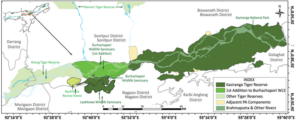
- Nestled between the Kaziranga National Park (NP) to the east and the Orang NP to the west and Laokhowa WLS to the south.
- It is a part of the Laokhowa-Burachapori eco-system and comprises wet alluvial grassland, riparian and semi-evergreen forests dotted by wetland and river systems.
- This sanctuary covers an area of 44.06 sq. km. and is home to the Great Indian one-horned rhinoceros, tiger, leopard, wild buffalo, hog deer, wild pig, and elephants.
- Bura Chapori’s bird list includes the highly endangered Bengal Florican, Black-necked Stork, Mallard, Open billed Stork, Teal, and Whistling Duck.
- The grassland is also rich in various kinds of medicinal herbs and plants.
Ecological importance of Burhachapori
- Burha Chapori , along with the adjacent Laokhowa WLS acts as a crucial wildlife corridor connecting Kaziranga National Park with Orang National Park and Pobitora Wildlife Sanctuary.
- Identified as part of the buffer zone of the Kaziranga Tiger Reserve.
- Characterised by grasslands, wetlands, woodlands, and river islands, supporting endangered mammals, reptiles, and migratory birds.
- Burha Chapori is a significant habitat for both resident and migrant wildlife.
Why compensatory afforestation matters
- It is a legally mandated mechanism to restore forest cover when land is diverted for non-forest use.
- Encroachment on such land weakens conservation efforts and threatens biodiversity.
The eviction underscores the State’s effort to balance law enforcement, ecological restoration, and wildlife conservation, especially in sensitive riverine and grassland ecosystems of Assam.
Exam Hook – Prelims
Consider the following statements about Burhachapori Wildlife Sanctuary:
- It is located on the southern bank of the Brahmaputra River.
- It serves as an important wildlife corridor between Kaziranga and Orang National Parks.
- The sanctuary forms part of the buffer zone of the Kaziranga Tiger Reserve.
Which of the statements given above are correct?
Answer: 1, 2 and 3



Start Yours at Ajmal IAS – with Mentorship StrategyDisciplineClarityResults that Drives Success
Your dream deserves this moment — begin it here.