
Syllabus: GS–II: Governance
Why in the news?
West Karbi Anglong in Assam witnessed violent protests after a long-running agitation demanding eviction of illegal settlers from grazing reserves escalated into arson, injuries, and police firing.
- The unrest followed the detention of protesters and culminated in the burning of the residence of the Chief Executive Member of the Karbi Anglong Autonomous Council.
What exactly happened
- Protesters belonging to various political and social organisations were on an indefinite hunger strike for over 15 days at Phelangpi, under Kheroni Police Station.
- Their core demand was the eviction of illegal settlers from Professional Grazing Reserves and Village Grazing Reserves in Karbi Anglong and West Karbi Anglong districts.
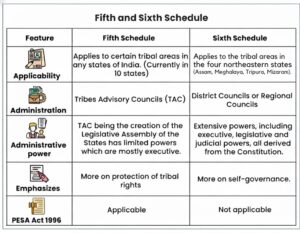
- They cited protections available under the Sixth Schedule of the Constitution, which safeguards tribal land and customary rights.
- Tensions escalated after seven protesters were detained, triggering mass mobilisation.
- Thousands marched from Kheroni to Dongkamukam, blocked a key bridge, and demanded dialogue with the leadership of the Karbi Anglong Autonomous Council.
- The situation turned violent when public and private property was vandalised, including homes, shops, vehicles, and an ambulance.
- The ancestral residence of the KAAC Chief Executive Member was set on fire, following which security forces opened fire, injuring three protesters and a policeman.
Understanding the core issue: land and autonomy
- Grazing Reserves were originally created to protect common land resources for indigenous communities.
- In Sixth Schedule areas, tribal land cannot be transferred to non-tribals without due process, making land encroachment a deeply sensitive issue.
- For many indigenous communities in Karbi Anglong, land is not merely an economic asset but central to identity, livelihood, and self-governance.
Role of the Sixth Schedule
- The Sixth Schedule (Articles 244(2)) provides autonomous councils legislative and administrative powers over land, forests (other than reserved forests), and local governance.
- Karbi Anglong Autonomous Council (KAAC): An elected body that governs the Karbi Anglong and West Karbi Anglong districts.
- The agitation reflects a perception that constitutional protections are not being enforced effectively, leading to frustration and prolonged protest.
- At the same time, the Schedule does not sanction mob justice or violence, even when demands are constitutionally grounded.
Law, order, and governance challenges
- The incident highlights a serious coordination gap between civil administration, police, and autonomous council authorities.
- While peaceful protest is a democratic right, arson, vandalism, and attacks on individuals cross the boundary into criminality.
- Police firing, though sometimes unavoidable, raises questions about crowd management, proportionality, and use of force.
Human cost of escalation
- Injuries to civilians and security personnel underline how quickly legitimate grievances can spiral into human tragedy.
- Damage to homes and local infrastructure disproportionately affects ordinary residents, many of whom are not part of decision-making.
- Such violence deepens mistrust between communities and the state, making resolution harder.
What is needed going forward
- Immediate confidence-building measures, including transparent inquiry into police action and violence.
- Time-bound, lawful eviction processes with clear communication to avoid rumours and panic.
- Stronger dialogue mechanisms between autonomous councils, state authorities, and community leaders.
- Clear distinction between constitutional assertion of rights and criminal acts, ensuring accountability without collective punishment.
Key terms explained
- Sixth Schedule: Constitutional framework for tribal self-governance in parts of Northeast India.
- Grazing Reserve: Land set aside for community use, especially for livestock.
- Autonomous Council: Elected body with legislative and executive powers in Sixth Schedule areas.
- Use of force: Lawful but regulated action by police to maintain public order.
- Encroachment: Unauthorised occupation of land, often a trigger for social conflict.
Conclusion
- The violence in West Karbi Anglong is not merely a law-and-order issue, but a symptom of deeper governance failures in managing land, autonomy, and dialogue.
- Protecting constitutional rights under the Sixth Schedule requires institutional action, not street justice.
- Sustainable peace lies in firm law enforcement combined with sincere political engagement and administrative clarity.
Exam Hook
Key Takeaways:
- Sixth Schedule protections are meaningful only when implemented through strong institutions.
- Failure to address land grievances early can convert peaceful protest into violent unrest.
Mains Question:
“Sixth Schedule areas often witness conflicts over land and identity. Examine the causes of such unrest and suggest measures to balance constitutional autonomy with public order.”
One-line wrap
The West Karbi Anglong violence shows how unresolved land grievances and weak dialogue can turn constitutional demands into a crisis of governance and law and order.



Start Yours at Ajmal IAS – with Mentorship StrategyDisciplineClarityResults that Drives Success
Your dream deserves this moment — begin it here.